The Pentagon Found a New Way to Undercount US Casualties in Iran
Nick Turse The Intercept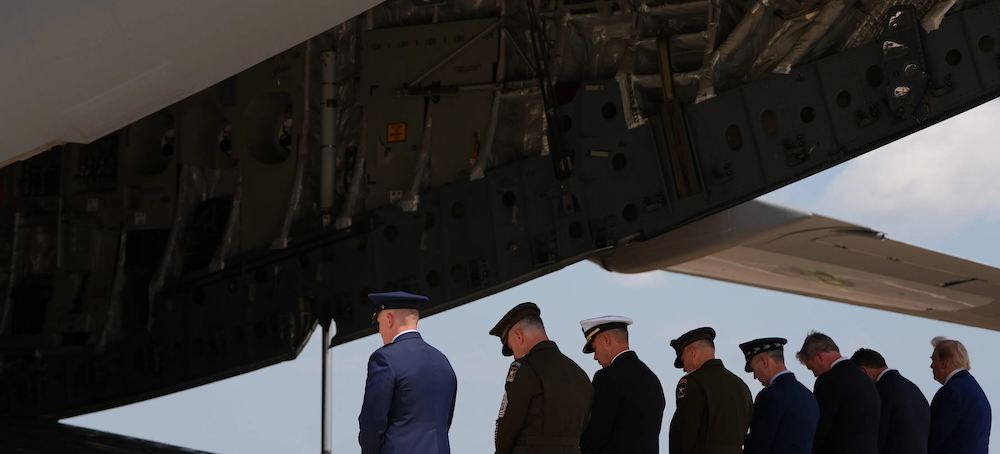 Donald Trump, far right, and Pete Hegseth, second from right, attend the dignified transfer of four U.S. service members recently killed in the Middle East, on July 22, 2026, at Dover Air Force Base, Del. (photo: Julia Demaree Nikhinson/AP)
U.S. troops killed or wounded since July 7 are now counted separately from casualties during the first months of the Iran war.
Since the start of the conflict, the Department of War has posted the official count of casualties on the website of the Defense Casualty Analysis System, or DCAS, which tracks “deceased, wounded, ill or injured” service members for Congress and the president. This official total of dead and wounded personnel, as documented over months of reporting by The Intercept, has been a gross undercount, stemming from what that same official previously called a “casualty cover-up.”
But after a series of Iranian strikes on U.S. facilities in the Middle East in July, the Pentagon last week rolled out a new approach. Casualties since July 7 are now counted separately on a new webpage with a generic designation: “Overseas Operations.”
Two hundred and seventy-three U.S. troops were killed or wounded since July 7, according to the Monday total on the new Overseas Operations page.
When combined with the existing DCAS page for the Iran war, the official count stands at 704, an 83 percent increase in casualties since April 8, the day the first ceasefire deal was struck between the Trump administration and Iran. When counting known casualties overlooked by the DCAS page, the total exceeds 900 personnel.
For months, the Pentagon has failed to comment on DCAS anomalies reported by The Intercept nor the reason for the change in the way it now counts casualties, which was first reported by the New York Times. Last week, the Pentagon told the newspaper that “since Operation Epic Fury has concluded, the department classifies casualties as overseas operations in the CENTCOM area of responsibility.” Central Command oversees U.S. military operations in the Middle East.
“This is certainly designed to conceal the count of the wounded,” the official said, while noting that “incompetence” has also caused confusion in the casualty count.
The change comes after a July 20 rant by Pentagon spokesperson Sean Parnell who claimed reports of a Pentagon effort to withhold news of dozens of U.S. casualties were “baseless and malicious” and a U.S. official’s disclosure to The Intercept that same day that recent attacks on U.S. bases by Iran had wounded “far more” personnel than the Pentagon had acknowledged.
The casualty spike resulted from Iranian attacks on at least nine U.S. outposts across the Middle East since July 9, according to a second U.S. official who spoke to The Intercept on the condition of anonymity because they were not authorized to speak with the press.
Iran’s military managed to overwhelm U.S. air defense systems using a mix of attack drones and advanced ballistic missiles, despite months of claims by President Donald Trump and self-styled War Secretary Pete Hegseth that Iran’s military was annihilated.
Last month, the tally of wounded personnel fluctuated by the day in the wake of increased Iranian attacks. On July 21, the casualty count on DCAS for Operation Epic Fury, the military’s official designation for the Iran war, stood at 500. Now, it has shrunk to 431.
For months, The Intercept found anomalies with the counts offered on the DCAS website. On April 21, for example, the number of wounded-in-action troops declined by 15 without public acknowledgment by the War Department. Despite repeated questions for months, the Pentagon has not commented on the disparities in its casualty count.
Prior reporting by The Intercept also found DCAS is missing hundreds of dead and wounded personnel from Epic Fury. The Pentagon list of the names of the dead is still missing Maj. Sorffly Davius, a signals and communication officer with the New York Army National Guard who was assigned to the headquarters of the 42nd Infantry Division and reportedly died of sudden illness while on duty in Camp Buehring, Kuwait, on March 6. Davius’s death was widely acknowledged even as it was excluded from the the official count: Rep. Mike Lawler, R-N.Y., spoke about him during a memorial service that month, and Gen. Dan Caine, the chair of the Joint Chiefs of Staff, recognized Davius while “honoring our fallen.”
While DCAS provides a running tally of “non-hostile” deaths — meaning those who died from accidents or by illness — it doesn’t include “non-hostile” injuries. The DCAS figures for Epic Fury show that 65 Navy personnel were wounded in action. Missing, however, are the more than 200 sailors treated for smoke inhalation or lacerations due to a March 12 fire that raged aboard the USS Gerald R. Ford. The aircraft carrier had been conducting round-the-clock flight operations to, Caine said, “project combat power” in the Middle East.
Recent reporting by the War Horse, using Pentagon records obtained via the Freedom of Information Act, found more than 400 casualties were recorded between February 28 and April 8. Seventy occurred on March 18 alone, but this huge single-day toll was never reported by the Pentagon.
The records provide more granular detail than DCAS, revealing that at least 17 troops sustained life-threatening injuries. They show that U.S. troops suffered shrapnel wounds, broken bones, smoke inhalation, and other injuries. The most common injury recorded, however, was head trauma — which affected at least 170 troops, according to the data.
President Donald Trump has long dismissed brain injuries as “headaches” and “not serious.”