
The Pace of Everglades Restoration Has Accelerated. But Is It Working?
Amy Green Inside Climate News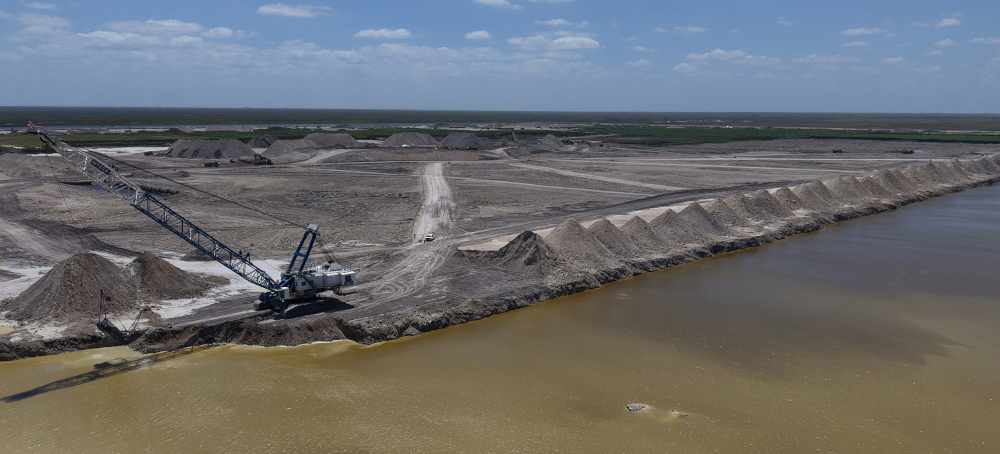 A dragline excavator is used to dig at the project site for the Everglades Agricultural Area reservoir on April 13 in South Bay, Fla. (photo: Joe Cavaretta/Getty)
The National Academies, in a new report, call for more clarity around how effective the massive effort has been and what it ultimately can achieve.
The report from the National Academies of Sciences, Engineering and Medicine, published last month, said the river of grass has benefitted recently from better collaboration between the federal and state governments and a record infusion of funding. Now that several projects are complete and the nearly 26-year effort continues to transition from one of planning to operations, a clearer vision also is required of what the restoration can achieve amid constraints and changing conditions, the scientists said.
“We’ve hit our stride in getting projects constructed, to the point where they’re being operated. And also this report points out we’re beginning to see benefits on the ground,” said Steve Davis, chief science officer at the Everglades Foundation, an advocacy group. “This is a big, challenging undertaking, but with the progress that we’ve been seeing of late, we’re starting to see the benefits of Everglades restoration and we know this large-scale infrastructure can do what we intended.”
The mammoth restoration, envisioned as a 30- to 40-year effort, involves dozens of landscape-scale projects spanning central and south Florida, designed to revive the watershed that is responsible for the drinking water of millions of people. A series of historical attempts to drain the Everglades made modern Florida possible but led to a litany of environmental problems, such as harmful algae blooms that have sickened Floridians and left marine life belly-up. The National Academies, a private nonprofit organization, has provided biennial reports on the restoration’s progress since 2004, based on a congressional mandate.
The report said the pace of restoration has increased substantially over the past two years, reflecting the priority given to projects such as a massive reservoir under construction south of Lake Okeechobee that is the centerpiece of Republican Gov. Ron DeSantis’ environmental agenda. Seven Everglades restoration projects are complete, including reservoirs to the east and west of Lake Okeechobee designed to help address harmful flows of lake water that have contributed to some of the harmful algae blooms. South of the lake, the reservoir in the region called the Everglades Agricultural Area is scheduled for completion in 2029.
Benefits already are apparent, the report said. In Everglades National Park, dry season flows east of Taylor Slough have improved, although effects on salinity in fragile Florida Bay are difficult to discern. In Shark River Slough, flows have increased particularly during the dry season. In the Picayune Strand, the vegetation is transitioning from that of uplands to wetlands.
But the report said scientific analysis of these benefits has not been consistent, hindering understanding of the restoration’s progress and opportunities for learning. The U.S. Army Corps of Engineers and South Florida Water Management District, federal and state agencies, respectively, oversee Everglades restoration. The Army Corps said it was working with state, tribal and institutional partners to review the report. The water management district said it was focused at the moment on a recent rain event that caused flooding in coastal areas in central and southeast Florida.
The National Academies also raised concerns about the loss of federal staff responsible for Endangered Species Act protections. The effort to rehydrate the river of grass threatens, for example, the Cape Sable seaside sparrow, an endangered ground-dwelling bird found in a remote area of Everglades National Park and the Big Cypress National Preserve. During nesting season some water control structures are closed to spare the sparrows, but this inhibits the flow of water and can flood tree islands that are important to the Miccosukee Tribe and a range of animal and plant life. Sea level rise has exacerbated the problem.
“It takes not only funding, but it takes staff to analyze these project reports. It takes staff to communicate to organizations like ours so we can provide stakeholder feedback,” said Casey Darling Kniffin, policy director at Friends of the Everglades, an advocacy group. “That requires staff at the federal level. So despite having record funding, if we don’t have the staff to carry out this work we will see delays going into the future of Everglades restoration.”
The report noted the restoration’s success depends on water quality. A new standard took effect this year called the Water Quality-Based Effluent Limitation, designed to measure nutrient pollution in the Everglades associated with fertilizer use on the sprawling sugar farms south of Lake Okeechobee. Before the EAA reservoir, characterized by DeSantis as the “crown jewel” of Everglades restoration, can operate at full capacity, the WQBEL must be met for at least five years. So far the standard has not been met, based on available data through water year 2025, the report said. (Water years are measured from May 1 to April 30.)
The scientists warned that if existing strategies are not enough to bring the water into compliance then “aggressive and possibly contentious new actions” likely will be necessary. The National Academies raised similar concerns in 2022 and 2024, concluding in 2022 that meeting the WQBEL by 2026 would be a “significant challenge.” Davis said the two most feasible options would be to reduce even further the pollution flowing from the sugar farms or expand the engineered wetlands called stormwater treatment areas designed to filter nutrient pollution from the water. Both propositions would be costly and politically thorny.
“We have to hit the water quality mark,” Davis said. “There is no compromise on that.”
The National Academies also said the definition of restoration success will need to evolve as the effects of sea level rise, invasive species and other factors are understood and the natural characteristics of the Everglades continue to reappear. The scientists noted that even after the massive effort is complete, the river of grass will remain highly managed and that the demands of urban development, water supply, flood control and legal requirements will exert pressure, along with climate change, peat loss, legacy nutrients and invasive species. The scientists called for better communication tools to help decision-makers weigh competing interests.
“The caveat to changing any of the restoration definitions would be that we would want to make sure that the science is influencing that process and not the political will and maybe the fatigue around Everglades restoration,” Kniffin said. “We have to be careful about changing the goal post just to claim victory on the plan without seeing the ecological benefits.”
The report comes at a pivotal moment for Everglades restoration. Under DeSantis’ leadership, the state has invested billions of dollars in the effort, even as his administration has faced widespread condemnation and federal litigation over Alligator Alcatraz, the migrant detention facility that operated for a year in the Everglades before closing this summer. DeSantis’ second term concludes in January, and Republican Byron Donalds was elected to succeed him. Like his predecessor, Donalds has vowed to make the river of grass a priority.

