The Next Left
Jill Lepore The New Yorker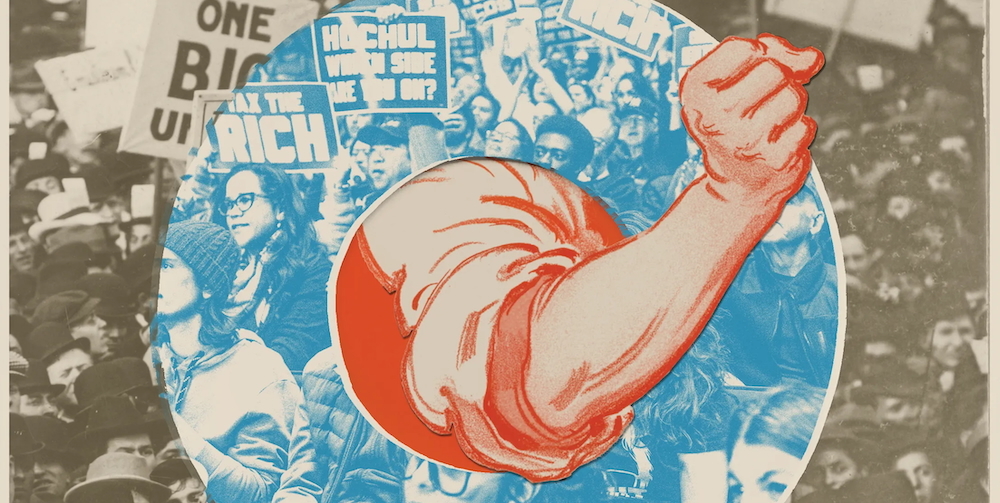 In 1912, more than a thousand socialists held office in the United States. Their ambitions ranged from lowering trolley fares to abolishing the Senate. (image: Matt Dorfman/Library of Congress/Getty Images)
The movement has often seen its ideas flourish as its organizations withered. Will today’s resurgence follow the same course?
At that convention, the Party adopted a platform that began by denouncing capitalism as a system that produced, among other evils, an “extortionate cost of living”: “Under this system the working class is exposed to poisonous conditions, to frightful and needless perils to life and limb, is walled around with court decisions, injunctions and unjust laws, and is preyed upon incessantly for the benefit of the controlling oligarchy of wealth.” The platform called for the collective ownership of everything from the railroads and the telegraph lines to mines, forests, oil wells, banks, and the currency system. It called for a shortened workday, a workweek no longer than five and a half days, a minimum wage, old-age pensions, workers’ insurance, unemployment insurance, and the abolition of child labor. It also called for a graduated federal income tax, female suffrage, and the abolition of the Senate, the Presidential veto, and the Electoral College—and, since each of the items on this last list would require amending the Constitution, for a constitutional convention.
“The socialist moment is here,” Nathan J. Robinson, the editor of the socialist magazine Current Affairs, announced this past summer, pointing to the swelling membership of the Democratic Socialists of America and to socialists’ newfound prominence: Zohran Mamdani on the cover of Time. Is it 1912 all over again?
This year, the banner of socialism is being carried by the D.S.A., whose hundred and thirty thousand members already include two U.S. representatives, Alexandria Ocasio-Cortez and Rashida Tlaib; there are hundreds of D.S.A.-backed state and local officeholders across the country. (Bernie Sanders is a longtime socialist, but he is not a member of the D.S.A.) The D.S.A. is not a political party, but it does have a platform. Sort of. In 2017, its National Political Committee decided to replace its “priorities resolution” with a platform. Promised for 2019, it was postponed to 2021, given the D.S.A.’s “ideological diversity.” A new platform, which the D.S.A. prefers to call a “program,” was released this summer. It has much in common with the Socialist Party platform of 1912.
“We are workers fighting to transform society: to win the battle for democracy, draft a new constitution, and create a democratic socialist republic,” the program pledges, while inveighing against the existing parties: “Both are funded by the same criminal class of billionaires and war profiteers.” The program proposes, among other things, the abolition of the Senate and the replacement of the Presidency and Supreme Court with an executive and judiciary chosen by and subordinate to Congress.
A number of prominent Democrats condemned the platform. On Fox News, the host Shannon Bream asked Megan Romer, a D.S.A. co-chair, to confirm some of its proposals:
Bream: Abolish borders and give amnesty to anyone currently in the U.S. illegally.
Romer: As a long-term plan. Yep.
Bream: Defund the Pentagon.
Romer: Absolutely.
Bream: Abolish prisons, at least in large part.
Romer: Yeah, again, as part of a long-term program. Yeah.
Bream: O.K. So no prisons. Government or public ownership of most large corporations.
Romer: Yeah, absolutely.
Romer, who grinned and seemed almost to laugh at one point during this quiz, came across as glib and, at best, remarkably naïve. “These people are insane,” Ted Cruz tweeted.
Then came Election Day, an epic Democratic sweep that reinvigorated the Party and brought gains for socialists not seen since 1912. Six D.S.A. members—from California, Colorado, Michigan, New York, and Pennsylvania—won seats in Congress (and the two sitting D.S.A. members won reëlection). D.S.A. candidates won mayoral races in Los Angeles; Washington, D.C.; Ann Arbor, Michigan; and Providence, Rhode Island. Even socialism’s losses were triumphs. The little red scare of 2026 backfired. The D.S.A. member Angie Nixon lost her long-shot bid to unseat the Republican Ashley Moody, a U.S. senator from Florida, who had characterized the campaign as “freedom versus socialism,” but Moody’s margin of victory was just 2.9 per cent. Mamdani, speaking at the Election Night party of Kathy Hochul (no socialist she), announced the dawn of a new era: “We have begun the work of transforming our party and making it belong to working people once again.”
The United States has no meaningful socialist party, and socialism has never overtaken either of the country’s two major political parties. This distinguishes the U.S. from every other Western democracy and would have surprised early American socialists, who pointed to a tradition of communalism stretching from the Shakers to the Owenites. In 1869, John Humphrey Noyes, the American preacher and utopian, proclaimed that “this country has been from the beginning, and especially for the last forty years, a laboratory in which Socialisms of all kinds have been experimenting.” It was as if socialism was in the soil, as American as the Revolution.
Nevertheless, socialism didn’t really come to the fore of American politics until the Panic of 1893, when, according to Oliver Wendell Holmes, Jr., “a vague terror went over the earth and the word socialism began to be heard.” After the railway magnate George Pullman cut workers’ wages by a quarter, Debs called for a strike, and in 1895 he was sent to prison for his role in organizing it; Victor Berger visited him, bringing a copy of “Das Kapital.” (Debs’s extraordinary life is the subject of a lively and admiring new biography, “American Socialist,” by Shawn Gude.) Debs, a Democrat, said that he had previously “heard but little of Socialism,” and he did not become a socialist until 1897, after a campaign funded by plutocrats elevated William McKinley to the White House, convincing Debs that the rich controlled politics. “Money constitutes no proper basis of civilization,” he concluded. He first ran for President in 1900, and when he ran again four years later he earned more than four times as many votes.
“If my reading of history is correct, the prophecy of Marx will be fulfilled, and America will ring the downfall of capitalism the world over,” a socialist leader predicted in 1906, speaking in Chicago at the annual convention of the Industrial Workers of the World (I.W.W.). Yet, that year, the German economist Werner Sombart asked, “Why is there no socialism in the United States?” There was socialism, of course, but less than he and others expected. One of Sombart’s explanations was that Americans hadn’t suffered the worst ravages of “late capitalism” (a term that he coined): “On the reefs of roast beef and apple pie socialistic Utopias of every sort are sent to their doom,” he wrote. Call it the Too Many Arby’s theory of the American left.
“This is our year,” Debs said in 1912. And it was, but it was also American socialism’s last good year until this year. After that election, the Socialist Party began losing members from both its left wing and its right. At its convention in May, the Socialist Party had formally disavowed sabotage as a labor tactic; as a result, it saw members defect to the saboteur-friendly I.W.W. In November, the Democrat Woodrow Wilson won the Presidency, and soon Democrats began accomplishing much of what socialists had pledged to do. Although they neither abolished the Senate nor held a constitutional convention, progressives achieved the ratification of four constitutional amendments between 1913 and 1920, two in 1913 alone. (The Sixteenth granted Congress the right to impose a federal income tax, and the Seventeenth provided for the direct election of senators.) Other reforms proposed in the Socialist Party’s 1912 platform and adopted by Democrats—minimum-wage laws, maximum-hour laws, the abolition of child labor, old-age pensions, and unemployment insurance—saw success in the states, and by the end of the New Deal had been achieved nationally; meanwhile, the Socialist Party withered.
That was due to forces within and without. In 1917, American socialists divided over the Bolshevik Revolution, with some becoming Communists, and the Socialist Party announced that it opposed America’s entrance into the war in Europe: “In support of capitalism, we will not willingly give a single life or a single dollar.” To suppress dissent, Congress passed the notorious Espionage and Sedition Acts, under whose terms hundreds of socialists, including Debs, were prosecuted for their opposition to the war. In 1920, Debs, still in prison, ran for President with the slogan “From the Jail House to the White House.” Five years later, he declared the Socialist Party “as near a corpse as a thing can be.” After Debs’s death, in 1926, Norman Thomas, a former Presbyterian minister, replaced him as the quadrennial Socialist Party candidate for President. In 1939, the Party opposed American entry into the Second World War, on the ground that it wasn’t a working-class revolution but merely a clash between rival imperialist powers. The sociologist Daniel Bell memorably described the Party’s leader speaking in Madison Square Garden at an America First Committee rally in 1941: “Behind him lay only the charnel house of American socialism.” By 1950, amid the rise of McCarthyism and the second Red Scare, according to Bell, “American socialism as a political and social fact had become simply a notation in the archives of history.”
Commentators then set about pawing through those archives. In postwar America, observers revisited Sombart’s question about why there had been so little socialism in the United States. Aside from America’s prosperity relative to Europe, the top answers, over the years, have included: the United States has no feudal past and has never had an established class system; the American political apparatus dooms all third parties; American socialists failed to ally with unions; Americans don’t like ideas that come from Europe; the government has suppressed the political rights and, especially, the free speech of socialists; the Democratic Party has used socialist ideas to win elections for Democrats; and socialists are their own worst enemies, insisting on strict ideological conformity. As the sociologist Seymour Martin Lipset and the political scientist Gary Marks once wrote, “Explanations of socialism’s weakness in America are as numerous as socialists were few.”
Bell himself attributed much of socialism’s demise to its notorious fractiousness (“For every two socialists there are always three political opinions”). But, more broadly, he was inclined to believe that American socialists “could never resolve but only straddle the basic issue of either accepting capitalist society, and seeking to transform it from within as the labor movement did, or becoming the sworn enemy of that society, like the communists.” This dilemma has not abated.
Socialism in the United States failed as a political party. But it succeeded in influencing American economic and social policy, not only during the Progressive and the New Deal eras but also under Lyndon Johnson’s Great Society. This last era of influence owed a great deal to the socialist Michael Harrington, who had taken a vow of poverty when he joined Dorothy Day’s Catholic Worker Movement, became a Marxist in 1952, and served as a leader of the Young People’s Socialist League. By the end of the nineteen-fifties, he’d begun to devote his time to the civil-rights movement. In 1960, the Socialist Party neither nominated nor endorsed a candidate for the Presidency. Harrington explained, “American socialism must concentrate its efforts on the battle for political realignment, for the creation of a real second party that will unite labor, liberals, Negroes, and provide them with an instrument for principled debate and effective action.” His idea was that socialism could find a home in the Democratic Party, once “the Southern racists and certain other corruptive elements have been forced out of it.”
In 1958, Harrington was asked by an editor at the magazine Commentary if he’d write about poverty in America. What he produced led to queries from book publishers. He initially demurred but eventually agreed. The result, “The Other America,” came out in March, 1962. At a time when the country was said to be enjoying an age of affluence, Harrington drew attention to the millions of people living in poverty. The American poor needed, he said, “an American Dickens.”
Harrington never used the word “socialism” in “The Other America,” but Norman Thomas remarked that Harrington had “written a book which consciously or subconsciously, all of us Socialists have been waiting for.” Yet the book scarcely made an impact until Dwight Macdonald’s thirteen-thousand-word review for this magazine appeared in January of 1963. “Our Invisible Poor,” still the longest and perhaps the most important book review that The New Yorker has ever published, was searing, pointed, and urgent: it sought specific action. “The federal government is the only purposeful force . . . that can reduce the numbers of the poor and make their lives more bearable,” Macdonald wrote. Walter Heller, the chair of John F. Kennedy’s Council of Economic Advisers, read the review and reportedly gave a copy to the President, who began planning a policy that became, under his successor, the War on Poverty.
When Harrington was made the leader of the Socialist Party, in 1968, he was already America’s best-known socialist, which, as he liked to say (borrowing a gibe from William F. Buckley, Jr.), was “like being the tallest building in Topeka, Kansas.” The year he assumed the leadership of a party that he did not believe ought to be a party, Harrington published “Toward a Democratic Left: A Radical Program for a New Majority,” in which he called for a “majority party of the democratic Left” that might well “bear an old label: the Democratic Party.” In 1972, Harrington resigned as co-chairman of the Socialist Party, and the next year he helped form what would be called, by 1982, the Democratic Socialists of America.
After years of slow growth, the D.S.A.’s membership began expanding in fits and starts following Sanders’s Presidential bid in 2016. “America will never be a socialist country,” Donald Trump said in his State of the Union address in 2019. But popular support for socialism, and for positions held by democratic socialists like Sanders and Mamdani, has surged since Trump’s reëlection. This fall, a Gallup survey found that public approval of socialism had reached a new high of forty-three per cent, and that backing for key measures endorsed by the D.S.A. had surged, too: two-thirds of Americans support Medicare for All.
Socialism has been strongest in the United States during eras of high inequality and has been weakest during eras of shared prosperity. The share of income going to the top one per cent began climbing in the nineteen-seventies and has risen to levels last seen in the nineteen-twenties. There may still be, here and there, reefs of roast beef and apple pie, but the same cannot be said of affordable medical care, housing, or higher education. Democrats of the Progressive Era fought for and achieved labor legislation, campaign-finance reform, social-welfare provisions, and anti-monopoly measures. Democrats from Bill Clinton to Joe Biden have not been half as successful. Hence the Sanders insurgency in 2016, and the prominence of the D.S.A. today. But is a new New Left—what Harrington called the Next Left—really emerging? And, if it is, what is its plan?
Socialists, who advocate central planning of the economy, are strangely ambivalent about issuing plans. Marx himself cautioned against “writing recipes” for “the cook-shops of the future,” but he did imagine what a day without capitalism and the division of labor would look like—a day when people could do whatever they wanted. You could, Marx mused, “hunt in the morning, fish in the afternoon, rear cattle in the evening, criticize after dinner.”
Writing nearly a century later, the economist John Maynard Keynes, a liberal sympathetic to socialism, similarly imagined a future requiring very little labor, a “destination of economic bliss” that, he warned, would produce a new problem: “how to occupy the leisure, which science and compound interest will have won.”
In “Toward a Democratic Left,” Harrington took pains to insist that his ideas ought not to be taken as “blueprints.” But in recent years democratic socialists have not shied away from socialist solutionism. In “The Blueprint: How Socialism Can Work in the Real World,” an economist, a philosopher, and the founder of the magazine Jacobin propose a model for a just society and ask readers to imagine a day in a socialist future: “Some people may spend more time reading Russian novels or cooking elaborate meals with people they love or hiking and camping in nature.”
It’s no surprise, then, that the D.S.A.’s 2026 platform also asks Americans to imagine a day off in a world without capitalism. “Maybe in the morning, you walk your kids to school, run errands, or go to a doctor’s appointment. In the afternoon, you might play a sport, practice a new skill, read, plan a trip. In the evening, you could meet up with friends or family and eat together, maybe go to the movies or down to the park.”
If all this sounds oddly familiar, that’s because it’s the kind of future that Elon Musk and Sam Altman like to talk about, a world of abundance in a planned economy in which poverty has been eliminated and wage labor curtailed. In the twenty-first century, the belief that socialism is destiny has begun to converge with the belief that artificial intelligence is destiny. (A planned economy is far likelier, after all, in an economy run by artificial intelligence than in any future imagined in “Das Kapital,” even if the prospects for human freedom are, alas, far worse.) These days, you can find A.I. boosters repurposing rhetoric once championed by Eugene Debs. “Quit being a wage slave,” one A.I. marketing service tells potential clients. “Stop building their dreams. Replace labor with AI systems.”
What will people do all day in an A.I. future? According to tech titans, there will be no need to do anything—you’ll be paid a universal basic income, or, as Musk likes to call it, a “universal ‘you can have whatever you want’ income.” Altman has proposed that instead of universal basic income people might be given “universal basic compute,” which they can use, sell, or donate. “You own part of the productivity!” he has said, sounding like Marx. Altman is sure that in this future “we’ll find stuff to do that we really care about.” Musk likens working in this future to growing vegetables even though you can buy them at the store. “Some people still do it because they like growing vegetables,” he says.
The fullest statement of this world view is the philosopher Nick Bostrom’s 2024 book, “Deep Utopia: Life and Meaning in a Solved World.” It begins with a Marxian joke about how Bostrom made his fortune by writing a “recipe book.” He is best known for his 2014 book, “Superintelligence,” which warned of the coming A.I. apocalypse. In “Deep Utopia,” though, he imagines a post-scarcity, post-work utopia whose chief problem is “the purpose problem,” which he meditates on for some five hundred pages that constitute nothing so much as an illustration of his own attempt to find some purpose . . . by writing a meandering book of random, self-indulgent musings about purposelessness.
For socialists in 2026, as for socialists in 1912, absorption into the Democratic Party risks trading the ambition to replace capitalism for the more modest goal of reforming it. But this time around there’s a strange new twist: the convergence of socialist determinism with technological determinism, Marxism become Muskism. The Democratic Party may well advance socialism’s most practical and urgent demands: Medicare for All, a Green New Deal. But Silicon Valley, with more power than any political party, seems keen to turn socialism’s most extravagant dream into a nightmare: a world in which people no longer have to do anything, because they are no longer needed.