The Media’s Ilhan Omar Blind Spot Handed Trump an Opening
Sophia Tesfaye Salon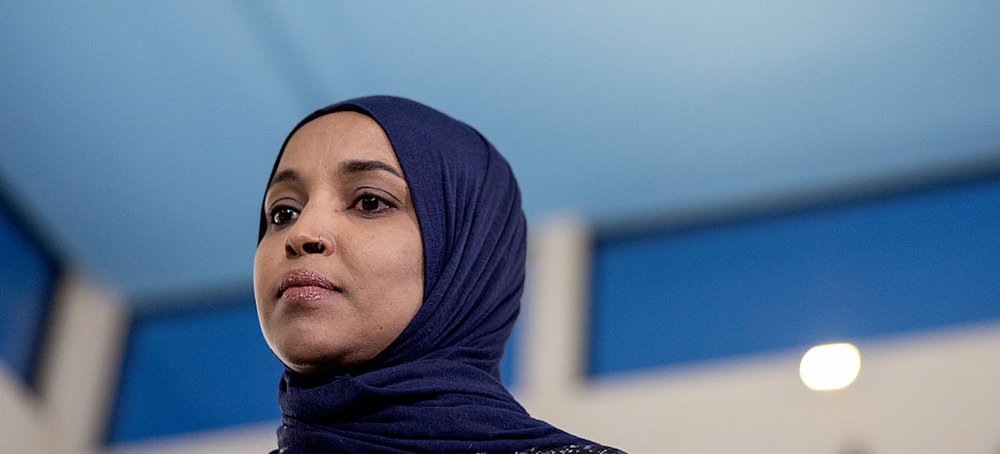 (photo: Salon)
How mainstream journalism sanitized MAGA's weaponization of justice against the Minnesota Democrat
Senior Writer
Rep. Ilhan Omar, D-Minn., speaks at Karmel Mall on Jan. 28, 2026 in Minneapolis, Minnesota. (Eric Thayer / Los Angeles Times via Getty Images)
The pre-dawn search of Rep. Ilhan Omar’s Washington, D.C., home on Monday should have prompted a searching national outcry about presidential power and the weaponization of federal law enforcement for political purposes. Federal agents seized her phone and passport and searched her residence as part of an investigation into allegations dating back to her childhood. Authorities have also issued more than a dozen grand jury subpoenas, including to her relatives. But instead of treating this escalation as a major test of American democracy, the mainstream media’s editorial response to the breaking news has been sorely lacking. Rather than interrogating the fascistic implications of a president weaponizing federal immigration agencies to threaten political opponents with deportation, major media outlets platformed the administration’s narrative that something fishy must be occurring.
This is not how the American press normally reacts when armed agents of the federal government knock on the door of a prominent political figure. As media watchdog Adam Johnson noted at the Intercept, the very day of the FBI raid against former national security adviser John Bolton brought scathing editorials from the New York Times, The Washington Post and The Wall Street Journal. Over the next week, each newspaper published opinion pieces opposing the raid and leveling outrage at the obvious power grab. The raid was explicitly condemned in POLITICO, The New Yorker and The Atlantic, which published four different indignant columns.
The asymmetry in the mainstream media’s response to the Omar raid is the story. It is not simply the search itself but the absence of a sustained institutional response to the right’s yearslong campaign targeting the congresswoman that made it possible.
The asymmetry in the mainstream media’s response to the Omar raid is the story. It is not simply the search itself but the absence of a sustained institutional response to the right’s yearslong campaign targeting the congresswoman that made it possible. For years, the press treated each escalation against Omar as a discrete political controversy rather than examining how the attacks were clearly building toward a confrontation with the federal government. The allegations appeared on right-wing television, circulated through MAGA podcasts and were repeated by administration officials. The investigation was discussed publicly before the search took place. By the time agents arrived at Omar’s home, the political narrative had been prepared. Yet the national conversation too often focused on whether there might be something suspicious about Omar rather than on how the administration had transformed longstanding partisan allegations into a federal investigation.
Right-wing media had agitated for this result for months, as Media Matters’ Matt Gertz has documented. In July, Fox News host Sean Hannity told a caller on his radio show that an investigation into Omar was underway. “I can tell you this: There is an investigation going on. I don’t know why it’s being slow-walked,” he said. In September, right-wing podcaster Benny Johnson said he had been hearing “rumblings” about Omar and that Vice President JD Vance had told him on the record that something was about to happen.
The administration was not subtle about what it wanted. In March, Vance said on Johnson’s podcast that “we think Ilhan Omar definitely committed immigration fraud against the United States of America,” and then described the project in plain terms: “That’s the thing that we’re trying to figure out is what are the legal remedies now that we know that she’s committed immigration fraud — how do you go after her, how do you investigate her, how do you actually do the thing, how do you build a case necessary to get some justice for the American people?” In September, Homeland Security Secretary Markwayne Mullin told Johnson there was an “ongoing investigation” into Omar and raised the possibility of deportation, declaring that “something’s going to happen” while stating as fact that Omar “married her brother to try to bring him to the United States.”
But not everyone in the MAGA coalition was satisfied. Laura Loomer, the conspiracy theorist and internet personality who once traveled to Minneapolis in her own fruitless attempt to prove that Omar had married her brother, fumed after the Mullin interview that the congresswoman was somehow being protected from deportation. Fox host Tomi Lahren was angrier still, devoting much of her Sept. 12 show to accusing Mullin of using Omar’s case as a sideshow to distract from the lack of larger-scale deportations. “If they want to do an investigation, do an investigation,” Lahren said, while also noting that whether Omar married her brother wouldn’t “get people out to vote.” What would, she said, was “promises made, promises kept” — mass deportations.
After Monday’s search, the celebration became even more explicit. Johnson opened his show by asking his audience whether they were excited to send Omar “back to her indigenous peoples” before announcing, “We were right. Forgive us. We’re going to gloat just a bit today.” He called the developments his “crowning achievement for life” and presented the investigation as a victory for his program. Katie Miller, the wife of White House deputy chief of staff Stephen Miller, reportedly posted “promises made, promises kept” above an article about the search before deleting the post. Even CNN anchor Jake Tapper’s questioning why Omar’s didn’t seek to make a deal with the Biden Justice Department was celebrated by MAGA influencers and right-wing outlets such as Breitbart as evidence that mainstream journalists shared their suspicions.
The federal inquiry apparently reaches back to 1995, when Omar arrived in the United States as a Somali refugee, and to her naturalization in 2000. The warrant reportedly lists conspiracy, false statements on immigration paperwork and immigration fraud. Officials are examining allegations concerning Omar’s age and her late father’s records. Mullin has also discussed a possible racketeering case, suggesting that a conspiracy theory could connect alleged conduct across different periods. Jeanine Pirro, the U.S. Attorney for the District of Columbia, has said that several investigations involving Omar are underway, including one concerning her financial disclosures.
The scope of these inquiries makes independent scrutiny essential. A congressional watchdog previously cleared Omar of wrongdoing in connection with financial disclosures that are now reportedly under examination. The Washington Post has also reported that immigration officials scrutinized similar allegations during Trump’s first term and did not find citizenship-related issues. The administration has not publicly demonstrated why the earlier review was insufficient or what new evidence now justifies the extraordinary escalation. These are precisely the questions that a serious press corps should pursue relentlessly.
This pattern extends beyond Omar. Former FBI Director James Comey and New York Attorney General Letitia James faced indictments after Trump publicly pressured his attorney general to prosecute them. Both indictments were later dismissed because of a defect involving the appointment of the prosecutor, although the Justice Department subsequently pursued a new indictment against Comey. Former Federal Reserve Chair Jerome Powell and Fed governor Lisa Cook have faced investigations or other government actions following sustained attacks by Trump. Their cases differ in important respects, but together they raise questions about the relationship between presidential hostility and the exercise of state power.
The consequences of this dynamic extend beyond Omar. When an administration can repeatedly identify enemies, encourage public speculation about their criminality and then launch investigations without facing sustained institutional scrutiny, the boundary between law enforcement and political retaliation becomes harder for the public to discern. The next target may be a different member of Congress, a public official or a naturalized citizen without Omar’s visibility or resources. The danger lies in normalizing a method of governance in which the president’s adversaries are continually placed under suspicion while the administration’s motives receive comparatively little examination.
The press cannot determine the outcome of Omar’s investigation, and it should not prejudge the evidence. But it can insist on transparency where legally possible, investigate the history of the allegations and examine whether officials are adhering to the standards that protect prosecutorial independence. It can also refuse to let the story disappear once the initial spectacle has passed.
Trump’s advantage lies in his ability to make extraordinary actions feel routine. Each failure to examine the cumulative pattern makes the next escalation easier to present as ordinary government business. That is how a media blind spot becomes a political opening. If the media can summon immediate outrage when federal power threatens one political figure but offer only procedural coverage when it threatens another, it risks helping normalize the very abuse it is supposed to expose.