The Limits of Trump’s Midterm Trickery
Quinta Jurecic The Atlantic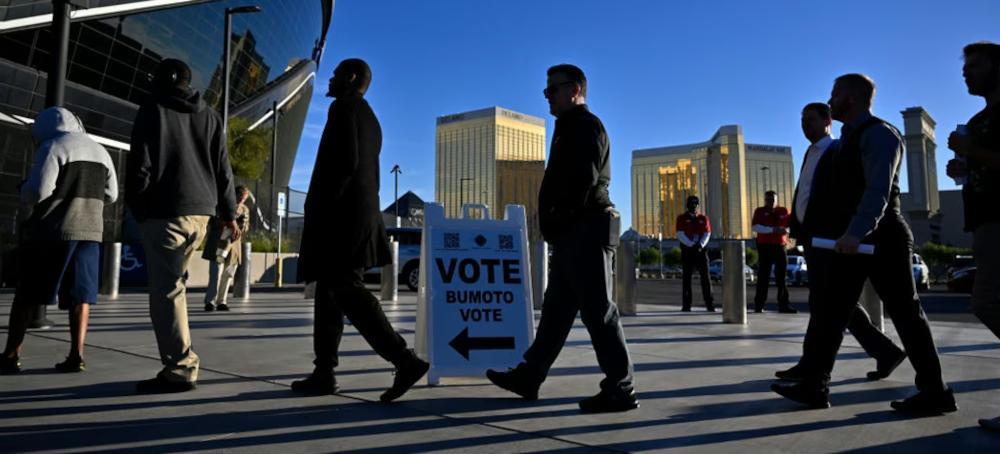 A big night for the Democrats could stymie any efforts to interfere with the election. (photo: David Becker/Getty)
A big night for the Democrats could stymie any efforts to interfere with the election.
But Trump may have a different problem on his hands. Polls show Trump’s approval falling to all-time lows in the weeks before Election Day; the percent of voters happy with his performance has now sunk into the 30s. Democrats, meanwhile, appear likely to retake control of the House of Representatives and maybe even the Senate, which last year seemed well out of reach. The polls could be wrong—and high-profile-polling misses of the Trump era are hard to forget. But if the polling is right, the GOP may be in for what George W. Bush, after a disastrous 2006 midterm, ruefully termed a “thumping.” And a thumping, as opposed to a narrower Democratic victory, could render most efforts to suppress turnout irrelevant, and make it far more difficult to implement any more dramatic effort to rig the results.
To Trump’s endless frustration, elections in America are organized at the state and local level, with little role for the federal government. In a typical midterm year, almost 470 congressional seats are up for grabs across 50 different states. Though a small number of those races are actually competitive, tinkering with the outcome of the votes would still require meddling with a number of different elections, all run differently, in different jurisdictions, under different laws. A strong night for the Democratic Party would make conjuring an ersatz House majority hard for the same reason that a losing sports team is less able to cheat its way to a victory in a blowout. (Even on a very strong night for the Democrats, the Senate may still be quite a close call.)
Tight margins, by contrast, can make an election more vulnerable to efforts to undo the voters’ will. Trump’s attempt to overturn the 2020 presidential election relied in significant part on tight margins in some swing states, sometimes with only 10,000 or 20,000 votes deciding the winner. In Georgia, the president famously pushed Secretary of State Brad Raffensperger to “find 11,780 votes” to make up his deficit against Joe Biden. As described by both the House January 6 committee’s report and Jack Smith’s indictment of Trump, Trump and his allies used close tallies in swing states, together with the slow counting of mail-in ballots, to engineer doubts over election results and provide Republican members of Congress with the tools to delay the formal counting of the electoral vote on January 6. The attack on the Capitol followed.
The memory of January 6, and the entrenchment of the election-denier movement since 2020, has led to speculation—both anxious and enthused—about the possibility of a comparable attack on election results in 2026. If, once most of the results are in, Democrats seem set to eke out a House majority by just a few seats, perhaps committed Trump allies in positions of power could make trouble in a handful of the closest districts. A local election commissioner, say, could refuse to sign off on a Democrat’s narrow victory, or the Justice Department could execute a warrant to seize ballots and thus delay or upend the counting of votes. This could create chaos on January 3, when the new House gathers for the first time: What happens if the contested seats are enough to deny the should-be-majority party the votes it needs to select a new speaker and take control of the chamber? Although this isn’t a foolproof trick for stealing control of the House, such a play could make things very precarious very quickly.
But the bigger the majority secured by Democrats, the more difficult it would be for Trump to shave that majority down—the more clerks to convince, warrants to secure, and court rulings to dodge, all over the country. “If there is a House majority in either direction that is 20, 30 seats, I think the likelihood of an attempt to engage in some kind of shenanigans around January 3 is way less than if the majority is two or three seats,” Jonathan Diaz of the Campaign Legal Center commented recently on a preelection panel convened at UCLA’s law school.
Other tricks are also less effective when the vote swings heavily in one direction. For example, Trump’s unprecedented push for explicitly partisan off-cycle redistricting may net only a few extra GOP seats rather than the double-digit gains Democratic strategists had once feared.
Political constraints matter too. Any scheme to steal the House for the GOP would depend on the willingness of congressional Republicans to vote in lockstep, with no defectors—something that the current fractious House Republican caucus can barely manage. Already, though, Republicans spooked by Trump’s bad poll numbers have begun distancing themselves from him on the campaign trail as they fight to hold on to their seats. Over the summer, Republican politicians and MAGA-friendly media outlets responded coolly to a rambling address by the president casting doubt on election integrity. If the GOP loses the House, how many Republicans concerned about their own political careers would be actually inclined to adopt the fringe message of an ever more unpopular lame-duck president? (Trump has been notably quiet recently about the possibility of running for an unconstitutional third term.)
Trump will be hard-pressed to fight against “a clear loss, coupled with the expectation of a clear loss,” Bob Bauer told me. Bauer—a longtime Democratic lawyer who played a central role in the Biden campaign’s fight against Trump’s efforts to overturn the 2020 election—now focuses on bipartisan election-integrity work, alongside Ben Ginsberg, an election lawyer known for his past work representing the Republican Party. In 2020, Bauer said, the additional days required for the presidential race to be called after the polls closed helped fuel Trump’s claims of fraud. But now, broad public dissatisfaction has aligned with dismal polling for the GOP and a growing anticipation among both politicians and the press that Republicans will do poorly. “It would be very difficult in these circumstances, if things turn out that the Democrats do well, for him to suddenly announce that he was denied his landslide by vote rigging,” Bauer told me.
Just because such a scheme would be implausible does not, of course, mean that Trump won’t try it. Last week, the Justice Department filed a bizarre lawsuit seeking to preemptively block Alaska from certifying the results of its Senate race—but only if Republican Senator Dan Sullivan loses. (“The legal argument is one of the worst ones I’ve ever seen,” wrote the law professor Derek Muller in an analysis of the case.) DOJ also continues to pursue litigation seeking to force California to set aside mail-in ballots to voters whom the federal government claims to have identified as noncitizens. These cases are sloppy, tardy, and almost certainly doomed. But they do have the advantage of helping Trump and his allies build a narrative about the courts blocking Trump’s efforts to ensure a fair election. Likewise, if a Trump-aligned rogue local election official tried to block a Democratic candidate’s victory, whatever he or she concocted as reasoning could provide fuel for election-fraud rumors on the far right, even if the effort—as it likely would—ultimately failed.
In a wave election, some races will still be close. They may just be in different states or districts—mostly, more Republican ones—than in a year with more typical political geography. House seats in deep-red areas across the country may be newly up for grabs. In the Senate, races in Texas and Alaska stand out as potential flash points. “Any close race in the Senate is going to be hotly, hotly contested,” Bauer told me. He pointed to the bitter fight between the Democrat Al Franken and the Republican Norm Coleman over the 2008 Senate election in Minnesota, which took months to resolve and ended with the courts upholding Franken’s 312-vote victory.
In the final weeks before the midterms, election experts have seemed notably calmer than some of the the anxious rhetoric around Trump’s potential subversion of the vote might suggest. Eight experts interviewed by The New York Times (including Bauer) voiced worries about possible upheaval but overall confidence that officials are prepared to protect the integrity of the elections. The nonprofit publication Votebeat likewise surveyed 31 authorities on election administration and found the group to be wary but “cautiously optimistic” that the midterms will go smoothly. If the elections pass without serious disruption, a hefty margin of victory for the Democratic Party could be partly why. But the fact that such a margin may be needed to avoid chaos is itself sobering. In a healthy democracy, the opposition party should not have to win by enormous numbers to ensure victory, and voters should be able to trust that even a close election will be free and fair.