The Kennedy Center Was Solvent When Trump Took Over. Then Its Finances Collapsed.
Federica Cocco and Naema Ahmed Washington Post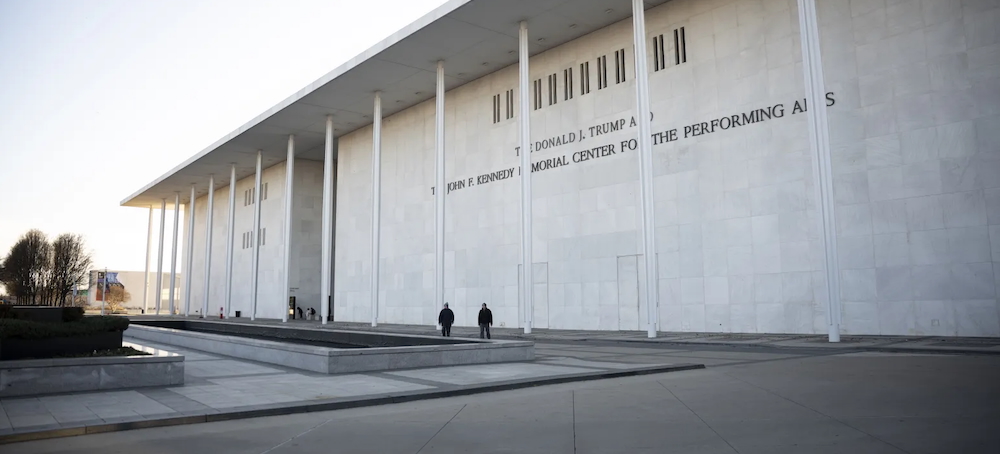 The John F. Kennedy Center for the Performing Arts in Washington, D.C. (photo: Celal Gunes/Anadolu/Getty Images)
The Post examined 15 years of the institution’s financial records to see why it went south after the president took over.
Trump said the center was “losing hundreds of millions of dollars” when he took over, and his board has warned of “bankruptcy.”
It is true that when Trump took over, the center was in worse shape than it was in 2021, when it was flush with pandemic relief funds. But the old leadership handed over an institution that was better off financially than in most years before covid-19.
“This was a pretty stable — large, complicated, but stable — organization,” said Karen Gahl-Mills, an expert in arts management and director of the Indiana University arts administration program. “It had a hard time during the pandemic, lots of people did. And it was pretty stable at September 30, 2024.”
Ticket income never covered costs at the center, and the gap was filled by donors. Federal appropriations, about $45 million a year, were “really just to fund the maintenance of the memorial, which is the building itself,” said Andrew Taylor, who directs the arts management program at American University.
“Nonprofit performing arts centers do not make positive revenue on earned income. That’s why they’re nonprofits,” Taylor said.
What sets the Kennedy Center apart is the building: “It’s a memorial, and it’s a federal building, but it also behaves like a nonprofit.”
How the dam burst
After the takeover, both donors and audiences walked away. Ticket income fell by 15 percent in the financial year that ended in September 2025, and gifts dropped by nearly a quarter. The center expects ticket income to fall by more than two-thirds this year, and gifts in the first four months of 2026 were down about 40 percent on the previous quarter, according to an internal report from June.
Tickets and gifts were “the beating heart of the institution,” Taylor said. “Most of the fuel that made that organization work stopped flowing starting in about February ’25.”
He blamed the new leadership’s decisions for the loss of donors and audiences: “The burst happened up the pipe. The water stopped flowing into the organization because of the choices the administration was making.”
Most of the people whose job it was to bring money in have left the center. Richard Grenell, then the center’s president, told the board in March that the development staff had been cut from 94 to 16. The center has also written off $48 million, according to its latest tax filing, and most of it appears related to pledges it no longer expects to collect.
Gahl-Mills said the figures, taken together, were “a sign of something going wrong.” The center was “less stable at September 30, 2025, and it seems that it is in free fall now,” she said. “This is unusual, that this organization has gone this far south, this fast. It’s not the thing we typically see. It is an organization clearly in distress.”
Scraping for cash
The center had long kept a $10 million line of credit that it sometimes dipped into during the year and paid back by year end, according to its audits. In September 2025 it doubled the line to $21 million and has since borrowed against all of it, according to an internal June report.
“It’s really hard to slow down expenses. You have to pay them. In order to pay your payroll, we have to start borrowing,” Taylor said. With the government covering the building but not the shows, “they need to keep borrowing and keep firing people.”
The center has also been draining its debt reserve, which fell from $18 million last September to $13 million in June and was projected to hit $9 million by this week, the end of the fiscal year. About $9 million of the reserve is collateral for the loan on the Reach — the center’s expansion that opened in 2019 — so the money it can actually spend is nearly gone.
It also dipped into the endowment for the Washington National Opera, a pot of donated money that is usually meant to go untouched. Charities generally only use the returns from its investment.
In normal years the Kennedy Center took a payout equal to about 5 percent of its endowment’s value, but by June this year, it had taken $10 million out of a $10.3 million endowment fund, describing it as an extra payout to cover opera bills.
On its part, the center counts the $10 million against the roughly $71 million it says the opera owes it. Conversely, the opera says the center owes it $19 million. The opera has since left, and the two sides are fighting over who owes whom.
By this month, the center “was only able to pay its bills thanks to 17 million dollars raised by President Trump,” the Justice Department told an appeals court on Monday, and that money “is fast being expended.”
The figure appears to refer to the Trump Kennedy Center Foundation, a charity rebranded after the takeover: Internal documents put the foundation’s takings at $17.5 million but don’t disclose the donors.
The documents don’t show the fullest possible picture of the center’s finances; that comes from its audited financial reports. The center has not published 2025 audited accounts, which would have usually come by around March. Gahl-Mills said the trustees have a duty to oversee both the audit and the tax filings.
“Where is the board?” Gahl-Mills asked, adding that the center was established as America’s National Cultural Center. “This is a place that belongs to all of us, not a place that belongs to one person.”
The Kennedy Center declined to answer questions about the figures in this article.