The Floods Nepal Didn’t Cause
Ishaan Tharoor The New Yorker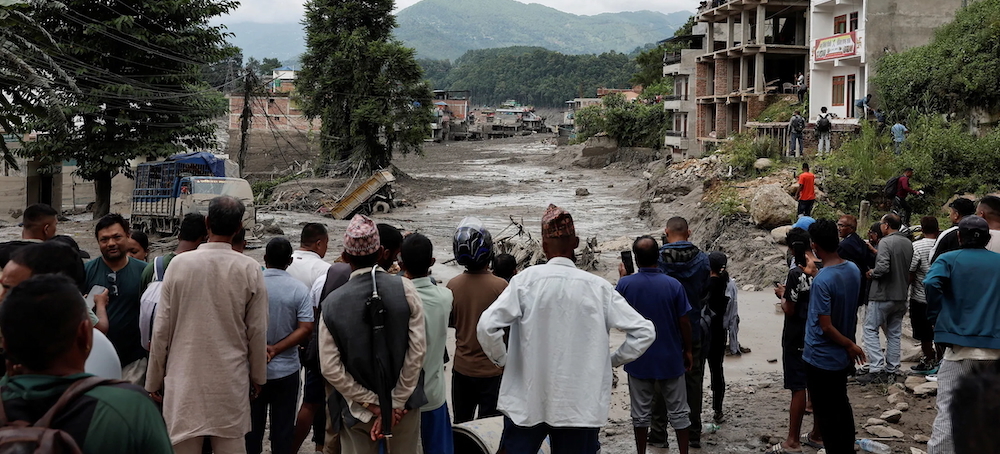 "Scientists at the U.S. Geological Survey believe the disaster was set off by a glacial collapse in the Himalayas so thunderous that it was first registered by monitors as an earthquake." (photo: Navesh Chitrakar/Reuters)
Flash floods, triggered by a glacial collapse in the Himalayas, have killed at least five hundred people in a nation that has contributed little to climate change but is disproportionately affected by it.
Poudel went on to paint a picture of wider devastation: roads and bridges smashed, agricultural fields submerged and lost, food markets gone, whole settlements wiped off the map. Many of these villages sat dozens of metres above the banks of the Trishuli River, which ran through Poudel’s native Nuwakot District. “I am 44 years old, and I have never once, in all that time, seen the river come for us,” he wrote.
But come it did—last Wednesday, an apocalyptic, tsunami-like surge of water, mud, and debris coursed through the Trishuli and Bhotekoshi river systems, along the China-Nepal border, killing at least five hundred and thirty-eight people, as of Friday. The death toll is bound to grow. Nearly two thousand people are still missing. Survivors told stories of desperate scrambles to safety and hopeless efforts to find loved ones in towns “swallowed by silt,” as one account put it. Civilian infrastructure failed or disappeared, telecommunications broke down, and hundreds of thousands of people were stranded in what was already a relatively remote, rugged corner of the country. On Friday, relief operations in some areas had to be stalled, owing to fears that a newly formed lake upstream might overflow and trigger further flash floods.
Scientists at the U.S. Geological Survey believe the disaster was set off by a glacial collapse in the Himalayas so thunderous that it was first registered by monitors as an earthquake. The rupture released a torrent of ice, mud, rock, and water that built up and then burst through the region’s narrow valleys and waterways. On the Chinese side of the border, in the autonomous region of Tibet, the deluge overwhelmed Gyirong Port, a major border crossing with Nepal that, in scenes reminiscent of a disaster movie, appears to have been completely washed away. Satellite imagery showed virtually nothing remaining of the post, which is a significant hub for trade and tourism. Many of the dozens missing in its environs were foreign nationals, chiefly Indian or Indian-origin pilgrims who were returning from, or preparing to make, the journey further into Tibet to Mount Kailash, a holy site for Hindus and Buddhists.
In Hindu mythology, Mount Kailash is the abode of Lord Shiva; according to one story, the deity sat on its peak and, in order to save the earth from drowning, caught in his matted hair the celestial might of a divine river as it came down from the heavens. As the legend goes, he then allowed just a trickle to form the great river Ganges that carves through the Indian subcontinent. The advent of man-made climate change has intensified the terrifying power of this sacred geography; the glacial lakes of the Himalayas and the Tibetan Plateau feed some of Asia’s biggest rivers, but, as they melt faster and faster, they’re thrusting impoverished, landlocked Nepal onto the front lines of a battle that was started by other nations. “Nepal is paying an extraordinarily disproportionate price for a crisis it did not create,” Sumnima Udas, a member of Nepal’s Parliament and the chair of its committee on international relations and tourism, told me. “We contribute a negligible share of global emissions, yet we sit downstream of some of the fastest-warming glacial systems on Earth.”
Udas said she hopes vulnerable nations such as Nepal can get a “real seat at the table” in future negotiations over global climate policy, and that Nepal, India, and China can work together to better manage the mountains, rivers, and “accelerating risks” that they share. That may be a tall order, given the enmities in the region and the current lack of trust between the three governments. Before the floods, Brahma Chellaney, an Indian commentator who is hawkish on China, warned of the “strategic leverage” that Beijing has accrued through its control of the Tibetan Plateau. “It has built cascades of dams on transboundary rivers, withheld hydrological data during periods of tension, and resisted entering any water-sharing treaty with downstream states,” he wrote. “Water has become another instrument of coercive statecraft.”
The flooding in Nepal is yet another calamity for a country grimly accustomed to crisis and upheaval. Udas is among a wave of reform-minded politicians who came to the fore after a popular and violent Gen Z uprising last year toppled the country’s political establishment. Their anger was a generation in the making: at the beginning of this century, Nepal, then a Hindu monarchy, was convulsed by a civil war between Maoist rebels and government forces. A peace process brought the rebels into the mainstream and led, somewhat remarkably, to the abolition of the monarchy and a transition toward a secular republic. But it was a tortured journey, marred by the caprice, narrow-mindedness, and corruption of political élites, including the former guerrillas. In the last decade and a half, a carrousel of feuding political factions took turns governing, all inadequately. Corruption was endemic, and the country’s deeper troubles—its poverty, its social inequities, and the hopeless conditions that drive millions of Nepalis to emigrate for work—endured, laying the kindling for last year’s explosion.
In the midst of all this, Nepal’s geology and geography remained unforgiving: a 2015 earthquake killed close to nine thousand people; deadly floods and landslides, though nothing on the scale of this past week, routinely hit the country. The new government, led by a thirty-six-year-old engineer and rapper, and most recently the mayor of the city of Kathmandu, Balendra Shah, had hoped that fresh ideas and a record of good governance could turn the economy around and bring in sorely needed foreign investment. The floods will likely change that outlook, squeezing a country that’s heavily dependent on tourism while forcing a costly period of reconstruction. “This disaster sets Nepal back by at least a decade,” Udas told me.
On Thursday, I spoke with Anup Kaphle, a former colleague of mine at the Washington Post who is now the editorial director of the Kantipur Media Group, Nepal’s largest media company. His newsrooms, including the Kathmandu Post, have deployed all their assets to cover the tragedy, and to provide Nepalis with clear, accurate information on emergency relief, river monitoring, and other immediate needs. “We’ve stopped asking who covers the Prime Minister’s office, districts, police, health, and essentially put everyone on the disaster desk,” he told me.
“A year ago the ground shook because of us—our politics, our anger, our frustration,” Kaphle said. “Yesterday, it was the actual ground again. It’s as if Nepalis are having to alternate between the disasters we cause and the ones that just arrive.”