The Cuban Revolution Was a Revolution in Art and Culture
Simón Vázquez Jacobin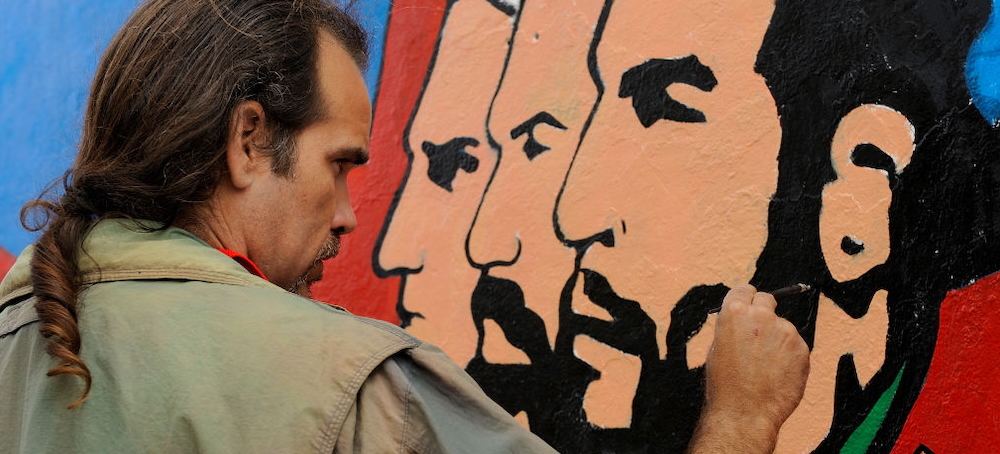 A painter works on a fresco on a Havana wall, February 17, 2010. (photo: François Goudier/Gamma-Rapho via Getty Images)
The Cuban Revolution was not just a transformation of the county’s political-economic order. It was a revolution in culture as well, bringing literacy to the masses and inspiring diverse artistic and intellectual ferment.
In this discussion with Jacobin, Prieto takes stock of the cultural legacy of the Cuban Revolution, its errors — from the Padilla affair to the anti-gay repression of the Military Units to Aid Production (UMAP) — and the challenges of Cuba’s present: the blackouts, emigration, social media, and the battle over meaning.
Simón Vázquez Let’s start at the beginning. How would you characterize the Cuba you came of age in, prerevolutionary Cuba?
Abel Prieto Remember that we were a colony of the Yankees for sixty years. In 1898, they intervened in Cuba to rob us of our victory over Spain, and then they seized the island and turned it into a neocolony.
Cuba was where the neocolonial model made its debut: for the first time they built a false republic in the country — with the money, with political control and economic control. Here the most important figure was the United States ambassador: he was the voice of the master. Our bourgeoisie was not properly national, as in other Latin American countries; it was a bourgeoisie that looked obsessively to the north. It sent its children to study in the north, and it tried to consume all the cultural junk that came from the north and to parrot it.
It was a bourgeoisie that despised the African roots of our identity. Just imagine trying to understand Cuba while despising the African component: it’s impossible. The entire spiritual legacy of our country’s African roots, which is enormously rich — they regarded as the devil’s work. What they consumed was their made-in-the-USA culture. It was in that context, the context of a new Cuba, that I was formed.
Simón Vázquez Faced with that criollo bourgeoisie that despised all things African, what did the revolution do with that legacy?
Abel Prieto From very early on, the revolution gave great standing to the African cultural and spiritual legacy, which is essential to understanding this country. The National Theater helped place the National Folkloric Ensemble, in terms of artistic prestige, on the level of the National Ballet of Cuba: the Frenchified, white, bourgeois ballet, suddenly on the same footing as the dance, movement, and music of black Cubans. Before the revolution, ballet was like an ornament of the bourgeois family — the little girl playing piano and learning her dance steps. Suddenly it became an expression of a new, mixed-race national culture. There were great mestizo dancers: our own Carlos Acosta — they’re stars.
Simón Vázquez You worked very closely with Fidel Castro. On the centenary of his birth, his relationship with culture and the intelligentsia hasn’t been the most-discussed side of him. What kind of relationship did he build with Cuban intellectuals?
Abel Prieto The relationship Fidel created with Cuban intellectuals is unique. In 1961, with the speech “Words to the Intellectuals” (“Palabras a los intelectuales”), he had founded a cultural policy that had no precedent in any revolutionary process. From the Fourth Congress on, he “moved into the Union [the National Union of Writers and Artists of Cuba],” as people say: he didn’t miss a single meeting of the national council, didn’t miss a single congress, spent the whole time listening to people, taking part in the debate.
“From very early on, the revolution gave great standing to the African cultural and spiritual legacy, which is essential to understanding this country.”
Fidel loved intellectual debate. That caricature of Fidel as a dictator who listened to no one, who imposed his own criteria, is false and indefensible. Fidel was a great intellectual — though perhaps he wouldn’t have liked being called one — who relished debate.
Simón Vázquez And on a terrain as thorny as race?
Abel Prieto There in the UNEAC, several black actors and actresses put it to Fidel that we still had racial prejudice in Cuba. Out of that discussion came, in my judgment, Fidel’s most important speech on the racial question.
Fidel explained how, at the start of the revolution, he and the revolutionary leadership had believed that by liquidating the institutional barriers of racism — doing away with whites-only beaches, the institutional, formal side — the problem would be solved; racism would dissolve. And he said that he was now coming to understand that it is a cultural problem, a complex problem, even if solving that kind of problem was slower.
Out of those discussions, he began asking about the skin color of art students, of social workers; he deliberately promoted greater participation by dark-skinned people. Che Guevara had already said it: the university has to be painted the colors of the worker, the peasant, the black, the mulatto.
Simón Vázquez That drive to democratize culture — how did it dodge both Soviet socialist realism and North American mass culture at the same time?
Abel Prieto Fidel was an enemy of elite culture. But at the same time, from 1961 on, he rejected the Soviet model of didactic, simplifying realism — the kind that turned art into propaganda, until in the end it worked neither as propaganda nor as art — and he also rejected the Yankee model of mass culture, the idea of stereotypes, the good guys and the bad guys, the mediocre, Manichaean, simplified vision of the world. Fidel allied himself with the intellectual vanguard.
Simón Vázquez Can you give a concrete example of that?
Abel Prieto He invented a television program he called University for All. The first course was a workshop on narrative technique taught by a great Cuban writer, now deceased — a workshop for young writers that he’d been giving to a tiny group — and Fidel turned it into something massive: he put it on television. Each course came with a booklet, a tabloid printed on newsprint, sold for a few cents at the kiosks, with print runs of half a million copies.
The interesting thing, when you ask how many people actually learned to write narrative from that course, is that it wasn’t many. But what it did promote, in an incredible way, was reading, because people went to the library, to the bookstore, to look for the books mentioned in the course.
Simón Vázquez It was a cultural prescription.
Abel Prieto That too. There’s the key to escaping simplification, whether of the Soviet or the Yankee stripe: put the vanguard front and center, ally yourself with the vanguard.
Fidel was convinced that people could be prepared to understand and enjoy any kind of artistic or literary expression: the key lies in education and culture. For him — he said it a thousand times — without culture there is no possible freedom. It’s the idea of culture and emancipation, a Martían idea: José Martí said that to be cultured was the only way to be free. Fidel said that without culture there is no possible freedom, because you can be manipulated.
Simón Vázquez Do you see that mechanism at work today, with the rise of the New Right?
Abel Prieto We’re seeing it today, with the rise of fascism, with these elections in Latin America. In a speech at the University of Havana in November 2005, Fidel analyzes what he calls the conditioned reflex. He says: imperialism says, “Cuba is bad, socialism is bad,” and off go the wretched of the earth behind it — those with no job, no education, no public health — repeating, “In Cuba, socialism . . . ” and they do it without thinking, without analyzing, by conditioned reflex.
“José Martí said that to be cultured was the only way to be free. Fidel said that without culture there is no possible freedom, because you can be manipulated.”
That’s what’s happening today with social media. In that speech, in my opinion, Fidel anticipates the debate over social media, the idea that people stop analyzing, stop thinking, and instead react to a stimulus with hatred, with rage, or with contempt, by conditioned reflex.
Simón Vázquez Fidel spoke of the “right-wing poor.”
Abel Prieto It worried him: poor people handing their vote to a demagogue because they’ve been manipulated. It’s a phenomenon we have in abundance: you have it in Spain, all over Latin America, in Europe, in the United States. Many people voted for Jair Bolsonaro in Brazil — people from the favela, humble people — and Bolsonaro was never going to look out for the fate of their families. Fidel said that only education and culture could guarantee you the ability to think for yourself, independently.
Simón Vázquez You were saying that in culture, too, one can regress.
Abel Prieto There can be regression: you can’t treat it as conquered territory. When the Cuban National Press was created, Fidel said: We don’t tell the people “believe,” we tell them “read.” We’re not interested in producing fanatics; we’re interested in producing cultured, free people.
And this country became a country of readers. Here we published Fyodor Dostoevsky in print runs of twenty thousand or fifty thousand copies, all the great Russian literature; but also Benito Pérez Galdós, Victor Hugo’s Les Misérables, and the great literature of the United States, from Mark Twain to Gore Vidal.
Today people read less and less, all over the world. We’ve regressed.
Simón Vázquez An example of that regression?
Abel Prieto Baseball, which is part of Cubans’ cultural heritage, and today young people are into soccer. This World Cup is a frenzy among the youngest. It makes sense that they’d share in that global appeal, because we live in the famous global village. But we’re losing something very important. Baseball is a slower sport, one that demands that you understand it, that you analyze it; and today people have no capacity for concentration.
Simón Vázquez In the midst of the crisis, what role do social media and that nostalgia for 1950s Cuba play?
Abel Prieto Because of the great offensive of mass idiotization, we have a very large emigration of young people, driven mainly by economic motives but also cultural ones: they’ve bought the fairy tale of the golden kingdom of prosperity in the United States. One of the things being done on social media is to idealize the Cuba of the past, the Cuba before the twenty-first century. There are tons of AI-generated videos of 1950s Havana, the Havana of glamour: a kid in the middle of a blackout suddenly sees a glamorous Havana, full of lights, of cars, of neon, Tropicana, the Hollywood stars. On one side, there’s the lack of information — we have to teach history — and on the other there are the new codes.
Simón Vázquez And is anyone responding in those same codes?
Abel Prieto There are very interesting initiatives using reels, those little one-minute videos. I saw one I liked a lot that uses a Bad Bunny song called “Lo que le pasó a Hawaii” (What Happened to Hawaii): the thesis of a very young, mixed-race kid is “we don’t want what happened to Hawaii to happen to Cuba.” There’s a really promising path there for getting young people interested in an issue, coming at it through music they like. But the challenge is enormous: a Cuban teenager is under the influence of the phone twenty-four hours a day.
Simón Vázquez Let’s return to “Words to the Intellectuals.” Sixty-five years have passed since that founding speech of cultural policy, which held that the Cuban Revolution would not have one specific artistic form, as socialist realism was, and which sorted artists into three categories: revolutionary artists, counterrevolutionary artists, and nonrevolutionary artists. What was the most important thing about that speech?
Abel Prieto It’s a subject I’m passionate about. That speech goes so far as to say that we can only renounce those who make themselves incorrigibly reactionary, incorrigibly counterrevolutionary. That word is tremendous: “incorrigible.” The idea that a counterrevolutionary might set himself straight. And he always says “if he is honest”: the idea of honesty, of ethics — that a counterrevolutionary might rectify, might draw closer to the revolution.
Fidel says the revolution must have room for a nonrevolutionary artist and guarantee that artist’s space of creative freedom. There he was answering a Catholic writer who asked whether he would have the freedom to express his faith, and Fidel told him yes — that it was about opening a space to work for the revolution, with the revolution, in freedom. Fidel doesn’t put labels on art; he speaks to the creators.
“The revolution must have room for a nonrevolutionary artist and guarantee that artist’s space of creative freedom.”
“Words to the Intellectuals” is a call for the most generous, the broadest unity, acknowledging diversity and the great cultural work the revolution has ahead of it. Fidel even says something to the writers and artists: we want you to create for the people, but not to make concessions on quality, because we have to work with the people so that they can understand, enjoy, and absorb your creation, however complex it may seem. That’s why the betrayal of “Words to the Intellectuals” from 1971 onward was so bitter.
Simón Vázquez “Words to the Intellectuals” was put forward as the revolution’s cultural policy, and years later came a turn in the opposite direction — the notorious “gray five-year period” and its censorial turn, the well-known Padilla affair. [The Padilla affair was the episode that fractured the relationship between the Cuban Revolution and much of the international left-wing intelligentsia. Heberto Padilla, a poet who had supported the revolution but who turned to criticizing it in the late 1960s, saw his poetry collection Fuera del juego (Out of the Game) — awarded a prize by UNEAC in 1968 — published with a prologue branding it counterrevolutionary. In March 1971, he was arrested and jailed for just over a month, emerging only after reading a humiliating self-criticism before UNEAC in which he accused himself and other writers, a gesture that reminded many of Joseph Stalin’s Moscow show trials. The reaction was immediate: figures such as Jean-Paul Sartre, Simone du Beauvoir, Mario Vargas Llosa, Julio Cortázar, Susan Sontag, and Octavio Paz signed letters of protest, and the episode opened a schism in the cultural left and foreshadowed the hardening of the so-called Quinquenio Gris, the gray five-year period.]
Abel Prieto The so-called Padilla affair. We made fools of ourselves and broadcast it to the whole world: Herberto Padilla’s self-criticism was a caricature of the traps of the Moscow trials. It was a grave mistake, one in which UNEAC, the Ministry of the Interior, and the Communist Party all took part.
After the Padilla affair, great European intellectuals — even Sartre and Simone de Beauvoir — broke with Cuba. I think we were deceived. Padilla was an excellent poet, and I think we have to go on publishing him and, at the same time, make known an account of what really happened.
Simón Vázquez There were also very harsh stretches, like the Military Units to Aid Production (UMAP) — military units that herded together religious believers, pacifists, and gay men into forced-labor camps in agriculture.
Abel Prieto The stance we took toward gay people had several moments of repression. The infamous UMAP. . . . On Fidel and Raúl’s instructions, an investigation was carried out, because [there was a belief] that a homosexual who worked the land would “man up,” that he’d turn into a tough guy if you handed him a hoe and a machete. It’s absurd. All of that coincided with those currents of universal homophobia, the hormone-injection kind — like the case of Alan Turing, for example.
Simón Vázquez You like to joke that you’re a “Marxist-Lennonist,” after John Lennon, and you claim the British artist as part of the revolution’s heritage.
Abel Prieto Every time I post images on social media of Fidel at the Lennon monument in Havana, people pile on the hate, but they hate me even more intensely when I try to reclaim Lennon as part of the heritage of the Cuban Revolution. Lennon, an agent of empire? A revolutionary, absolutely! He backed every cause, against the Vietnam War, and he helped us.
“The Padilla affair was a grave mistake, one in which UNEAC, the Ministry of the Interior, and the Communist Party all took part.”
It’s madness that, out of clumsiness, we weren’t consistent about spreading the best of Lennon’s music and of authentic rock; instead there was a tendency to flee from English, “the language of the enemy.” That was my battle at the university: long hair, seed necklaces — the Cuban barbudos brought that into the twentieth century; the hippies imitated that symbol of rebellion of ours, not the other way around. How can we call a foreign affectation a symbol that we Cubans ourselves brought into the modern world?
Simón Vázquez In your outlook, there’s an idea that becomes urgent today: that we face a confrontation between humanism and barbarism, trying to “salvage what we can” of humanity.
Abel Prieto Life, people, the right to live.
Simón Vázquez I’d like you to talk about that syncretism, that construction of socialism in the Caribbean, joining together elements that in a dogmatic phase might have been seen as utterly divergent.
Abel Prieto At the beginning of the revolution, there were courses in scientific atheism; if you’d had your child baptized you couldn’t join the Communist Party, and neither could you if you’d married in the church: a phase of searching for a kind of ideological purity. That changed. A turning point was Frei Betto’s interview with Fidel, Fidel and Religion, which changed us Cubans and, more broadly, changed the way the revolutionary movement in Latin America looked at religion.
Simón Vázquez And today?
Abel Prieto It’s not possible to abandon the spiritual dimension, the religiosity of human beings; it’s not possible to leave man — as Sartre said — facing death, facing the void, facing nothingness. Revolutionary processes have to take that into account and integrate it.
The besieged-fortress mentality, which has often done us harm, never led us to reject Cuban Santería, the Regla de Palo Monte, the Babalawos, the Abakuá, or the spiritists. Cuban spiritism is revolutionary. And the Family Code is a model of the vanguard: marriage equality, the right to adopt children. The evangelicals managed to muster a bloc of no votes against the code, but a great battle was won.