
The Candidates Who Defeated the Politics of White Grievance
Keeanga-Yamahtta Taylor The New Yorker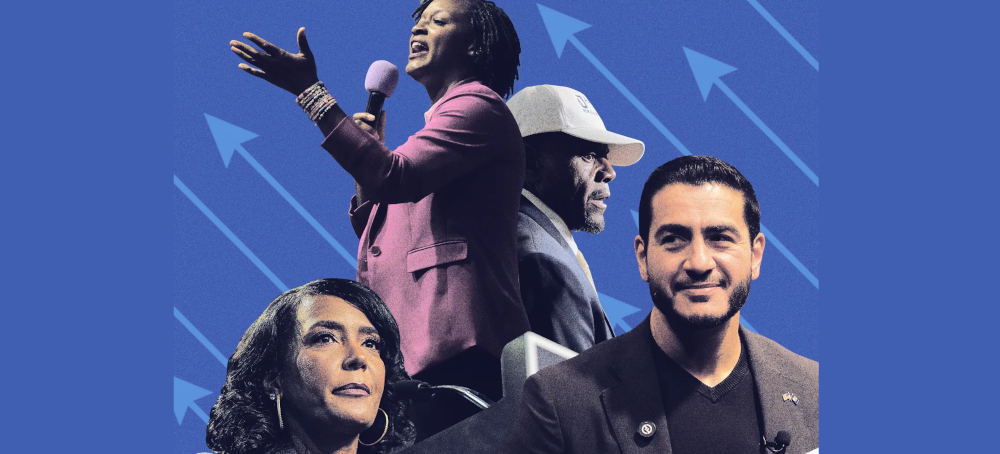 Will Democrats’ breakthrough in the South transform their party’s view of a winning campaign? (photo: Ben Kothe/Getty)
Will Democrats’ breakthrough in the South transform their party’s view of a winning campaign?
Apparently, there is an expiration date on the red-meat racism of Trumpism. El-Sayed defeated his Republican opponent, Mike Rogers, by seven points. Elsewhere, Republicans attempted to link Black candidates to chaos and crime, but these tried-and-true tactics appear to have had little effect. Angie Nixon, a Florida state representative and union organizer, ran an upstart campaign for the U.S. Senate, and was subject to witheringly racist attacks from the President and his supporters. Laura Loomer, who boasts of her access to Trump, described Nixon as “a ghetto, black, communist.” She mocked Nixon’s speech as “Ebonics” and wrote, “Maybe I need to bark at you and tug your leash and then you’ll finally understand.” Trump said of Nixon, “She’s not of the intellect that should be running for the Senate. She’s a very-low-I.Q. person.” Yet Nixon—who ran a campaign centered on Medicare for All, universal child care, and taxing billionaires—came within three points of defeating the Republican incumbent, Ashley Moody, converting an estimated six per cent of Floridians who voted for Trump in 2024.
In the Georgia gubernatorial race, the Democratic candidate, Keisha Lance Bottoms, was pitted against the Republican Rick Jackson, a billionaire health-care executive who spent more than two hundred million dollars of his own money on the election. Bottoms, who served as the mayor of Atlanta during Trump’s first term, gained prominence during those years as one of the President’s opponents: she denied ICE the right to hold detainees in the city’s jail, in response to the Administration’s family-detention practices, and opposed the rapid reopening of Georgia at the height of the pandemic. Jackson, a white man, repeatedly blamed Bottoms for violent crime in Atlanta and for the 2020 unrest in response to police brutality—often conflating the two. Not to be outdone, Trump held a rally outside of Macon, where he accused Bottoms of having “destroyed Atlanta with her crime and filth and constant riots.” She won the race by nearly nine percentage points, becoming the first Black woman elected governor of any state. Across Georgia, seven other Black women won statewide seats.
In Louisiana, Jamie Davis, a third-generation Black farmer, ran for the Senate on what he called the “four pillars” of affordability, education, health care, and upholding the Constitution. He also supported a moratorium on building new data centers and pledged to introduce legislation barring elected officials from signing nondisclosure agreements. According to a local news investigation, his opponent, Representative Julia Letlow, signed an N.D.A. with Meta about a fifty-billion-dollar data-center project in her district; she went on to purchase stock in Meta and then failed to disclose those trades for more than a year, in violation of federal law. (In response to the reporting, a spokesperson for Letlow said that these purchases were made by a broker and that she did not direct any of her trades.)
Astonishingly, Davis was neck and neck with Letlow well into the fall, when, in an act of desperation, a Republican PAC released an ad showing an A.I.-generated Davis lumbering toward the camera in a T-shirt and jeans. A Louisiana Republican pollster, Bernie Pinsonat, explained to a local Fox News affiliate that the ad was intended “to turn any whites off that would think about voting for him. You know, we do have a lot of RINOs”—Republicans in Name Only—“in this state.” Davis came within two points of Letlow, losing by a mere twenty-five thousand votes. The Fox News Voter Poll for Louisiana estimates that he earned the support of ninety-two per cent of Black voters, thirty-four per cent of white voters, and eleven per cent of people who said they had voted for Trump in 2024. Every parish shifted toward Democrats by at least nine points.
The outcome may well have been different had Davis received meaningful assistance from the national Democratic Party. Days before the election, the longtime Democratic Party consultant and Louisiana native son James Carville noted, “I beat my head against the wall trying to get some national money in here. It’s almost impossible.” Scott Colom, the Democratic Senate candidate in Mississippi, whose exceedingly close race was called in his favor on Wednesday, was also left out in the cold. In July, the Democratic Senatorial Campaign Committee made a forty-million-dollar investment in ten Senate battlegrounds, part of which funded outreach to Black voters, that did not include Mississippi—even though a poll had shown that Colom was within three points of the Republican incumbent, Cindy Hyde-Smith. Finally, the D.S.C.C. joined Colom on a five-hundred-thousand-dollar ad buy with just six days left to vote.
Even near-misses, such as Jamie Davis’s and Angie Nixon’s Senate bids, convey a larger truth about the midterm elections. Two years after Trump’s return, his appeals to white supremacy and victimhood can’t compensate for voters’ struggles with the cost-of-living crisis, disgust with Trump’s corruption, or rage at the billionaires’ prerogative to put data centers anywhere they please. In races across the South, Democratic candidates attracted the support of a wide swath of voters. Their campaigns are evidence of the viability of class politics in every corner of the country. In Mississippi, a remarkable nine per cent of residents who voted for Trump in 2024 voted for Colom in 2026. In Louisiana, one field organizer for Davis said, “I’ve never worked with Republicans this much. Ever.”
The G.O.P.’s racist attacks may not have worked to turn out white voters, but they undoubtedly helped to mobilize Black voters. These date back to the Administration’s war on D.E.I.—specifically, its attack on Black workers in the federal government, led by Elon Musk and the short-lived DOGE. By September, 2026, federal employment had fallen by roughly three hundred and twenty-eight thousand jobs since Trump took office. Multiple lawsuits have alleged that the firings targeted Black workers, who made up roughly eighteen per cent of the federal workforce in 2024. (The Trump Administration has responded that its firings were not racially biased.) The attacks on Black employment were amplified by the continued evisceration of the Voting Rights Act. After the Supreme Court’s Callais decision, in April—which allowed states to redraw, or “crack,” districts that concentrated Black voters to assure their representation—Louisiana dismantled its second majority-Black congressional district, Tennessee split Memphis’s Black communities among three districts, and Alabama reinstated a map that reduced Black voters’ share of the voting-age population in its Second Congressional District.
Just two years ago, Republicans boasted about their new currency with Black men and Latino voters. But the A.P. Voter Poll estimates that, this year, about ninety per cent of Black voters supported Democratic House candidates; roughly eighty per cent backed Kamala Harris in 2024. Only about ten per cent of Black male voters supported Republican candidates, just two years after approximately twenty-five per cent cast ballots for Trump. In Louisiana, where the Callais case originated, Black voters cast more than eighty-six thousand early and absentee ballots—an eighty-three-per-cent increase from the 2022 midterms.
In Alabama, Representative Shomari Figures, a Democrat, won reëlection in the cracked Second Congressional District by nearly eight points. The candidates in Louisiana’s cracked Sixth District are headed to a runoff election. In Tennessee, the Democratic state representative Justin J. Pearson ran in a newly configured district, which previously was centered on Memphis and now stretches over roughly two hundred miles, only to lose by some twenty-five hundred votes to his Republican opponent. In fourteen of the fifteen counties making up the new seat, Republican majorities voted for Trump in the 2024 election. Across these counties, Pearson won 48.5 per cent of the vote.
Pearson is a longtime progressive activist, but not all of these candidates are on the left—Davis ran as a gun-toting farmer and business owner. Nearly all of them, however, campaigned on the affordability crisis, which extends far beyond the cost of gas. Their campaigns upend the assumption of many Democratic consultants that rural and Southern outposts are a poor use of financial resources and political talent. Whether they mark a political turning point will depend upon whether Democrats now choose to take the whole of America, and especially the South, seriously. If Party leaders invest in the Southern candidates who are attracting Black, white, and brown voters and rebuilding regional political organizations, they may find the source of a sustained electoral turnaround. If they do not, we can expect right-wing forces to reassemble a possibly more dangerous version of Trumpism—more serious, more determined, and more destructive.

