The Bystander
Molly Olmstead Slate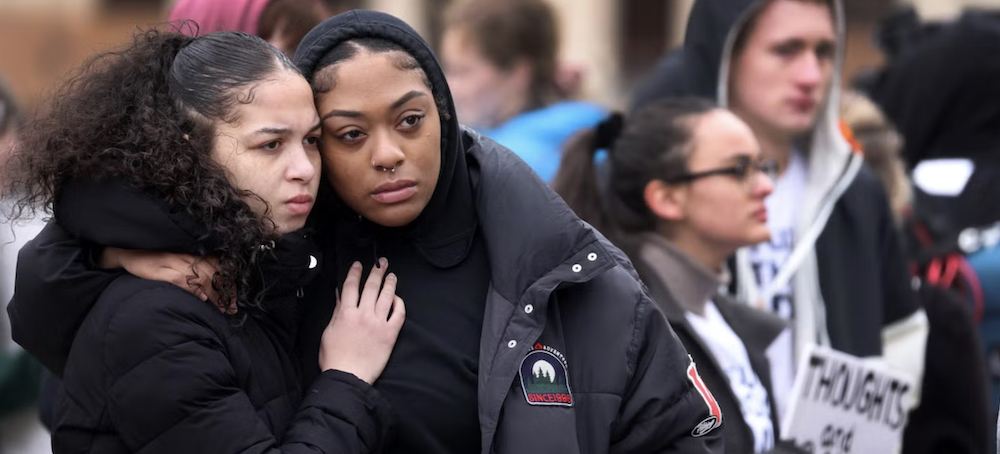 Michigan State University students and others attend a rally outside of the state capitol building in Lansing, Michigan, in honor of those who died in a school shooting on Feb. 13. (photo: Scott Olson/Getty Images)
How one college student is grappling with the “gasp” of emotions that flooded him after the shooting at Michigan State.
“When I was hiding, for a long while, the only thing I could hear was silence,” he said in a recent phone call. “You’d hear sirens occasionally. And this helicopter was flying over my head the whole night.”
Ted, who asked not to share his last name, was not in Berkey Hall on Feb. 13 at the time the gunman opened fire. Nor was he in the MSU Union, the site of the second attack. But he has found himself grappling with feelings of overwhelming depression, anger, and intense anxiety. He now knows he was never in any direct danger, but he still existed, for several hours, in a state of suspended fear, helplessly watching as false but frightening reports came in through texts and on social media—as they often do, in situations like these. The first reports of the shooting came in at 8:18 p.m. and the police sent out an alert that the shelter-in-place order had been lifted at 12:28 a.m. Ted had spent the whole night wondering if he was in the gunman’s path.
In the aftermath of the shooting, which claimed the lives of three people and left five critically wounded, the university set up extensive counseling programs, open to the public, no insurance needed. But survivor’s guilt is complicated; Ted said he felt bad about feeling so anguished. “I thought that I wasn’t allowed to use these resources because they weren’t for me, because I didn’t get shot at,” he said.
“Why should I feel so affected?” he asked. “It’s weird. I don’t feel like I have the right to feel like a victim.”
While the toll of directly experiencing or witnessing a shooting is, in many ways, self-evident, it’s easy for us to forget that the students who were just there—who experience a shooting from the periphery, from relative safety—have no roadmap for how to cope. And the aftermath often comes as a surprise to the students themselves, many of whom struggle with denial, frustration, and, above all, guilt.
The first indication Ted had that something was wrong came as he was pulling into the garage near his dorm on Monday after dinner at an off-campus shopping center. A dozen or more police cars were parked around Berkey Hall, two buildings down. In the opposite direction, toward the MSU Union, there were a couple more. It was a little odd, but not too alarming: He was used to seeing an unnecessarily strong police response to any kind of report on campus.
He parked and got out of his car. The time, he would later estimate, was around 8:25 or 8:30—a time when no one knew the gunman’s whereabouts. But Ted didn’t yet know this. He had no indication of just how horrible the night would be until he spotted a woman acting strangely. She was standing between cars, partially hiding her body from view, while also swiveling her head to look around the garage. Ted approached her and asked what was going on.
“‘Someone came in and shot up my classroom,’” Ted recalled her saying. Stunned, he asked if she knew where the gunman was, or if she knew what was going on. She didn’t.
“And then I saw her, too. Really saw her. She was covered in blood. Her hands were completely covered in blood. She had blood on her shirt, her jacket, blood on her pants, her shoes,” he said. “I said, ‘Oh my God, you’re covered in blood. Are you OK?’ She said, ‘It’s my friend’s blood.’ And I said, ‘Is your friend OK?’ Like, fuck, obviously not. But I just said that. And she said, ‘I don’t know.’ I think she was in shock, too.”
Ted asked the woman if she needed help, but she told him a friend was picking her up. She got on the phone, walked away, and he heard her crying. Later, in his mind, Ted would replay this conversation, envision the bloody woman, piece together the timing and location, over and over.
Ted didn’t know what to do, so he left the parking garage and walked toward the MSU Union, where there were now “a million police everywhere.” He hadn’t yet heard of the second shooting at the student union, so he approached an officer with an assault rifle to ask for information. The officer told Ted to turn back. He returned to his car, drove to the top of the parking ramp, and waited.
For around three hours, Ted waited there. For a while he hid under a blanket he had in his car, hunched in a state of anxiety. He scrolled through texts and tried to keep up with the new reports of sightings or of gunfire, many of which turned out later to all be false. He, unlike many other students, refused to listen to the police scanner; he felt like he couldn’t handle it. “I was genuinely scared that this guy might come and try to find me,” he said.
His worst moment came when a man appeared at the top level of the parking ramp; for a split second, before Ted realized that the man didn’t match the description of the shooter, Ted experienced a jolt of intense fear. But the second man was visibly terrified. Ted waved at him; the man stayed away. Later that night, Ted would find out that the man had been in Berkey Hall studying when the shooting started.
Eventually, around 11:30 or 11:45 p.m., by Ted’s estimate, police arrived to question him and then told Ted it was safe to walk home as long as he stuck to the main road. Ted and the second man, who had also been hiding in the parking area, walked back together. Shortly afterward, he saw the news that the gunman had killed himself.
“I didn’t really have a chance to deal with anything that night, I was so in shock,” Ted said. “I couldn’t process anything. I felt, like, nothing for a while.”
But he stayed up late, unable to sleep. Once the fear ebbed, it left a strange void of emotion. “I felt numb, like, ‘this isn’t even real.’ It felt weird. I wasn’t sad or angry; I didn’t feel anything. Just nothing at all.”
The next day, that same numbness continued, even as his thoughts fixated on the events. “I was telling myself I wasn’t really affected by this,” he said. “I don’t think I’d really realized the gravity of it.”
Then, around 7 p.m., he said, “it just all came through and hit me.”
He was sitting in his dorm room, in a largely empty campus, keenly aware of just how quiet it was—most students in his building had gone home for the week. The emotions hit him, he said, like a “gasp.” He felt overwhelmed by anxiety and anger and a feeling of isolation and hopelessness. “It really messed me up, to be honest,” he said.
He found himself unable to stop replaying the night’s events in his head. His actions, his words, the small decisions that led him to be in that car that night, and not more directly in harm’s way. “I kept thinking, ‘I could have been there, so easily. How did I not end up being there?’”
Despair took hold. “I felt hopeless knowing this is never going to change, that nothing is going to get better, nothing is going to get done,” he said. “It’s just going to keep happening. This hopeless feeling, I can’t shake.”
He reached out to friends to talk to them, and sharing their grief helped, he said. So did distracting himself with video games. But these measures didn’t fully resolve the turmoil. “I just wanted it to stop,” he said. “I wanted it to go away, and there was nothing to make it stop, all the feelings and the thoughts.”
Then, there was the guilt. The shooting “had an impact on the whole community,” Ted said. “Multiple people have told me that. But it still feels wrong.”
After talking to friends, Ted decided to join online “listening groups,” over Zoom, to discuss his feelings with other students. Talking helped. It also helped to hear other students struggling with the same guilt and bewilderment. Ted remembers hearing from one international student who felt particularly confused. “They lived off campus, and they didn’t feel, necessarily, that they belonged to this community in the same sense,” Ted recalled. “And yet they felt traumatized by what happened. They felt like a victim. And they said something about how they can’t talk with any of their friends because they’re from overseas, and no one understands this kind of thing over there, because it just doesn’t happen. I was thinking, ‘I don’t understand this either. I’m from here, and this shit happens here, but I don’t understand it. I don’t understand what I’m feeling or why I’m feeling this way.’”
Counselors told Ted that many of the students had struggled with these feelings—the sense they hadn’t earned the right to feel traumatized. “The people there told me they were there for me, that the resources are for everybody, because we’re all affected,” Ted said. “Hearing those people tell me that and actually believing it—it’s a different thing.”
In recent days, students who lived through the shooting have attempted, in so many different ways, to express their shock, horror, fear, and guilt—some by sharing what their phones looked like during an onslaught of alerts and terrified text exchanges, some with bitterly dark humor. They’re leaning on each other, but they’re also the TikTok generation, inclined to show their experiences, and process their grief and anger on social media. It’s a form of coping that has given us real-time insight into the immediate world of college shooting survivors.
The sharing doesn’t necessarily ease their minds, but for many, it feels like the only form of immediate action they can take. (As Ted put it, some friends seemed to be coping much better than he was, and it caused him to question himself. “In a way that made me feel worse,” he said. “It’s just like, they’re fine, I should be fine, too.”)
Ted decided not to leave campus and go home to his family, as many students did. He figured he would feel just as alone there as he does on campus, given that his friends and family at home wouldn’t understand. All he wants, he says, is to be around people who feel what he feels.
“Talking about it with other people is the only thing that’s helping; When I’m sitting here alone, it’s really bad,” he said. “I don’t feel like a real victim. And yet I feel so messed up by it all.”