The Bulldozer Came at 10:30 AM Twenty Minutes Later, the Odehs’ Home Was Gone
Amira Hass Haaretz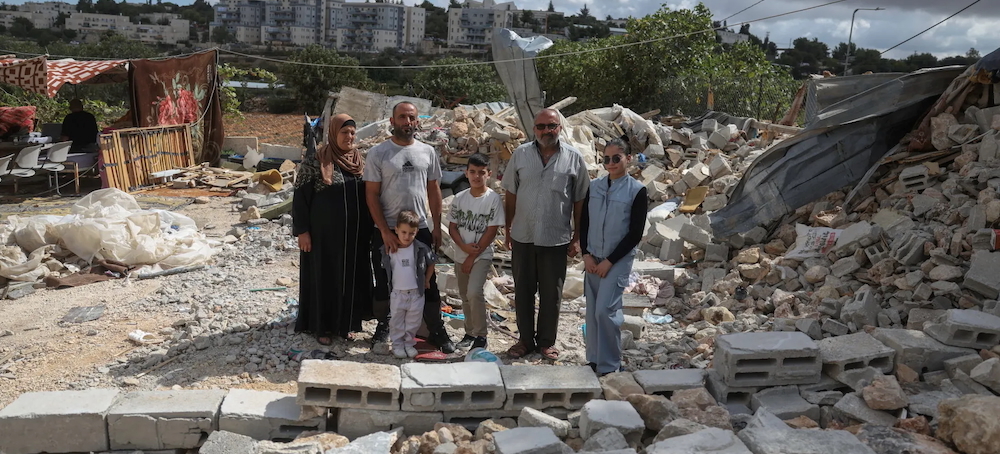 The Odeh family beside their demolished home, with the settlements of Rosh Tzurim and Alon Shvut in the background. (photo: Menahem Kahana)
The Israeli government is conducting "governance operations" in the West Bank, and home demolitions are soaring. This month, more than 140 structures have been razed and 215 Palestinians left homeless as the space where they can live and work shrinks
They went in and out of the house almost as fast, hauling heavy-duty plastic bags into which they'd emptied the kitchen and the closets. The furniture and some of the electrical appliances were taken out too. The washing machine was left inside. "The officer told me there was no time, they were in a hurry," Odeh says. By the time his eldest daughter, Tulin, 12, came home from school at midday, the house was gone.
The Odeh family's home, demolished at the beginning of the month, joins a growing number of Palestinian structures the Civil Administration has razed in recent years. Finance Minister Bezalel Smotrich calls the demolitions "governance operations," saying they are meant to enable the expansion of settlements and their "fortification." On the day the Odehs' house was destroyed, the Civil Administration demolished 31 more structures in the West Bank – two in the nearby village of Nahalin and 29 in Khallet at-Taban, in Masafer Yatta in the South Hebron Hills. Thirteen of the structures were residential (six of them uninhabited); the rest were agricultural.
The laborers who emptied the family's house had their faces covered, and the family concluded they were Palestinians. "Poor guys, they don't have any work," they said sympathetically. They are all in the same boat, all of them hurt by Israeli policy.
Odeh says a security coordinator from a nearby settlement was also present at the demolition. According to Odeh, this is the man who delivered the Civil Administration's stop-work order to the family in 2024. Since then he has shown up several times, on Saturdays, to check that they hadn't added anything to the house, which they built on their own private land in 2014.
"He'd lift up the rug to make sure we hadn't put down tiles," Odeh says, sitting in the "living room" the family has improvised next to the ruins of the house: a few sofas and armchairs arranged in a U, blankets stretched above them for a roof and tangled grapevines standing in for a wall. The weather still allows them to spend time there, and Issa's father, Mohammed, even sleeps there at night. The rest of the family has split up to stay with various relatives.
According to the UN Office for the Coordination of Humanitarian Affairs, in the first 17 days of September Civil Administration bulldozers set out on 20 demolition operations in 17 Palestinian communities. The scenes of destruction looked and sounded alike: the pounding of concrete and the growl of an engine filling the air, and all around, silence. Those affected stand nearby and watch their savings and their hopes collapse and get crushed under the steel blade.
This month's toll came to 143 structures, 42 of them residential; the rest were infrastructure and agricultural structures that families depend on for their livelihood. In all, 215 people were displaced and some 300 others saw their livelihoods hit.
The first half of September has already surpassed August's record, when the Civil Administration demolished 109 structures. The 10 residential buildings among them had housed 60 people, and more than 400 people made their living from the rest. The largest operation took place on August 12, when the Civil Administration razed 25 commercial structures at the entrance to the village of 'Aba, east of Jenin, which provided – or were meant to provide – a livelihood for some 120 residents.
"The goal of the wave of demolitions is to prepare the ground for Israeli families to resettle the land," the ultra-Orthodox news site JDN reported openly that same day. Sure enough, the next day two re-established settlements – Ganim and Kadim – went up on the land. Smotrich, who ordered the demolitions, said the move was "an important and necessary step toward fortifying settlement," and that the demolished structures "threatened the [Jewish] communities of northern Samaria."
The expansion of the settlement enterprise has always relied on barring Palestinians from building and developing in most of the West Bank. These bans are a decree the Palestinian public cannot abide, so residents decide to build without a permit from the occupying authorities, on land that has been in their families for generations. The demolition policy, then, is not aimed at habitual building offenders – its purpose is to shrink Palestinian space.
The explanation Issa and his father, Mohammed Odeh, were given for the stop-work and demolition orders matches Smotrich's words. "The house is too close to the settlement's homes," the security coordinator told them. And indeed, over the years the houses of the Alon Shvut settlement have crept closer to Khallet Sakariya. "It's not like we came to them – they came to us," Mohammed says, the hurt and anger audible in his voice.
Khallet Sakariya is one of five Palestinian residential clusters surrounded by fig trees, grapevines and deciduous trees, which the Gush Etzion settlements are steadily closing in on. Thirteen years after the small, long-established farming community of 800 residents applied for a master plan and building permits, the Civil Administration approved just 50 housing units for it in 2021. But the surrounding settlements protested that this endangered them and their suburban way of life, and the plan was shelved.
The village head, Mohammed Ibrahim Saad, known as Abu Ibrahim, says 35 demolition orders are pending against structures in the village. "Any minute a bulldozer could come and knock them down," he adds. Thousands more Palestinians across the West Bank live in constant fear. According to the Palestinian Authority's Colonization and Wall Resistance Commission, the Civil Administration issued nearly 1,000 demolition and stop-work orders last year, and some 250 more since the start of this year.
Since the start of the year, the Civil Administration has demolished 960 structures on the grounds that they lacked building permits. Eight of them were in Area B, where the Palestinian Authority is in charge of planning. More than a fifth of the demolished structures were residential and about a third were agricultural. The average since January is 113 Palestinian structures demolished per month. That puts 2026 ahead of the two preceding years: In 2025, an average of 106 structures were demolished per month, and in 2024, 88.
Accordingly, the number of people affected by the demolitions is also rising – 1,040 have lost their homes in less than nine months this year, compared with 1,160 last year and about 850 in 2024 – about half of them children. Each year, thousands more suffered financial losses because of the demolitions. According to UN data, since 2009 Israel has demolished 11,000 Palestinian structures for administrative reasons, leaving some 13,000 people displaced. The figure does not include demolitions for military or punitive purposes, such as those in the Jenin and Tulkarm refugee camps, or demolitions carried out by the Jerusalem Municipality and the Interior Ministry in East Jerusalem.
Adding to the financial strain on the Odeh family and other local residents are increasingly tight restrictions on their movement. Mohammed and his son Issa used to supplement their modest income with construction work – in Israel and in the settlements – but that source dried up after October 2023. Since then, they and the residents of other villages have also been barred from much of their cultivated land, on the grounds that it is too close to the settlements.
The effort to shrink Palestinian space is evident in yet another phenomenon. According to Abu Ibrahim, about six weeks ago Civil Administration personnel arrived late in the evening at the community living west of the military checkpoint at the Gush Etzion junction and conducted a census. A total of 380 residents were counted, and according to Abu Ibrahim, the army barred those who weren't home at the time from continuing west through the junction. What's more, soldiers at the checkpoint tore off the appendix to their ID cards stating that they live in Khallet Sakariya.
The Civil Administration has conducted similar head counts in other small communities trapped between settlements, thereby controlling and reducing the number of residents in areas where construction for Jews is accelerating. Palestinians are being squeezed into the centers of the towns and villages, and they are increasingly absent from the landscape they – and their parents – grew up in.
The Civil Administration said in response: "The Civil Administration and its inspection units work to enforce planning and building laws throughout Judea and Samaria, in accordance with established priorities and subject to the approval of the political echelon. Enforcement activities are intended to uphold the rule of law and regulate construction in the area." The Civil Administration's spokesperson's office did not provide figures on the number of demolitions and stop-work orders since the start of the year, and did not explain the spike in demolitions.