The American Revolution of 2026
Marc Ash Reader Supported News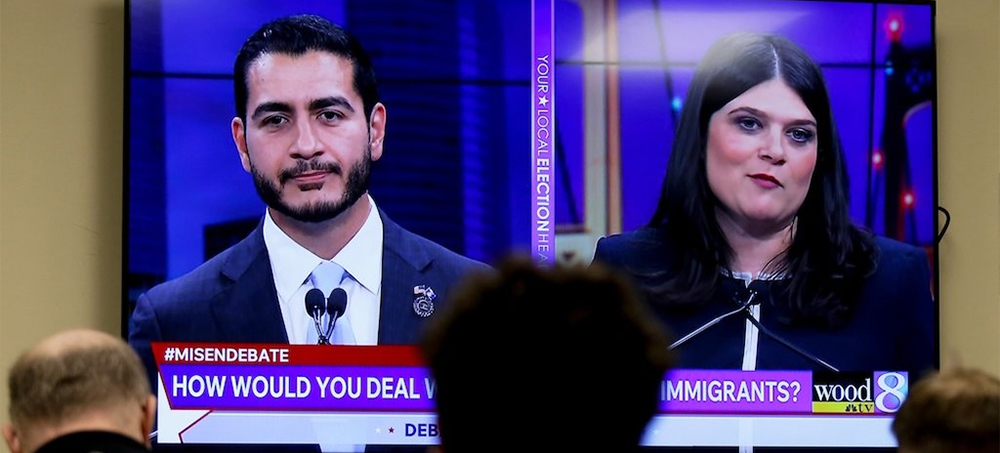 July 7, 2026: Abdul El-Sayed and Haley Stevens square off in a Democratic Michigan Senate primary debate. (photo: AP)
The struggle to get money out of politics isn’t new, what is new is that the problem has never been worse than it is right now. To understand how it got this bad start with the Supreme Court’s Citizens United v. Federal Election Commission decision of 2010. The Brennan Center for Justice sheds this light: “The Supreme Court’s 2010 ruling in Citizens United v. Federal Election Commission is a controversial decision that reversed century-old campaign finance restrictions and enabled corporations and other outside groups to spend unlimited money on elections.”
Citizens United was an all out assault on campaign finance reform. The Court’s conservatives argued that it would not promote corruption. It’s now 16 years later and the truth is painfully clear. Governments, particularly the federal government are awash in Political Action Committee (PAC) money and the corruption it facilitates.
If there is a quintessential poster boy for campaign donation abuse it has to be Elon Musk. In 2024 Musk donated $290 million dollars to Republican political PACs with $76 million going directly or indirectly to Donald Trump. That was at the time the largest amount ever donated to influence an election by someone not running for office. In 2025 and 2026 Musk has donated over $366 million mostly to, you guessed it, Republican leaning PACs. Establishing an allegation of corruption requires demonstrating a corrupt motive. Does Musk have a corrupt motive?
Congressional estimates put Musk’s earnings from business dealings with the US government at a minimum of $38 billion since 2003. Mostly from contracts with SpaceX and purchases of Tesla vehicles. If the US government creates a Musk friendly business environment Musk’s net worth rises significantly. Currently Elon Musk’s personal net worth is estimated to be roughly a trillion dollars. His interest in maintaining a Musk friendly government is clear. Musk also has a note of caution for incoming members of Congress who are thinking about scrutinizing his interactions with the Trump administration. In a recent X post he issued this mafia style warning, “Live by the sword, die by the sword. Those who pick fights with me should understand that I will find out who is really pulling the strings and come for them, not just their puppets …”
Live by the sword, die by the sword. Those who pick fights with me should understand that I will find out who is really pulling the strings and come for them, not just their puppets …
— Elon Musk (@elonmusk) October 21, 2026
How much power does Elon Musk’s relationship with the Trump administration afford him? According to the Wall Street Journal it was in fact Musk that made the decision to throttle the Ukrainian military’s data transfer speeds via the StarShield satellite system. What were the real life ramifications of that decision? The New York Times put it this way, “When Starshield Cut Out, Ukrainian Drones Fell From the Skies.”
The struggle for campaign finance reform has been a long one, there have been wins and loses almost always and ultimately at the Supreme Court level. The Tillman Act of 1907 and Taft–Hartley Act of 1947 restricted the flow of both union and corporate money into federal elections. But it was the otherwise liberal leaning Burger court in its 1976 in the Buckley v. Valeo decision that first said campaign contributions were in fact protected under the 1st amendment. The law that seeks to regulate campaign donations is the Federal Election Campaign Act of 1971.
But the campaign finance revolution really cannot come in the Congress or in the Courts the final battle always plays out in American polling booths. Big money in politics only works if it works. If it doesn’t produce the result that the donor/investor wants then a new and far more effective form of campaign finance reform governs the political landscape.
The Michigan Democratic Senate primary contest between Haley Stevens and Abdul El-Sayed ended up being the most expensive Senate primary race in history. But Stevens enjoyed a nearly 12 to 1 advantage in the crucial outside money column. AIPAC the pro Israeli lobbying group alone spent roughly $30 million on ads for Stevens in an effort to defeat El-Sayed. In the end it was close but El-Sayed prevailed.
The impact of AIPAC’s electoral drubbing was so severe that the group announced that it was stepping back substantially from campaign endorsements and scaling back donations significantly. This from NPR, “AIPAC halts endorsements and direct contributions to candidates.” But AIPAC’s spending is a drop in the bucket compared to what Elon Musk is spending. Musk’s $366 billion is a blatant attempt to buy the influence his enterprises profit from.
Should Musk’s massive cash gambit fail a gauntlet will have been thrown down by the American voters, a bridge will have been crossed and a revolution without a shot being fired will have occurred.