The Amazon’s Defenders Declare a State of Emergency
Katie Surma Inside Climate News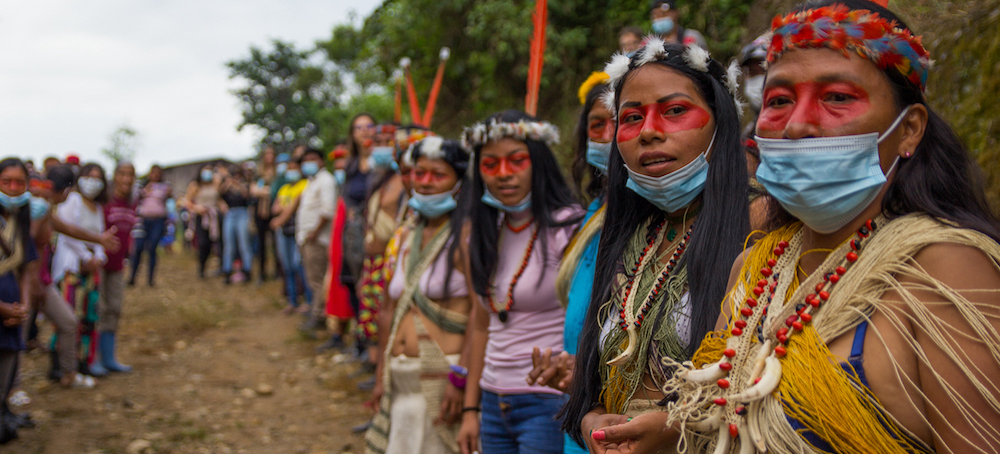 Waorani women in Ecuador. (photo: Kimberley Brown/Mongabay)
As governments push oil and mining expansion, thousands of Indigenous leaders and activists gathered in Ecuador to chart another path.
The 12th Pan-Amazonian Social Forum, known as FOSPA, brought together Indigenous leaders, Afro-descendent communities, women, youth and other environmental defenders and social-movement members from across the Amazon and Andes for six days of debate in August about how to protect the region from the forces reshaping it.
A central message of the gathering was that the Amazon basin is an interconnected living system that national borders have unnaturally divided—and that attacks on the forest cannot be separated from attacks on the people who defend it.
The ecological stakes could not be higher.
As the world’s largest tropical rainforest, the Amazon holds a stunning amount of biodiversity, including one-third of the planet’s plant species and 10 percent of all identified species, many found nowhere else on Earth. It also acts as a buffer against global warming and drives South America’s water cycles, generating rainfall far beyond its boundaries, including in Argentina’s fertile Pampas region, according to Carlos Larrea, a professor at Universidad Andina Simón Bolívar in Quito who spoke at the conference.
About one-fifth of the Amazon has already been deforested. Scientists at FOSPA warned that combined with global warming, the forest is nearing an irreversible tipping point where tree loss dries out the region, triggering a self-reinforcing collapse that could turn the rainforest into a savannah and further accelerate climate change.
Despite these warnings, governments across the region continue to expand oil drilling, mining and industrial agriculture. This extractivist push has had major impacts in local communities and on environmental defenders. In Ecuador, for instance, some of the country’s most prominent anti-mining activists have recently faced terrorism charges and frozen bank accounts—part of a broader crackdown making land and water defense increasingly dangerous.
Speaking at the conference, Pedro Arrojo-Agudo, the United Nations’ special rapporteur on the right to safe drinking water and sanitation, told attendees that the extractivist model in the Amazon is inflicting human rights abuses as toxic pollution from mining, agrochemicals and oil spills devastates Indigenous and riverside communities. Arrojo-Agudo called this harm a crime against humanity.
At the conference’s closing on Aug. 22, FOSPA’s 2,500 participants declared the Amazon in a state of emergency near a point of no return and released a series of proposals. Among them:
- Creating more extractive-free zones where mining and oil production are banned.
- Expanding the recognition and enforcement of the rights of nature, legal rights that protect ecosystems’ and individual species’ ability to maintain the natural processes that sustain them.
- Increasing women’s political participation.
- Launching a pan-Amazonian observatory to map organized crime and aid affected communities.
- Supporting economies based on agroecology, agroforestry and other community practices.
Participants also recommended creating networks to protect environmental defenders from violence and strengthening communities’ power to decide what happens on their lands—including land rights for Indigenous communities. The proposed plan of action will be implemented not by governments, but at the grassroots level by communities and organizations.