Supreme Court Allows Even More Money in Political Campaigns
Abbie VanSickle and Adam Liptak The New York Times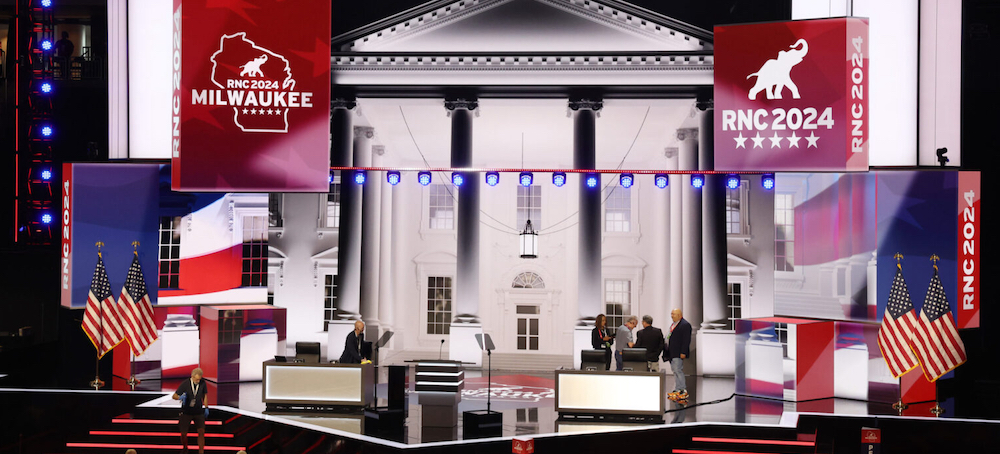 Workers prepare the stage for the Republican National Convention at the Fiserv Forum on July 13, 2024, in Milwaukee, Wisconsin. The National Republican Senatorial Committee brought a legal challenge against limits on coordinated spending when JD Vance ran for Senate in 2022. (photo: Scott Olson/Getty Images)
Republicans had asked the court to strike down restrictions on how much political parties can spend in coordination with candidates.
The 6-to-3 decision, divided along ideological lines, is a major victory for Republicans and could undercut one of the Democrats’ financial advantages going into the midterm elections.
The question before the justices was whether current federal limits on such spending — called coordinated party expenditures — violate the First Amendment. During oral arguments, Noel J. Francisco, a lawyer for the National Republican Senatorial Committee, which brought the legal challenge, told the justices that such limits were “at war” with previous decisions by the court that have found that restricting how money can be spent in politics amounts to limiting speech.
In the lead-up to the midterm elections, the ruling is likely to help Republicans, shrinking the advantage of Democrats in a crucial area: broadcast advertising time.
Federal law requires that broadcasters must offer low advertising rates to political candidates, but they are not required to offer the same low rates to super PACs.
In recent years, Democratic candidates have often raised more money than Republican candidates, particularly through small-dollar contributions online. The court’s decision will allow Republicans to send more money to candidates, likely allowing them to qualify for these same lower advertising rates.
Justice Brett M. Kavanaugh, writing for the majority, agreed that the court’s campaign finance precedents required it to strike down a law that had established those limits and to overrule a 2001 decision that had upheld the limits.
Justice Kavanaugh wrote that Tuesday’s decision “treats all political parties equally.”
“Whether the Democratic Party, the Republican Party or other parties,” he wrote, “all political parties and candidates going forward can compete equally under the same rules regarding coordinated expenditures and can structure their fund-raising, spending and political speech on a level playing field as they see fit within the law.”
In dissent, Justice Elena Kagan wrote that the ruling was a recipe for corruption, allowing donors to skirt contribution caps to candidates. “With no limits on coordinated expenditures,” she wrote, “the party can serve as the candidate’s checking account.”
She said that the upshot of the court’s campaign finance decisions was “a legal regime increasingly unable to stop political corruption, and thus to preserve our institutions’ democratic legitimacy.”
Got a news tip about the courts? If you have information to share about the Supreme Court or other federal courts, please contact us.
Sign up for the Docket newsletter. Adam Liptak helps you make sense of legal developments in a turbulent time.
The Trump administration had supported the Republican groups in the case, National Republican Senatorial Committee v. Federal Election Commission, asserting in court filings that the federal law “abridges the freedom of speech” under the court’s “recent First Amendment and campaign finance precedents.”
The case was the latest in a series of efforts to chip away at campaign finance regulations that were enacted after Watergate to lessen the influence of money in elections. In 2010, the Supreme Court struck down limits on independent spending by corporations and unions in Citizens United v. Federal Election Commission. That decision cleared the way for a flood of new money to enter politics and set the stage for further challenges to spending limits.
The coordinated spending case had been closely watched as the midterm elections approached.
The case began in 2022, when JD Vance, then a candidate for the Senate in Ohio, sued to challenge the campaign coordination limits. He was joined by several Republican groups. The Biden administration defended the limits, and a panel of federal judges agreed they were legal.
After President Trump returned to office, the federal government flipped sides in the case and backed the Republicans challenging the spending caps.
With the government no longer defending the spending limits, the justices appointed the veteran Supreme Court litigator Roman Martinez to argue on their behalf. He argued the justices should dismiss the case as moot because Mr. Vance is no longer running for office.
Democratic groups intervened in the case, urging the court to uphold the spending limits. They warned that overturning the law would create a system in which political parties would pay candidates’ expenses for everything from flower arrangements to electric bills.