Senate Votes to Fund ICE for the Rest of Trump’s Term
Theodoric Meyer and Jarrell Dillard The Washington Post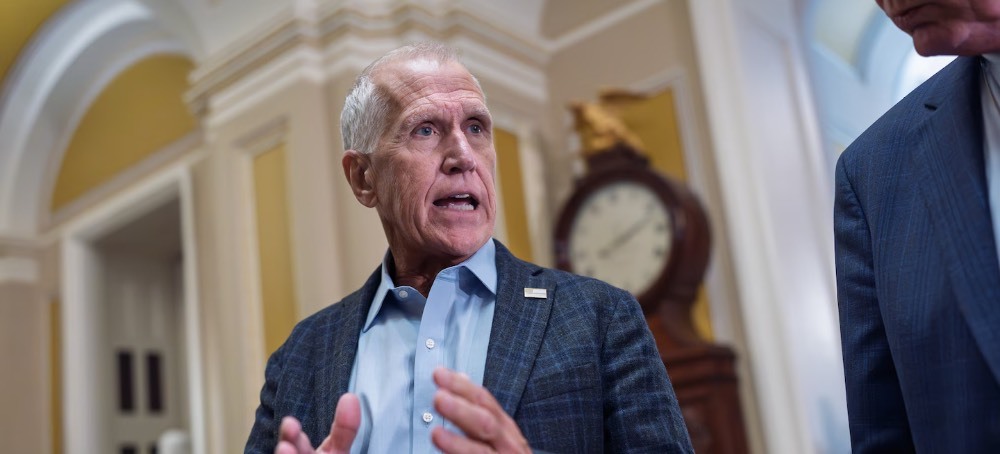 Sen. Thom Tillis (R-North Carolina) heads to the Senate chamber on Capitol Hill in Washington on Tuesday. (photo: J. Scott Applewhite/AP)
ALSO SEE: US Senate Passes $70 Billion ICE Funding; Fails to Ban Trump’s ‘Anti-Weaponization’ Fund
Senators rejected amendments meant to bar the president from creating a $1.8 billion fund that some lawmakers said could be used to pay Jan. 6 protesters.
The bill passed 52-47 along party lines, with Sen. Lisa Murkowski (R-Alaska) joining Democrats in opposing it. Sen. Michael Bennet (D-Colorado) did not vote.
The early-morning vote, which followed an 18-hour marathon of amendment votes, was one of the final steps in Republicans’ push to circumvent the appropriations process and direct nearly $70 billion to two immigration enforcement agencies without Democratic votes. The bill still must pass the House before it reaches Trump’s desk.
The bill’s prospects were endangered last month by the Trump administration’s decision to set up a controversial fund to pay people who claim they were wrongfully prosecuted or investigated.
The fund alarmed many Senate Republicans, who feared it could be used to compensate people convicted of attacking the Capitol on Jan. 6, 2021. Republicans refused to advance the bill until the administration addressed their concerns.
Todd Blanche, the acting attorney general, tried to quell those concerns Tuesday in testimony before the House Appropriations Committee, saying the administration had abandoned plans to set up the fund. But Trump himself has not said the fund is dead, telling reporters that he was unsure of its fate.
“Republicans are trusting the word of Todd Blanche, who built a career on lying, that the administration will just drop this slush fund,” Senate Minority Leader Charles E. Schumer (D-New York) said Thursday on the Senate floor.
Democrats offered an amendment meant to bar the administration from creating such a fund, forcing Republicans to take a politically uncomfortable vote five months ahead of the midterm elections.
The amendment would have sent the bill back to committee with instructions to add language safeguarding the Justice Department “from partisan political influence and corruption.”
Senate Majority Leader John Thune (R-South Dakota) held the amendment vote open for more than three hours as he huddled with wavering Republicans. The amendment narrowly failed, with Republican Sens. Susan Collins (Maine), Jon Husted (Ohio) and Dan Sullivan (Alaska) joining Democrats in voting for it.
All three Republicans face tough races in November. A Fox News poll released Wednesday found former Democratic senator Sherrod Brown leading Husted 53 percent to 45 percent in Ohio’s Senate race.
Some Republicans argued that the fund is politically toxic and pushed to make sure it is not revived.
“Republicans should do the stump speech test on this issue, particularly the ones who are in cycle,” Sen. Thom Tillis (R-North Carolina) told reporters Wednesday. “‘I stand solidly behind an administration that wants to potentially provide compensation to people who assaulted Capitol police officers. I stand fully behind that.’ Test that on the stump and see how it works out for you in November.”
But the Senate defeated every amendment to restrict the fund, including one from Tillis to bar the use of federal funds in connection with the fund, which Democrats argued did not go far enough. The amendment failed on a procedural vote, with 12 Republicans and three Democrats voting for it.
An amendment from Sens. Bill Cassidy (R-Louisiana) and Chris Van Hollen (D-Maryland) that would have set aside $100 million to compensate law enforcement officers who defended the Capitol on Jan. 6 also failed on a procedural vote.
The administration agreed to create the fund as part of a settlement to resolve a $10 billion lawsuit that Trump filed against the Internal Revenue Service over the 2019 leak of his tax records. The settlement also barred the Justice Department from prosecuting any potential tax crimes that Trump, his family or his companies committed before the agreement.
The Senate also rejected an amendment from Sen. Jeff Merkley (D-Oregon) to bar the use of federal funds or private donations to build Trump’s proposed White House ballroom without congressional authorization. Seven Republicans voted with Democrats to take up that amendment, which failed on a procedural vote.
Some Republicans tried to keep the focus on the bill as Democrats forced a barrage of amendment votes.
“When all the political statements have been made, we will pass the underlying bill and be one step closer to funding border security and immigration law enforcement for the next three years,” Thune said on the Senate floor before votes started.
The bill would send nearly $70 billion to two federal agencies: Immigration and Customs Enforcement and Customs and Border Protection. The money would fund the agencies through the end of Trump’s term without going through the annual appropriations process, an unusual move that has allowed Republicans to avoid compromising with Democrats.
The bill’s passage is the culmination of a months-long fight over government funding triggered by the killing of Alex Pretti by federal agents in Minneapolis in January during protests against the administration’s deportation operations there. Democrats in Congress refused to fund the Department of Homeland Security, which includes ICE and CBP, unless Republicans agreed to impose new restrictions on federal agents.
The administration negotiated with Democrats for weeks, but the two sides failed to reach a deal. Democrats ultimately agreed to fund the department except for ICE and Border Patrol, leaving Republicans to fund those agencies without their votes.
Republicans are using a special budget process known as reconciliation to pass the bill with a simple majority, evading a Democratic filibuster.
Democrats have argued that the maneuver undermines the filibuster, the long-standing Senate rule that requires 60 votes to advance most legislation. Some Republicans also expressed concern that the move will erode the bipartisan appropriations process, but they have countered that Democrats’ intransigence gave them little choice.
“What we’re doing has to be done,” Sen. Lindsey Graham (R-South Carolina), chairman of the Budget Committee, said on the Senate floor. “I hate that we’re having to use reconciliation to do this, but we have no other choice.”