Senate Republicans Resist Trump’s Bid To Bypass Democrats On Defense Funding
Jarrell Dillard, Theodoric Meyer and Noah Robertson The Washington Post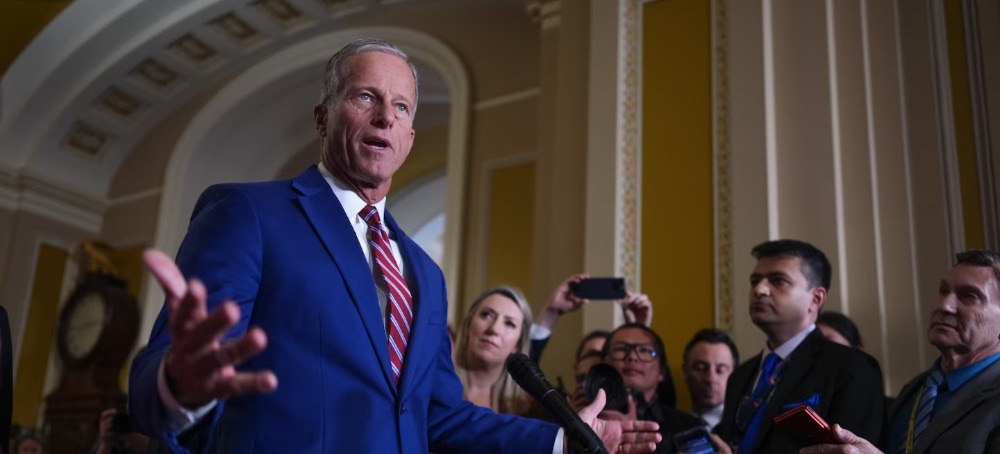 Senate Majority Leader John Thune speaks to reporters after a closed-door caucus meeting on Tuesday. (photo: J. Scott Applewhite/AP)
Senate Majority Leader John Thune (South Dakota) said the GOP would attempt to negotiate a deal to pass the spending package.
“We want to explore all the possibilities for funding the military, one of which would be seeing whether or not there’s an appetite on the Democrat side to do it,” Senate Majority Leader John Thune (R-South Dakota) told reporters Wednesday after meeting with Senate Republicans. “I don’t know that they will. But we think that we ought to at least explore that possibility.”
Though Republicans will first attempt to negotiate a deal with Democrats, both Thune and Senate Budget Chair Ron Johnson (R-Wisconsin) said that a party-line bill is not completely off the table.
Thune’s announcement came after multiple meetings over the past week where GOP senators discussed Trump’s $350 billion request and whether Republicans could come to a consensus. However, passing yet another party-line bill drew concerns from multiple Republicans.
“I’m not for a partisan Republican bill to spend more money or borrow more money,” Sen. Rand Paul (R-Kentucky) said Wednesday. “There’s quite a few of them that I guess did not, were not aware of what happened with the election recently. All the exit polling showed that people were upset about the price of gas and the Iran war.”
Republicans control the Senate 53-47, meaning they cannot afford to lose more than three votes on a party-line bill if every senator is voting. And the party’s margin is set to shrink Dec. 15, when the term of Sen. Jon Husted (R-Ohio) — who was appointed last year to fill Vice President JD Vance’s Senate seat — expires.
Republicans are grappling with how to handle Trump’s request to fund the Pentagon as they reckon with crushing midterm losses that cost them control of both chambers, in part due to voters’ negative sentiment toward the war with Iran.
Some Republicans lined up behind Trump’s renewed call last week for Republicans to go it alone on defense funding, as Democrats have been opposed to sending any money to the Pentagon that could be used toward the war.Ask The Post AIDive deeper
“I think we have a responsibility when people protect us to keep them safe, just like they’re keeping us safe,” Sen. John Boozman (R-Arkansas) told reporters Wednesday. “And if you leave them underfunded, then that creates a huge problem for the people who serve.”
However, some Republican appropriators, including Appropriations Chair Susan Collins (Maine), said they preferred to move funding through the normal bipartisan process.
So far, reaching a deal with Democrats remains elusive, as they have adamantly opposed Trump’s defense budget request. Disagreements over the request has encumbered negotiations on appropriations bills. Democrats are pushing for a short-term funding bill to avoid a government shutdown in December and punt the issue into next year when they will control Congress.
The $350 billion is part of Trump’s broader $1.5 trillion defense budget request for fiscal year 2027. The $350 billion would fund a wide range of military equipment, from F-35 fighter jets to precision missiles. Some of the money would go toward munitions and weapons platforms strained because of the war with Iran.
The reconciliation process, as it’s called, would allow Republicans to send the $350 billion to the Pentagon with a simple majority vote in both chambers, foregoing Democratic support.
Republicans have already passed two reconciliation packages during Trump’s second term, including the One Big Beautiful Bill and another measure that funded immigration enforcement agencies through the end of Trump’s term.
GOP lawmakers already made an attempt at a third reconciliation package before the midterm recess period that was intended to send money to the Pentagon and provide relief for farmers. But the effort fell apart in the Senate as it faced pushback from multiple GOP senators.
Among the top concerns for some Republicans on a third party-line bill is that there is no plan to pay for it, which would add billions to the nation’s $40 trillion debt load.
House Budget Chair Jodey Arrington (R-Texas) said that while he supports the military funding, if Senate Republicans were to pursue the money through reconciliation it would need to include ways to offset the spending. He suggested there are a number of provisions targeting “fraud” in government programs that could be included to save money and avoid a spending package that adds to the deficit.
“I’m worried that they’re going to pass something that just is a clean $350 billion in spending with no offsets,” Arrington told The Washington Post on Wednesday. “And that would be a very hard pill for many Republicans to swallow given the alarming levels of not only debt but what that would do to put upward pressure on already high interest rates and inflation.”