Sanders to Grill Starbucks Founder Howard Schultz in Senate Hearing
Lauren Kaori Gurley The Washington Post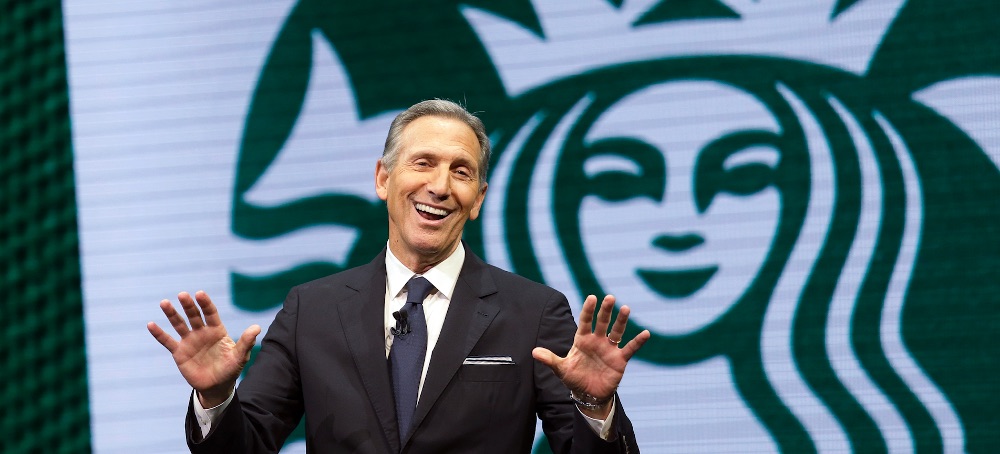 Senators question former Starbucks CEO Howard Schultz on March 29 over alleged illegal union busting efforts by the coffee giant. (photo: Elaine Thompson/AP)
The founder denied the coffee company has broken any labor laws
When asked by Sanders when Schultz planned to follow a National Labor Relations Board order for Schultz to read workers a message about their labor rights, Schultz said, “Starbucks coffee company did not break the law.”
But Sanders kept the pressure on Schultz during the tightly packed hearing.
“Over the past 18 months, Starbucks has waged the most aggressive and illegal union-busting campaign in the modern history of our country,” Sanders said. “That union-busting campaign has been led by Howard Schultz, the multibillionaire founder and director of Starbucks who is with us this morning only under the threat of subpoena.”
Sanders asked Schultz about his involvement in a long list of findings from the NLRB that Starbucks had violated labor law.
Schultz said he was not involved in decisions to discipline or fire union activists or close unionizing stores, though he said he had conversations that may have been interpreted as threatening to workers. Schultz told a pro-union barista during a meeting in Long Beach, Calif., last year, “If you hate the company, you can go work somewhere else.”
Schultz initially declined to testify at Wednesday’s hearing, but he relented after Sanders, the committee’s chairman, threatened to hold a vote earlier this month to subpoena him. Schultz stepped down from his role as Starbucks chief executive last week and passed the reins to Laxman Narasimhan.
Schultz’s testimony highlighted Starbucks’s record of being among the first major employers to begin providing industry-leading benefits, including stock options, health care, and 401(k) retirement benefits.
“We are a different kind of public company that balances profitability with social conscience,” Schultz said. “Aspiring to achieve that vision has been my life’s work.”
Schultz also talked about growing up living in poverty in public housing in New York City “without resources or adequate benefits.” When his father, a delivery driver, slipped on ice, he was fired, Schultz said.
“The image of my dad, lying on the sofa and immobilized in a body cast has been burned into my memory,” Schultz said. “I decided at an early age that if I ran a business, it would be a company based on respect and shared success, unlike the company that had fired my dad.”
Scores of Starbucks corporate employees and union baristas flew in from around the country to attend the hearing. The corporate employees donned shirts that said “We belong together,” while the baristas shirts’ said “We are the union.”
The push to unionize Starbucks is one of the most high-profile labor campaigns in decades. Starbucks workers since late 2021 have voted to unionize at almost 300 locations out of more than 9,000 corporate-owned stores in the United States.
But organizers of the Starbucks Workers United campaign accuse Starbucks of stalling contract negotiations and continuously retaliating against employees engaged in labor organizing.
The committee’s Republicans took a softer approach to Schultz, praising the company’s contributions to the U.S. economy. Sen. Bill Cassidy (R-La.) said that while Schultz is not above the law and workers have the right to unionize, the NLRB “is operating in violating its own operation and procedure,” noting allegations that it had collaborated with Starbucks Workers United.
“I am not here to defend Starbucks,” Cassidy said. “But let’s not kid ourselves. These hearings are anything but a fair and impartial proceeding. It is not surprising that Mr. Schultz was reluctant to testify.”
The NLRB has issued 83 legal complaints against the company so far in response to 513 unfair labor practice charges filed with the board, according to agency spokeswoman Kayla Blado. Nearly 100 charges have been filed with the NLRB against Schultz himself over statements he made during meetings with union members around the country, Sanders’s press office said.
Starbucks “strongly denies any wrongdoing and has committed to exercising its right to defend itself” against claims that it violated labor law, company spokesman Andrew Trull said.
“In many of these proceedings, the NLRB is attempting to use cases against Starbucks to change existing labor law — not because Starbucks is failing to comply with the law as it exists today,” Trull said. In response to claims that the company is anti-union, Trull said that the company prefers “a direct relationship with our partners.”
Dozens of Starbucks union members from around the country are expected to attend the hearing on Capitol Hill, and two Starbucks union members will testify. One of the workers, a veteran and parent, was fired after leading a union drive at his store in Augusta, Ga., the union said.
Labor experts said Wednesday’s session could sway the public’s view of Starbucks, a company that has long prided itself on its robust benefits package and professed commitment to social issues such as abortion and LGBTQ rights.
Sanders and Schultz both have working-class Brooklyn origins, but they hold clashing visions for labor relations in the United States.
Schultz, who considered seeking the Democratic presidential nomination before endorsing Joe Biden in the 2020 election, characterizes Starbucks as an entity that cares deeply for its workers. But he sees unionization as an existential threat to the company that he built.
Meanwhile, Sanders, a self-proclaimed socialist whose multiple bids for the Democratic nomination included a run against Biden in 2020, has spent decades fighting for unions and the labor movement. He has been an outspoken critic of Starbucks’s stance toward labor organizing.
Starbucks and the union have had roughly 85 bargaining sessions since October. The meetings have often stalled over a disagreement about whether to allow union members observe remotely by Zoom, which the company opposes.
NLRB prosecutors said this week that Starbucks violated the law by refusing to bargain if some workers observed over videoconferencing technology. A company spokesperson previously told The Washington Post said Starbucks has not attempted to delay bargaining and that the company has come to the table as legally obligated.
Sanders said that if Starbucks reaches a contract with employees, other companies around the country would be less inclined to fight unionization campaigns using illegal tactics.
“If on the other hand, Starbucks can get away with breaking the law and not negotiating a contract, other large companies will say ‘Hey, we can break the law, as well,’” he said.