Russia's 'Dirty Bomb' Ploy
Tom Nichols The Atlantic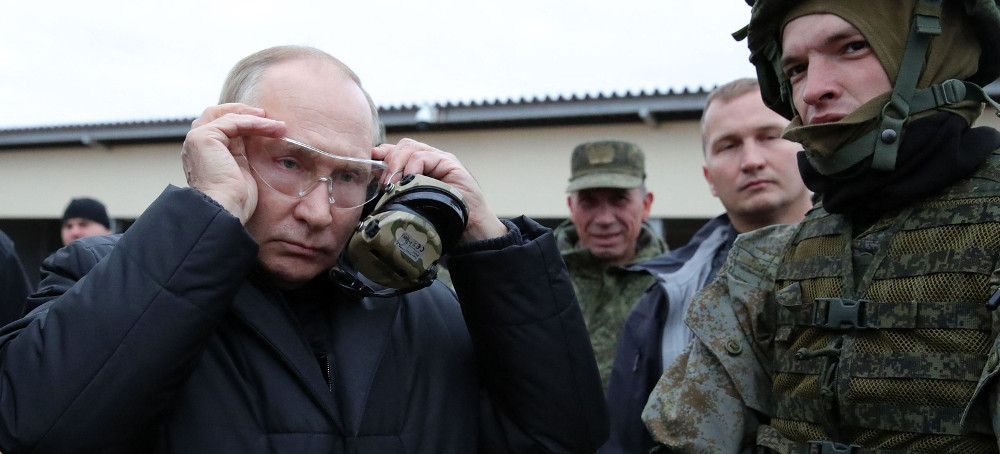 Vladimir Putin meeting Russian soldiers during an October 20 visit. (photo: Mikhail Klimentyev/Sputnik)
ALSO SEE: Ukraine's Top Allies Warn Russia About 'Dirty Bomb' Claims
ALSO SEE: 'Dirty Bomb' US Dismisses 'Transparently False'
Russian Claim That Ukraine Plans to Use Weapon
By groundlessly suggesting that Ukraine is preparing to use a “dirty bomb,” the Kremlin is testing the West—and potentially provoking a nuclear standoff.
Rationalization for Escalation?
Over the weekend, Russian Defense Minister Sergei Shoigu called his counterparts in the United States, the United Kingdom, France, and—interestingly—Turkey. In these calls, Shoigu claimed that Ukraine is about to use a “dirty bomb,” which would ostensibly allow Russia to open the door to retaliation with nuclear weapons. Today, General Valery Gerasimov, the chief of the Russian general staff, called his American and British counterparts to press the same case.
What is a dirty bomb, and what was the point in making this claim now?
A dirty bomb isn’t actually a nuclear bomb. It is, to use the clunky term professionals apply to it, a radiological dispersal device, which is just another way of saying that it is a conventional explosive wrapped around a lot of dangerous radioactive material. When the bomb explodes, it is not a nuclear detonation, but only the normal explosion of something like TNT or other munitions. The difference is that this conventional explosion spreads around a lot of radioactive material, poisoning anyone nearby and rendering the area highly dangerous—perhaps even impassable. The gunk inside a dirty bomb could be anything that is highly radioactive: nuclear reactor waste, the leftover pieces of a nuclear weapon, even radiological materials from a hospital.
This dirty-bomb charge could be part of the preparation for a Russian “false flag” operation, in which the Russians will explode their own dirty bomb, perhaps in the occupied territories of Ukraine or close to the Russian border; blame Ukraine; and then demand that Ukraine surrender or face nuclear retaliation. It could also be a way of trying to scare off Ukraine’s Western supporters with threats of escalation.
Let’s hope that this is just the Kremlin trying to engage in scare tactics. If, however, Putin and his circle are really considering a dirty-bomb provocation, it is likely because they would see such a plot as solving multiple problems at once. Russia would probably try to flip the script, and go from an aggressor likely guilty of multiple war crimes to the victim of a nuclear “event.” It might then issue an ultimatum to the Ukrainians that elevates the war to a nuclear crisis (which is probably the only way Moscow thinks it can win, now that the Russian army lies in pieces on the battlefield).
The Russians, in such a gambit, would likely be betting that a faked dirty bomb would alleviate the “first use” stain from any Russian decision to attack—or as they would almost certainly say in this scenario, “retaliate”—with a nuclear weapon. With nuclear weapons now in play, the West would have to decide just how much to commit to nuclear deterrence on behalf of Ukraine.
Why are the Russians now pushing this plot? I suspect the attempt to put nuclear issues back in play is rooted in Russian President Vladimir Putin’s realization that he has, yet again, humiliated himself in his harebrained scheming to prosecute a war he’s been losing since its first days. In particular, his attempt to conscript 300,000 Russian males has been a political disaster; some reports suggest that twice that number of Russians have already fled their country, and even Putin has admitted to “mistakes” and is winding back at least some of the mindless dragooning of his young men.
Thus, threatening this dirty-bomb ruse and risking subsequent escalation makes sense if you’re in a bunker under the Kremlin (which is why I think it’s Putin’s reasoning), but in reality, it is utterly unhinged and reckless.
For one thing, no one is going to believe the dirty-bomb story. The Americans, French, and British have already told the Russians as much. (We do not yet have a readout on the response from the Turks, but I cannot imagine they’re buying this fantasy any more than the other NATO allies.) That may not matter to Putin, who would probably care only that enough Russians believe it. But that plan, too, may backfire: One Russian-made dirty bomb followed by a nuclear crisis might panic the Russian public more than Putin expects.
And although the Russians may think that calling their nuclear attack a “second” use in retaliation will get them off the hook, it won’t. Putin is likely betting that the world will back off after some routine condemnations, but the story around the dirty bomb will collapse pretty quickly, and Russia will stand revealed as a nuclear aggressor, which might finally lead the rest of the world to the conclusion that this regime is an intolerable threat to global peace and security.
Putin could then find himself in a nuclear standoff with the West that neither he nor we want, but that will come anyway because of his own inability to foresee the consequences of his actions. (Ironically, one of the reasons the Russian president is in this mess is because he has a remarkable and completely unwarranted confidence in his ability to control events.) I do not want to speculate on how such a larger crisis could occur, but if the Russians choose this desperate path, there are multiple roads that could lead to a major East-West nuclear confrontation.
Putin, once again, is gambling with the lives of his own people and the world, and we can only hope that Moscow now understands—through warnings from Washington, London, Paris, and (ideally) Ankara—that we see through this attempted fraud, and that such escalation will only hasten Russia’s defeat and endanger the stability of the Russian nation itself.