Rape as a Weapon of War
Timothy Snyder Substack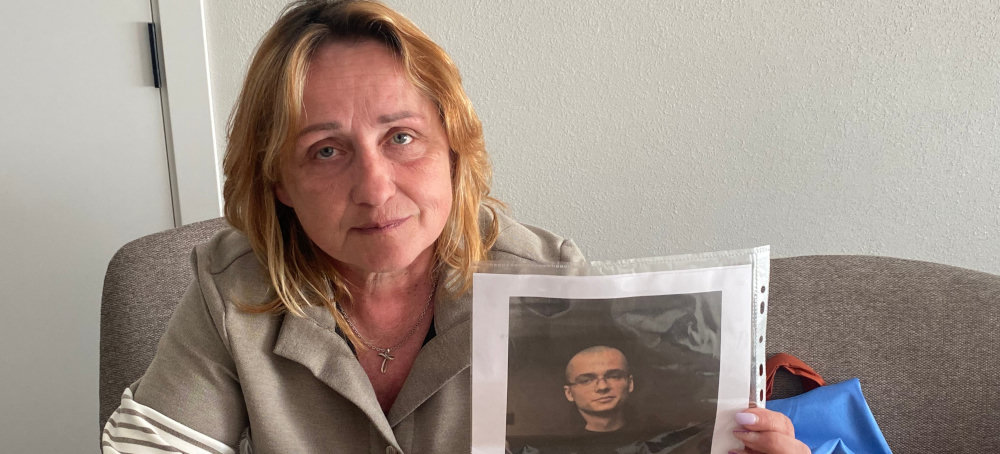 Olena Zaitseva holds a photograph of her son Vladyslav. (photo: Timothy Snyder)
Every now and then I will publish a guest post on an important topic. Today we encounter the wartime reporting of Sara Cincurova.
This text includes sensitive details about sexual violence during the Russian invasion of Ukraine.
For about two years, as a freelance journalist, I have been documenting Russian use of rape as a weapon of war against Ukrainian civilians. As we mark four and a half years since Ukraine was plunged into war, the immense use of sexual violence remains an underreported element of this conflict.
Ukrainian women and men have experienced extensive and concerted abuse at the hands of the Russian army since its initial occupation of Eastern Ukraine, including Crimea and the Donbas region, in 2014 and more intensively since the full-scale invasion in 2022.
Women have been detained and raped or brutalized with weapons and other objects while held captive illegally; others experienced sexual violence perpetrated by soldiers in their own homes. Still others had to watch their loved ones being killed in front of their eyes. Earlier this year, I wrote for the New York Times on the basis of testimonies of eight Ukrainian women who spoke with me about their experiences, both in occupied towns and villages and in Russian captivity.
Men have reported sexualized violence and torture in Russian captivity, with frequent use of electric shocks to their genitals, among other forms of abuse.
These are not crimes of opportunity or isolated incidents, but rather a systematic attack against both women and men under occupation or in captivity. The UN Independent International Commission of Inquiry on Ukraine, which is examining violations of international law arising from Russia’s war against Ukraine, found in 2024 that “the war crime of rape had been committed, which also amounted to torture.”
The UN investigators noted that frequently “the perpetrators were Russian soldiers, who had identified women in a vulnerable situation during one or several initial searches of their houses” (my emphasis).
In other words, when Russian soldiers seek their prey, even the most defenseless people can become targeted. Rape at the hands of the Russian troops was, and still is, perpetrated against pregnant women, persons with disabilities, children, and the elderly, who often receive less media coverage, and whose stories, often too painful and sensitive, rarely make the front pages.
I keep thinking about Halyna, a kind, energetic Ukrainian retiree who was raped in her home in 2022: A Russian soldier who could have been her son or grandson forced her to walk around her garden naked in the freezing cold, raped her, and violated her with weapons, mocking her for being old. And as she was in an occupied village, she had to suffer from her injuries for a long time without access to medical care. But today, Halyna has healed.
I also met Olena Zaitseva, who was a pregnant woman unlawfully detained and imprisoned together with her then 18-year-old son Vladyslav in 2019 in their home village in eastern Ukraine, an area occupied by Russia since 2014. The Russian soldiers raped Olena and caused her ongoing gynaecological and other health issues, including the loss of her pregnancy. After nearly four years of torment in Russian captivity, Olena was freed in a prisoner exchange in 2022. But she has not seen her son since 2019, when they were both imprisoned. Vladyslav is still being held, now for the eighth consecutive year, and is likely regularly tortured, as are other civilian detainees. Olena shared the painful details of her abuse and imprisonment with the press in the hope that one day, by some miracle, she will see her son again.
Based on my experiences gathering the testimonies of more than sixty survivors in the past two years, sexual violence has become one of Russia’s defining and systemic weapons of its war with Ukraine. We will likely never know the real number of victims in Ukraine but sexual violence is endemic to armed conflict and is on the rise globally. According to the UN, cases of wartime sexual violence rose by more than 25% in 2024 over 2023 — reflecting the scope of global warfare and conflicts erupting around the world.
Some survivors are not only victims of rape, but also of human trafficking. Another woman I interviewed, Olena Yahupova, was abducted from her home and held in a forced labor camp near the frontline of southern Ukraine’s Zaporizhzhia region, where Russian soldiers forced her to work alongside male detainees by day, digging trenches in the freezing cold. By night, she and other women were victims of brutal sexual violence, she said. For two months, Olena endured torture, rape, and inhumane treatment. After her liberation, she was diagnosed with a traumatic brain injury, hip and shoulder injuries, and post-traumatic stress disorder. She chose nonetheless to share her story with the media.
Unfortunately, testimonies like hers, which reveal the harsh reality of Russian labor camps and specifically the Russian use of gender-based sexual violence, are still rarely shared on account of the immense trauma they carry. The patterns of despite in the treatment of captive are however clear.
Another female survivor whom I interviewed last year told me a similarly harrowing story in the same region near the frontline. She and a Ukrainian man, both civilian captives, had also been forced to dig trenches for the Russian army, and, as a woman, she had also been forced to serve as a sex slave. “I will never be able to fully recount the scale of the horrors I went through,” she said. The silences that surround her story are characteristic of the Russian war strategy to break Ukrainians psychologically. Like so many survivors in Ukraine, she struggles with invisible injuries, though they did not come from drones, missiles, or artillery.
Hundreds of women and children, as well as large groups of detained civilian men, have officially reported being victims of sexual abuse and wartime rape since 2022 to the Ukrainian Prosecutor General’s Office. As of July 31, 2026, the office has been able to officially record 250 cases of rape committed against women, and 24 cases against children, although the real numbers are certainly far higher — this official number cannot even serve as a basis for estimates. Help is available for victims, provided by the government, the UN, and NGOs. Yet large groups of survivors live with their traumas in silence, trying to heal even as the war enters a new, more brutal phase with frequent ballistic attacks in Kyiv and elsewhere.
I have been following the story of young woman I will call Iryna (to protect her identity) for several years. Iryna had a child conceived as a result of wartime rape. She fled the violence in her frontline village, but soon found herself homeless, unable to pay the bills or rent an apartment without a stable job. Four years after the rape, she has no choice but to live with a violent man in her new village, as his house is the only place of “safety” she can afford — the landlord, albeit abusive, doesn’t ask her for large sums of money. Iryna is trying desperately to leave, which is particularly hard for a poor single mother in a war zone — and her options became even more limited since she was diagnosed with a potentially life-threatening condition.
NGOs such as Truth Hounds and International Partnership of Human Rights have also documented staggering levels of sexual violence perpetrated against men in places of captivity, including genital electrocution, rape, and castration. Based on 19 interviews I conducted with male survivors of sexual violence in captivity (imprisoned in Russia and occupied Ukraine and held between 2022 and 2026), all described the same pattern of abuse, as well as the same types of slang used to degrade and annihilate the Ukrainian people as a nation. All the men described Russian troops as being “prepared” for the captivity with specific “equipment” in advance — mostly old field army telephones (such as Tapik) or other electrocuting devices such as electric shockers, with which they would send electric shocks to the captives’ genitals, usually from the first day of detention. According to numerous testimonies recorded by NGOs that are consistent with my findings, the Russian soldiers also frequently force Ukrainian men to rape or harm fellow prisoners or threaten to castrate them in order to “stop Ukrainians from reproducing”. A doctor that I recently spoke to told me he had already treated at least one male victim of castration, while other male survivors of Russian captivity struggle to have their own children.
Anastasiia, a young woman in her twenties, spent three years searching for her father Oleksandr, a Ukrainian prisoner of war and defender of Mariupol and Azovstal, who was held in some of the most brutal prisons in Russia, such as those in Taganrog and Mordovia. He was subjected to ongoing sexual violence and electric shocks. Upon his liberation in 2025, he reunited with Anastasiia, his only daughter, whom he’d raised alone, in a beautiful family reunion. Shortly after his liberation, he agreed to sit for an interview with me: He was motivated, smiling, hopeful, and incredibly kind and open despite what he had experienced. Six months after our interview, Oleksandr died as a result of his injuries, ongoing health issues, and incessant psychoses, during which he saw and heard the voices of Russian prison guards everywhere. Despite her loss, Anastasiia is sharing her father’s story and helping to search for soldiers and civilians who remain missing.
As the war rages on, and even as ballistic missiles now regularly pummel Anastasiia’s neighborhood in Kyiv, she and many other survivors and their families cling to hope — the hope that their stories will resonate with readers around the world and perhaps bring them at least some form of justice and recognition. It is important not to forget these testimonies, essential in understanding the dynamics of this war, but also its human face and its human toll.
Sara Cincurova is a journalist working on a book on the sexual violence by Russian soldiers against Ukrainian civilians. You can find her work at saracincurova.com and follow her on Instragram (@sara_cincurova). She is also the author of the two photographs, which are used with the permission of Olena Zaitseva and Olena Yahupova.
If you or someone you know has experienced conflict-related sexual violence (CRSV) or needs support, the following tools and services suggested by UN Women.