Rachel Levinson-Waldman, Matthew Ruppert | DHS’s Domestic Surveillance, Data Collection, and Analytics Tools
Rachel Levinson-Waldman and Matthew Ruppert Brennan Center A woman uses her phone. (photo: Getty Images)
Fueled by a budget boom, the Department of Homeland Security is expanding its technological arsenal, with little oversight or transparency around how these tools are used.
These tools include capabilities such as video surveillance via cameras and drones as well as the expanded collection of biometric information, most notably via facial recognition. The department also obtains volumes of data from commercial data brokers and other outside entities that can be used to build exhaustive profiles on individuals. And it has acquired tools that can supply detailed information on the location of people’s phones and cars, which can reveal their movements, habits, and associations. When that isn’t enough, DHS has technology to access the content of phones, including messages, contacts, and photos. The data collected with these tools feeds into centralized repositories that can be searched and analyzed using AI-enabled software, generating leads, dossiers, and targets for immigration or law enforcement action.
While the justification for obtaining these tools is often to support criminal investigations or border security, the technology is capable of being turned on anyone. Immigrants and those participating in First Amendment–protected activities are among the targets. It is worth noting that DHS policies typically prohibit taking action solely on the basis of constitutionally protected activities like speech, association, or dissent, and DHS leadership has stated to Congress that it is committed to protecting constitutional rights. Even that statement left significant ambiguity, however, and the articles listed in the table below strongly indicate that the department has expanded its targeting of protesters, whether in violation of its own policies or through creative arguments and loopholes.
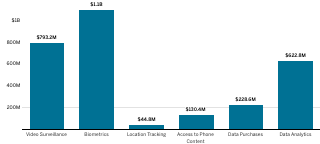
Contract obligations represent all funds that DHS has promised to pay vendors, including amounts that have not yet been paid out.
Source: USAspending
For each type of tool, the table below details the vendors with which DHS has contracted, the DHS subcomponents involved in each contract, the amounts spent or promised, the DHS policies governing the technology’s use, and news articles and reports about the technologies. It also highlights relevant entries in DHS’s public AI use case inventory, although the inventory discloses just a portion of the ways the department uses AI. A detailed breakdown of every contract included in this analysis is available here, and the methodology used to obtain the data is explained at the end of this resource.
As the table details, DHS has committed more than $2.9 billion to surveillance, data collection, and data analytics tools since the start of the Biden administration. While the contracts we collected suggest that spending on surveillance technology has increased substantially since 2021, particularly in the first half of 2026, it is challenging to quantify the extent of this surge due to the opacity of federal contracting data. What we do know for certain is that DHS’s spending in key areas during this time period has been immense.
Spending on biometrics has far outstripped the other identified categories in recent years, with more than $1 billion spent or promised. This spending is driven by three types of contracts: the expansion and maintenance of DHS’s massive biometrics database through contracts with General Dynamics, Peraton, and Science Applications International; the collection of biometric and biographical data from applicants for immigration-related services, via contracts with Amentum and Pluribus Digital; and new tools for mobile biometric matching from NEC Corporation, which created Mobile Fortify, and BI2 Technologies, provider of iris recognition. Combined, these contracts undergird DHS’s ability to identify individuals by their biometric identifiers, with agents in the field gaining access to this capability and reportedly turning it on protesters and observers.
While privacy documentation for Mobile Fortify, one of the tools that has received the most public attention, indicates that it is intended to be used to identify undocumented persons who are eligible for removal, it also notes that the technology can be used to collect information about anyone, including U.S. citizens, and that DHS will keep all photos for 15 years. At the same time, DHS has taken down its policy on the use of facial recognition, leaving it unclear what policy, if any, governs the department’s use of this powerful technology.
Video surveillance has also received significant funds since 2021. The bulk of this spending has been on Customs and Border Protection’s (CBP’s) drone program, which has promised more than $675 million to General Atomics across three contracts. While CBP has publicly described its unmanned aircraft program as providing support for the agency’s mission at the border, in maritime areas, and overseas, the second Trump administration has deployed drones in the interior to assist with immigration raids and monitor protests. Drone footage of protests has even made its way into recent DHS social media posts.
The third largest category of spending is data analysis tools, which ingest, organize, and provide insights from the troves of information DHS collects. Palantir has been providing data analysis tools for more than a decade, but the tools it has developed during the current administration are even more powerful. For example, a new Palantir-made software called Enhanced Leads Identification and Targeting for Enforcement (ELITE) maps immigrants’ locations and connects this to detailed information about individuals to inform where agents conduct operations, facilitating mass deportations. At the same time, there has been a dramatic increase in spending commitments to the company, rising from $20.4 million in 2024 to $162.2 million so far in 2026.
Palantir isn’t the only recipient of substantial government funding to build data analysis tools. Booz Allen Hamilton, Acuity, and Alethix all received tens of millions of dollars to contribute to an AI-enabled tool, the Repository for Analytics in a Virtualized Environment (RAVEn), that allows investigators to search and combine information from multiple databases to create detailed profiles on individuals. RAVEn, which was designed to perform complex data analysis, streamlines ICE’s immigration and criminal enforcement and could facilitate surveillance and the development of dubiously grounded criminal charges against protesters. These companies, along with the other leading recipients of DHS spending on surveillance technology, are listed in the figure below.
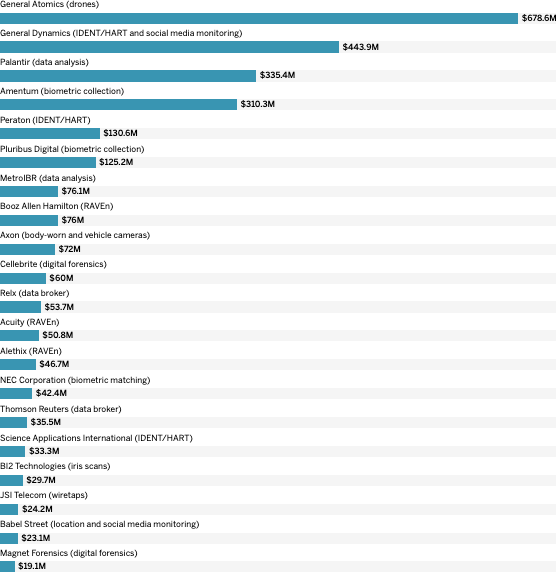
Intermediary sellers, such as Panamerica Computers, are excluded. Contract obligations represent all funds that DHS has promised to pay vendors, including amounts that have not yet been paid out.
Source: USAspending
The department’s capacity for these expenditures has been supercharged by the massive budget boosts Congress has granted DHS, especially ICE and CBP. It is critical that Congress reassert its control over the purse and investigate the department’s acquisition and use of these powerful tools.
Notes on the table below: First, the data about vendors and expenditures comes from the federal government’s publicly available database of contracting information. However, contract descriptions are sparse, technology is often purchased through intermediaries,1 and there is no way to filter by surveillance-related contracts, making it challenging to gather a full picture. As a result, the listed costs represent the minimum amount DHS may have spent on these tools. Additionally, some contracts are for a single tool or a set of tools that could fall into multiple categories. Nevertheless, each contract is listed under just one primary category to avoid repetition.
Second, the table below includes several acronyms. PIA refers to Privacy Impact Assessment and PTA refers to Privacy Threshold Analysis, documents that federal agencies are required to produce for each computer system that collects personally identifiable information in order to identify privacy risks and explain how they are mitigated. ICE consists of two units: Enforcement and Removal Operations (ERO), which is responsible for arresting, detaining, and deporting immigrants within the United States, and Homeland Security Investigations (HSI), which is responsible for investigating transnational crime, although in practice, many HSI agents have been pulled into interior enforcement.
The other subcomponents of DHS referenced in the table are: Customs and Border Protection (CBP); U.S. Secret Service (USSS); the Office of Intelligence and Analysis (I&A), the intelligence unit for the department; the Federal Protective Service (FPS), which is responsible for protecting federal facilities, though it operates far beyond those boundaries; the Science and Technology Directorate (S&T), which coordinates research and development of new technologies; and U.S. Citizenship and Immigration Services (USCIS), which handles applications for immigration-related services, such as changing visa status or obtaining a green card.
Methodology
This project aims to catalogue and present as many contracts as possible in which DHS purchased technology that is designed to, or can be used to, collect information on individuals or groups; purchased actual data about individuals or groups; or purchased infrastructure or software for analyzing and making use of this information. Databases simply for storing this information were not included.
The resource includes funds that were obligated during the Biden and second Trump administrations (i.e., since January 20, 2021). It focuses on technology that can be used in the interior. It thus does not include stationary technology installed at the borders or points of entry and is limited to subcomponents of DHS that operate in the interior (ICE, CBP, USSS, USCIS, I&A, and FPS) and portions of DHS headquarters that supply or assist those components (S&T, OBIM, the Office of Procurement Operations, and the Chief Information Officer). It does not include technology only used to screen individuals or commercial items coming from abroad, such as that used exclusively by CBP’s National Targeting Center. Also excluded are technologies related to immigrant detention or alternatives to detention.
To identify contracts on USASpending.gov that are potentially relevant, we used four primary strategies: reviewing news articles that identify and describe contracts with the department; reviewing prior Brennan Center work that identified vendors of surveillance technology; reviewing lists of vendors from similar projects (including the Electronic Frontier Foundation’s dataset of border vendors, the international Surveillance Watch, and the Tech Behind ICE report by Mijente, Surveillance Resistance Lab, and Just Futures Law) to identify relevant companies; and searching USASpending and the now-defunct fpds.gov for keywords such as “biometric,” “drone,” “BWC,” and “digital forensic.”
Once we identified potentially relevant contracts, we reviewed them to determine first whether the contract or public reporting provided sufficient detail to allow us to conclude with reasonable certainty what types of services or functionalities the contract covered and whether the contract fit the above criteria. A number of contracts failed at the first step due to the vagueness of their public descriptions (e.g., “technical investigative equipment upgrades”), which made it impossible to determine what function or functions the vendor was providing. Contracts with vendors that are usually intermediaries selling others’ technology and that had vague contract descriptions (e.g., just “license”) were excluded, as were contracts with technical descriptions whose meanings could not be determined (e.g., “elastic (ELK) node subscriptions”). When the item, software, or service purchased could be determined, contracts that fit the above scoping criteria were included in the final analysis.
All the contract values listed in this piece are the obligated funds from the included contracts, drawn directly from USASpending. “Contract obligations” means all funds that DHS has promised to pay vendors, including amounts that have not yet been paid out. Only funds related to surveillance technologies, as defined and laid out here, were included; funds provided to the same vendors but for other types of products or services were not included.
We recognize that not all the suppliers or vendors listed here contracted with DHS with the intent of furthering the department’s broad-reaching deportation ambitions, its targeting of observers and protesters, or other activities that have sparked concern from the public and lawmakers. The piece is intended to highlight the department’s acquisition and use of these technologies.
Endnotes
2: Atlantic Diving Supply and WS Darley & Co are often intermediaries selling technology made by other companies. While these contracts are likely for the purchase of Skydio or Parrot brand drones, the contract details do not specify the original designer or manufacturer of the drones purchased in these contracts.
3: Affigent is often an intermediary selling technology or software produced by another company. The description of the contract referenced here does not make clear the original designer or manufacturer of the purchased equipment.
4: While the office doesn’t directly interact with individuals targeted by DHS, many of the biometric systems at the department run through the Office of Biometric Identity Management. This centralized office facilitates funding for several contracts and maintains DHS’s main biometrics database, to which many of the department’s collection and matching tools are connected.
5: A negative value listed in this column means that the net contract actions during that year were negative, which results from funding adjustments, early contract cancellations, or contract close-outs that de-obligated payments to the contractor.
6: Panamerica Computers and Enterprise Technology Solutions are often intermediaries selling technology or software produced by other companies. The descriptions of the contracts referenced here do not make clear who is the original designer or manufacturer of the equipment purchased in these contracts.
7: Babel Street makes software to provide information on the content of social media and other web sources in addition to cell phone location information, and the contracts do not always clearly distinguish between these uses. Babel Street has been placed in this section to draw attention to the more unique aspect of its tools.
8: In addition to providing cell phone location information through its Webloc technology, Penlink also provides social media monitoring tools through its Tangles software. Publicly available information on contracts with the company does not specify which tools each contract is for.
9: While generally outside the scope of this resource, sharing of LPR data by state and local police departments with DHS is widespread. For example, DHS has accessed local LPR systems run by the company Flock by having other agencies run searches on its behalf. The International Justice and Public Safety Network facilitates similar information sharing. Under contracts worth nearly $2 million since 2021, the system allows DHS to query vehicle registration and driver’s license information across the country.
10: Thundercat Technology is often an intermediary selling technology or software produced by other companies. The description of the contract referenced here does not make clear the original designer or manufacturer of the purchased equipment.
11: Panamerica Computers is often an intermediary selling technology or software produced by other companies. The descriptions of the contracts referenced here do not make clear the original producer of the purchased software or equipment.
12: Babel Street sells tools for both location tracking and social media monitoring. The company’s contracts with DHS don’t adequately distinguish which tool is being purchased, so all expenditure data for Babel Street is included in the location tracking section. However, the CBP AI Use Case Inventory for Babel is exclusively about its social media monitoring technology and is therefore listed in this section.
13: Thundercat Technology is often an intermediary selling technology or software produced by other companies. The description of the contract referenced here does not make clear the original seller of the purchased product or information.
14: Whooster incorporates social media and other open-source information into the data it provides, but it also relies on data from numerous additional sources.