Putin’s Asymmetric War on Europe
Mark Hertling The Bulwark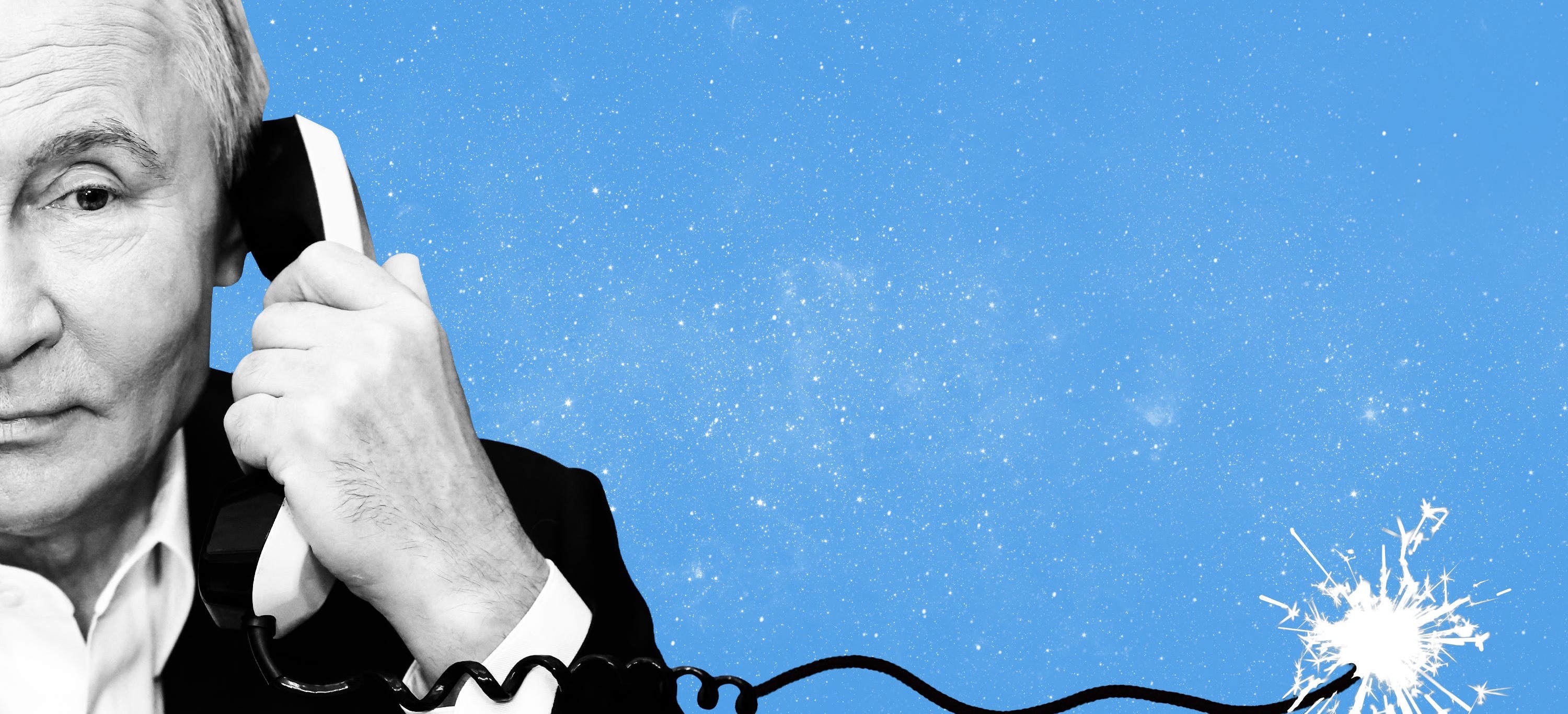 Russian President Vladimir Putin. (photo: Bill Kuchman/The Bulwark)
The recent spate of bomb threats remains unattributed—but Russia’s history of sabotage helps us understand the danger.
According to a November 6 analysis by the Institute for the Study of War (ISW), more than fifty threats against European aviation were reported in just the first few days of the month, and eighteen media organizations were targeted on November 6 alone. By the following week, the messages had begun threatening thousands of schools in Italy, leading to hundreds of evacuations. (Similar threats were directed at schools in Scotland, Northern Ireland, and the Republic of Ireland.) And more threats came this week, with over a hundred Italian schools on Monday receiving emails with the initials “M.A.” warning of the presence of bombs and now something new: poison in the school cafeteria food.
In its analysis, ISW did not blame Russia directly, but instead noted that the threats, which seem to be intended to “disrupt European society and impose economic costs,” were “consistent with Russian approaches.” To understand why requires some insight into the Russian psyche—and specifically into how Russian strategists view conflict and intimidation.
WHILE THE METHODS HAVE CHANGED over the decades, the use of intimidation to test Western resolve is familiar. I saw it play out in various ways across my own career. My first assignment to Europe was in 1975, during the Cold War. NATO had fifteen member nations at that time (up from the founding twelve in 1949). The alliance’s resources and energies were focused on the threat of conventional forces clashing in places like the Fulda and Meiningen Gaps. But even then, the Soviets conducted a variety of sanctioned reconnaissance, surveillance, and intelligence actions—activities usually kept covert—under the guise of the Soviet Military Liaison Mission (SMLM, or “smell-em,” as we American soldiers called them). Soviet intelligence officials would drive around West Germany in Ladas with unique but approved license plates, making note of NATO maneuvers, plotting base locations, and even recording the actions of soldiers and their families during off-duty hours.
During my next tour in 1988–91, things began to change: overt Russian threats diminished dramatically after the fall of the Berlin Wall. Then, after the Soviet Union’s collapse, NATO stopped focusing on Soviet armored formations. The alliance experimented with new kinds of cooperation: As over 150,000 U.S. forces were deployed from Europe to the Middle East for Desert Storm, several NATO nations joined the effort in what the alliance termed “out-of-area operations.”
Also, during the ’90s, several newly independent and former Warsaw Pact nations—Estonia, Latvia, Lithuania, Romania, Bulgaria, and others—felt threatened by a potentially resurgent and increasingly belligerent Russia, or by regional instability, ethnic conflict, and territorial disputes. (The Baltic States and Poland fell into the first category; the Balkans and the former Yugoslavia fell into the latter.) Several of these joined the alliance; by 1999, NATO reached nineteen members.
Meanwhile, though, after decades of the Cold War, the West’s relationship with Russia began to warm during the late 1990s and early 2000s. Russian forces participated alongside NATO forces during operations in Bosnia (1996) and Kosovo (1999), and they were also cooperating then, as now, with Serbia.2 And military-to-military engagements increased; Russia joined many exercises with NATO forces. (For example, Exercise Torgau, started in 2004, was a yearly military training exercise named for the village where Soviet and U.S. forces linked up at the end of WWII.) I was asked to join a five-person delegation participating in an initiative called “Partnership for Peace” that traveled to Russia to share military information and look for future opportunities between our two countries and within the region. When I returned to Europe after being deployed to Iraq in 2003–04, we began offering multinational training opportunities to our NATO Allies and European partners at the U.S. Grafenwoehr Training Center, where I commanded. Russia asked to participate in several of these, though they always included political officers with the soldiers when they came, even when they sent one group of soldiers to our Non-Commissioned Officer (NCO) training school.
As a new brigadier general commanding a critical training facility, I began receiving daily European intelligence updates in 2004. I remember a distinct uptick in what the intelligence community calls “reflections” about the actions of Vladimir Putin, who had ascended to the presidency of Russia four years earlier. One of my intel reads described the Beslan school siege in detail, suggesting that Putin used that September 2004 crisis to end popular elections for regional governors and further centralize his political authority. Russia’s political institutions were becoming significantly more entrenched, and we began to see fewer engagements and more fomenting of covert operations coming from our Russian friends.
Over the next several years, as I stayed in Europe and moved to other jobs, Russian actions made up a good portion of the intelligence bulletins. Most intelligence analysts at the time began to see that Russia was relying more on unconventional methods to intimidate its European neighbors. The November 2006 assassination of Alexander Litvinenko—an FSB officer who had defected to Britain—by radioactive polonium-210 poisoning, the extensive Estonian cyberattacks in April and May 2007, and the massive amount of information operations that preceded the eventual conventional incursion into Georgia’s South Ossetia and Abkhazia regions in 2008 were some of the more overt Russian ops.
I left Europe in 2009 but returned in 2011 to command U.S. Army forces. The initial intelligence briefing provided by the staff, with input from various agencies, included a growing stream of reports describing Russian intimidation and activities that were increasing in scope, sophistication, and frequency across the continent. Though I traveled to Russia several times, and the two Russian Ground Forces commanders I engaged with (Col-Gen. Aleksandr Postnikov-Streltsov and Col-Gen. Vladimir Chirkin) visited our headquarters, there was little effective cooperation or coordination, and there was always a requirement to ensure that Russian active collection—being targeted by intelligence agencies—did not succeed against us when we went to Moscow or they came to Heidelberg. But I can state that they tried.
Conversations I had with my successors after I retired suggested that those trends expanded. From 2014 to 2024, European security services investigated and confirmed over a dozen major Russian sabotage attacks targeting ammunition facilities in the Czech Republic; assassination attempts or plots in Bulgaria, the U.K., and Germany; close-access cyberattacks in the Netherlands, Poland, and the Baltics; and the hacking of presidential campaigns in France, Moldova, and, of course, the United States, as well as cyberattacks targeting the European Parliament. And then, over the summer, came the brazen incident at Leipzig/Halle Airport, a major European cargo hub supporting Ukraine, in which German authorities discovered an explosives-laden drone near a Ukrainian cargo aircraft. The device was defused before it could detonate, and in early September the German government formally attributed the attack to Russia.
Evidence from these attacks over the last decade varies from incident to incident, and not every disruption has been officially linked to Moscow. But together they show the range of threats European governments face.
OVER THE LAST FIFTY YEARS—from the Cold War to the democratic interregnum through the decades of Putin’s reign—Russia has employed both military and nonmilitary instruments, overt and covert actions, and ever-increasing psychological pressure to disrupt institutions and achieve its strategic objectives without provoking a military response. Its intelligence services have used operatives, criminal intermediaries, and even sympathetic individuals from within NATO nations. And of course, in some cases—Georgia in 2008, Ukraine’s Donbas in 2014, and Ukraine writ large in 2022—Russia has shifted from covert action to conventional military assaults against sovereign territory.
Which brings us up to the present, and the context for the extensive bomb threats across Europe. Washington is attempting to negotiate an end to the war in Ukraine. In early November, about the same time as the bomb threats began across the continent, Trump emissary and son-in-law Jared Kushner described productive discussions in Brussels with Ukrainian, NATO, and European representatives. He outlined five objectives, which may at first sound reasonable because of the emphasis on all parties’ security concerns.3 There was just one problem: Kushner’s comments echoed the recurring Russian claim that Moscow’s security requires changes to Europe’s existing defense arrangements.
Russia has repeatedly demanded that NATO return to its 1997 posture, effectively reversing decades of alliance enlargement and limiting the military presence available to defend newer members.4 Many of those nations sought NATO membership precisely because of their past experiences with the Soviet Union and their concerns about their future with Russia as a neighbor.
Russia’s invasion of Ukraine, its demands on NATO, and its documented use of sabotage and intimidation should inform every discussion of Europe’s future by our negotiators. An aggressor’s security concerns cannot be accorded the same legitimacy as the sovereign rights of countries threatened by that aggression, especially when that aggressor has repeatedly shown itself as not being amenable to the security of those on its borders.