NAZA Is Selling Out Theaters. Can It Influence The Hague?
Rachel Corbett The Vulture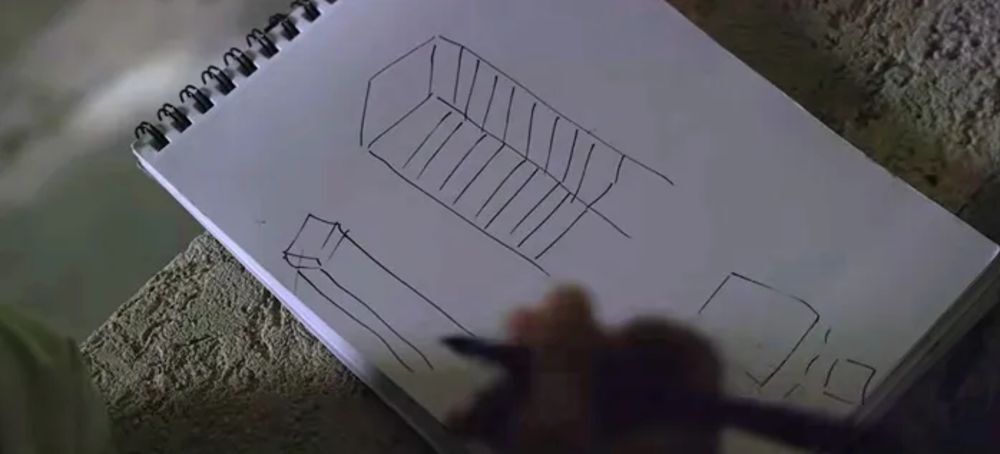 In a scene from NAZA, an IDF soldier sketches out how he targeted buildings in Gaza. (photo: Tiff)
“I couldn’t stop thinking about the Nuremberg trials,” said one attendee, Roland Lewis, who is Jewish and works in nonprofits. Like the Nazis then, he pointed out, the IDF sources largely blamed their actions on the chain of command. Their roles were “technical,” they said, “cogs” in a machine, albeit one they understood was designed to “erase Gaza.” Soldiers likened the ongoing slaughter of 73,000 Palestinians, more than a quarter of them children, to playing video games. “I wanted to leave ten minutes in,” a retired lawyer said afterward. “It’s the hardest thing I’ve ever seen.” She hoped everyone would watch it. That sentiment has been a recurring one in reviews. Caro Claire Burke, the author of Yesteryear, recently bought out all the 1 p.m. showings at IFC for a week to give the tickets away for free in an effort to encourage people to see it. “It’s hard to over-emphasize the significance of this documentary,” she wrote on Instagram. It “changed my understanding of what art can and should do.”
In the coming weeks, NAZA will continue its rollout to theaters across the U.S., and this week it hit No. 1 at the Italian box office, surpassing Avengers: Endgame. In late November, NAZA will begin streaming for free on The Guardian’s website, allowing it to reach an even bigger global audience. The film’s popularity has led to intense criticism from pro-Israel and pro-Palestine factions alike. On both sides are those who want the anonymous IDF personnel identified — so that they can be charged with either war crimes or, perhaps, treason. And on both sides are those attacking the Israeli filmmakers, Yuval Abraham and Rachel Szor, for telling the story from their country’s vantage point. (A representative declined an interview request on the directors’ behalf.)
Prime Minister Benjamin Netanyahu has vowed to change Israel’s laws in order to revoke Abraham and Szor’s citizenship, while a mural went up on an Israeli street with crosshairs next to their faces. On Thursday, the IDF released a statement saying the film contains “substantial factual errors stemming from a misrepresented and manipulative depiction of reality.” It downplayed the most serious claims in NAZA, such as the reliance on faulty kill lists generated by an AI database known as Lavender, saying that human intelligence officers are involved in every decision. (The claims around Lavender were first published in 2024 in +972 Magazine followed by the New York Times.)
Some expect it to affect legal proceedings in The Hague too. South Africa will almost certainly update its 750-page dossier of evidence to include testimonies from the film in its genocide case against Israel at the International Court of Justice, says Kevin Jon Heller, an international law scholar and former war-crimes adviser at the International Criminal Court. The anonymity of the sources could lessen its significance in the judges’ eyes, he says, but the fact that there are so many of them corroborating each other’s accounts could bolster it.
“I guarantee you, right now there are groups all over the world trying to figure out who these people are and how they can build a case for arresting them and prosecuting them in a national court,” says Heller. The IDF has called on the security agency Shin Bet to assist it in investigating the anonymous sources for possible legal action. (The officers’ identities were verified by attorneys and editors at The Guardian, which produced the film.)
NAZA’s goal is to expose the inner workings of a genocidal system, says Ben Reiff, Abraham’s editor at +972 Magazine, which published many of the initial investigations built upon in the film. “The idea is that it can help build cases for accountability on a much bigger scale than would be true of trying individual soldiers in a handful of cases when actually thousands of soldiers and the highest levels of state have overseen and ordered this campaign of annihilation,” he says. Whether the film can be used to advance South Africa’s genocide case at the ICJ or assist in issuing arrest warrants for war crimes at the ICC, however, may be more complicated than convincing viewers.
NAZA focuses largely on the principle of proportionality, the violation of which can constitute a war crime. (“NAZA” is an acronym for the Hebrew words for collateral damage.) In international law, proportionality dictates that civilian harm should not exceed military advantage. The IDF officers in the film repeatedly recount the staggering ratios they used to justify civilian casualties while targeting suspected combatants. Shortly after Hamas’s massacre on October 7, while Israel’s defense minister was promising to “eliminate everything” in Gaza, it was routine to kill 20 civilians for a single low-level Hamas fighter, according to sources in the film and 2024 investigations by the New York Times and the Washington Post. One officer claimed that strikes were authorized for as many as 500 civilians. “I don’t think there’s any military in the world other than Israel,” says Heller, “that would say you can kill 20 civilians for any Hamas fighter.” To justify 500, he says, it would have to be Osama bin Laden. In its statement, the IDF denies ever authorizing civilian casualties to either extent but did not specify what numbers were deemed acceptable. (“Paradoxically, the film presents the exceptional effort and detail the IDF devotes to estimating such harm in strikes as evidence of indifference to civilian lives,” its statement read.) A source close to the film said that its claims, including the 500 number, were “verified with multiple sources.”
Proving violations of proportionality is nearly impossible, however. Judges give militaries broad deference to determine for themselves what is a high-value target and how many civilian casualties are worth their death. Only once in the history of international criminal law has there been a successful conviction on these grounds, and that was for Bosnian Serb commander Stanislav Galić, who was found guilty of crimes against humanity.
In addition to the genocide case at the ICJ, Netanyahu faces several charges of war crimes and crimes against humanity at the ICC, including for using starvation as warfare and intentionally attacking civilians. In the face of these accusations, proportionality is probably the least of Israel’s concerns. “Frankly, their lawyers are probably saying, ‘Don’t worry about it. That’s so much better than them talking about other things,’” Heller surmises. The term has become the new descriptor of choice for celebrities who want to address the war without upsetting anybody. Some of Israel’s top defenders in the entertainment world, including Piers Morgan, have begun to admit that maybe there’s something a little “disproportionate” about what Israel is doing. That was the word Ed Sheeran used too to describe “what is happening in Gaza” after the Macklemore PR crisis pushed him to comment on it.
“We’re playing into their hands by using the language of disproportionality,” says Heller. “They’re winning when Ed Sheeran is talking about disproportionality and they’re losing when people are saying, ‘You’re intentionally attacking civilians, you’re trying to exterminate the Palestinian people.’ That’s what Israel really wants to avoid.”
The film also makes a case for those bigger accusations by focusing on the system that enabled the interviewees to carry out their crimes. “The danger of what Yuval did is that he went after the IDF, not the government, and that hurts Israel more substantially. Governments come and go, but the IDF is what Israel’s entire national identity revolves around,” says Muhammad Shehada, a Gazan political analyst and friend of Abraham. Even if Netanyahu loses the upcoming election, his likeliest replacement, Gadi Eisenkot, will probably not take a radically different approach. Eisenkot is a former IDF chief of staff, while another candidate in the race, Benny Gantz, was previously minister of defense. And the military’s highest ranks have become increasingly filled by extremist settlers, including Avi Bluth, who commands the West Bank occupation, and Yehuda Vach, a Brigadier General in Gaza whose own soldier accused him of turning the murder of Palestinians “into a competition between units.” At the same time, Israeli society has shifted so far to the right that even if a politician wanted to hold IDF criminals responsible, it could risk their career.
Where NAZA may ultimately be more successful is in the court of public opinion. After the documentary received a 25-minute standing ovation at the Venice Film Festival a few weeks ago, it was clear it was going to have immense cultural resonance. The “hero-like reception” for the filmmakers, as Shehada put it, also invited backlash from some Palestinians. “The whole thing was deeply uncomfortable for them,” says Reiff, who was in attendance, of the filmmakers. “A few times they intended to leave and were convinced to stay” by producers who understood that the response would generate valuable buzz for the film.
Among Palestinians who have been posting evidence of the atrocities inflicted upon them for three years, some are frustrated by the international disregard for their voices. “Palestinian claims always need an Israeli voice to legitimize them,” Shehada says. The IDF soldiers “come forward to describe what victims had already documented and shared with the world in real time,” wrote Pulitzer Prize–winning writer Mosab Abu Toha, who continues to document Palestinian deaths, sometimes by the hour, on X. “How the hell is that more shocking than the actual footage of babies being killed?” Another criticism came from those who believe the filmmakers should have immediately released the film for free to the public rather than after completing a theatrical run in the U.S. — a requirement to qualify for the Academy Awards. “Release NAZA online now!” wrote the Palestinian American journalist Ali Abunimah on X. “I understand that this will exclude it from the Oscars and other awards, but if it’s so urgent to help stop the genocide, that’s the only moral thing they can do.”
Szor and Abraham know from their 2024 Oscar-winning film, No Other Land, which they directed with Palestinians Basel Adra and Hamdan Ballal, the dramatic reach such a prize can confer. The weekend after it won an Academy Award, No Other Land’s box office jumped 172 percent, and 24 theaters were added to its run. “They’re not trying to undermine the work of Palestinian journalists in Gaza,” Reiff says. “The point of the film is to make it harder to deny what Israel has done in Gaza.” For now, the layers of denial run deep, certainly among several interviewees in the film. Toward the end, one officer says the IDF made psychologists available to meet with soldiers struggling with the trauma of killing people. But they never came. “There was no need,” the soldier said. He felt no remorse.