Mexican Cenotes Are in Danger
Andrés Muedano Inside Climate News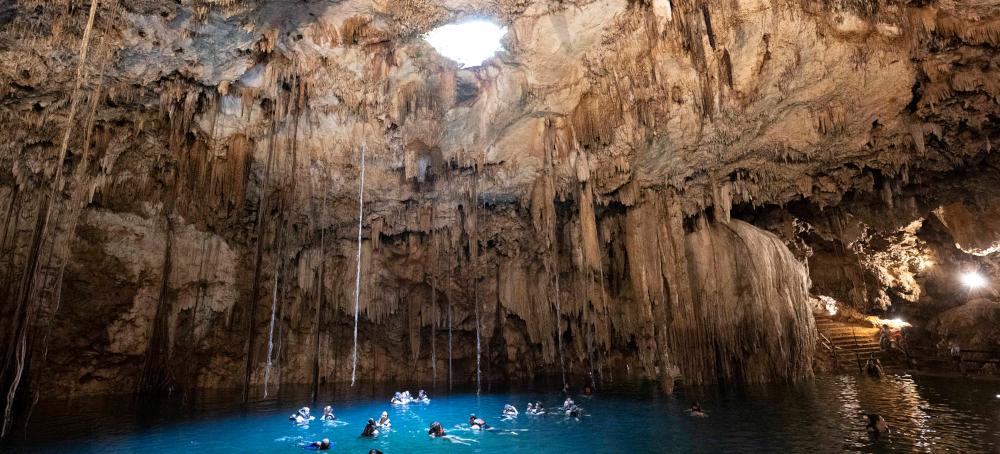 Visitors swim in the water at the Cenote Xkeken near Chichén Itzá in Yucatán, Mexico. (photo: Getty)
Researchers found microplastics, chemicals like PFAS and other potentially toxic elements in these sinkholes, the primary source of drinking water in the Yucatan Peninsula.
Inside, she stared in awe at the limestone columns: pillars formed when a stalagmite growing from the ground up fuses with a stalactite growing from above. Solid structures like these will form incredibly slowly, sometimes over the course of hundreds of thousands of years. Droplets of calcite-rich water will drip from the tip of hanging stalactites, and as the liquid evaporates, minerals will start to build up. Ayala remembers how the crystals embedded in these formations shone back at her as she moved her bright headlamp.
Then she and her teammates got to work. Since 2021, Ayala has participated in cave-mapping efforts led by Cenotes Urbanos, a citizen science organization devoted to the conservation of cenotes—open or closed geological depressions that are inundated with groundwater. The word “cenote” is derived from the Yucatec Mayan tz’ono’ot, meaning cavern with water, or natural well, and cenotes have indeed been the main source of freshwater for inhabitants of the Yucatán Peninsula since humans first settled in what is now the south of Mexico.
More recently, however, in the face of interconnected environmental threats, cenotes have seen unprecedented levels of degradation. These ecosystems are in danger, as are the communities, human and non-human, that rely on them for survival. Two recent studies shed light on the processes driving the cenotes’ perilous condition. Citizens are working hard to raise awareness as well.
A Changing, Urbanizing Region
The Yucatán Peninsula—made up of the three Mexican states of Yucatán, Campeche and Quintana Roo—is not unlike a sponge. Given its porous and highly permeable limestone bedrock, water seeps through the ground when it rains. As acidic compounds in the filtrated liquid react with the calcium carbonate in the limestone, the bedrock starts dissolving, giving way to large underground rivers and giant water-filled caves. Open cenotes form when the ceiling of such a cave collapses, thereby exposing previously trapped freshwater.
In a region with no surface rivers, cenotes are of the utmost importance. Thousands of years ago, these natural wells sustained the economy and cultural practices of the ancient Maya civilization, playing a central role in its ritual practices and everyday life. Today, cenotes continue to be the main source of freshwater in the peninsula, and also serve as some of the region’s most popular tourist attractions.
But with a booming real estate industry, a growing agroindustrial sector and the construction of the highly controversial Tren Maya railroad, the peninsula is witnessing unprecedented levels of urban growth. And cenotes, research has found, have not gone unaffected.
A study in the upcoming August 15 issue of the journal Environmental Research explores the relationship between urbanization and the contamination of cenotes in the rapidly growing Playa del Carmen area in Quintana Roo. The study is a collaboration between Cenotes Urbanos, the nonprofit organization of which Mitzi Ayala is a member, and the laboratory of Mariana Capparelli, a researcher affiliated with the Madrid Institute for Advanced Studies’ Water Institute and the National Autonomous University of Mexico’s Institute of Marine Sciences and Limnology.
“We wanted to see whether a cave’s level of contamination depends on the degree of urbanization around it,” said Ayala, who is also a doctoral student in Capparelli’s lab and one of the study’s co-authors. To study this relationship, she and her fellow researchers selected caves along a gradient extending outward from the center of Playa del Carmen. Then they went to the caves to collect water and sediment samples, which they subsequently studied to measure the concentration of different pollutants: microplastics, chemicals like PFAS and potentially toxic elements.
Their experiments found that cenotes in urban areas are the most highly polluted. The finding is particularly troubling because, according to the study, one of the two cenotes with the highest concentration of microplastics is also regularly used for drinking water.
“We obviously need to care for the cenotes because they are important for tourism and because of all the animals that live in them,” said Daniela Alvarado Zambrano, the study’s lead author. “But it is also important to remember that cenotes are the main source of freshwater for the Peninsula’s population.”
Waste All the Way Down
The importance of cenotes may seem self-evident, but environmental awareness is limited. “For a long time, cenotes have been used as dumps,” said Jaime Rendon Von-Osten, a professor at the Autonomous University of Campeche. “Those who clean cenotes have even found bicycles down there.”
However, Rendon Von-Osten doesn’t think that citizens who pollute cenotes do so in bad faith. “They just lack the information. For them to dispose of something in a cenote is like sweeping it under the rug,” he said.
Rendon von-Osten is the author of a November 2025 article highlighting, much like Alvarado Zambrano’s, the importance of waste management for protecting the cenotes. The article, also published in Environmental Research, investigated the presence of toxic metaloids in cenotes. “Heavy metals are harmful for human health,” said Erick Sosa, a trained diver and one of the study’s authors, in an interview with Mexican news outlet UnoTV. “It was important to know what was in the water of these ecosystems to start making better resource management decisions,” he said.
A video featuring Sosa, who collected the samples for the 2025 study, shows the surface of a cenote littered with glass bottles, empty chip bags and cans. What was once a pristine ecosystem is now a contaminated waste site, a situation worsened by the fact that cenotes are connected by underground water channels, which only makes pollution more difficult to contain.
In 2022, another diver exploring the Chen Ha cenote found over 100 electricity meters, which Rendon von-Osten speculates must have been discarded by the state-owned Federal Electricity Commission. “Who else is going to throw away so many electric meters?” he said.
Electronic waste contains toxic levels of copper, aluminium and mercury, he said, which is why he and his team wanted to explore how metals underwater might be interacting with other waste. Strikingly, all collected samples in the study were contaminated with microplastics, some of which had aluminium, chromium and stannum attached to their surface.
Taken together, the findings of both studies highlight the need to regulate how waste is handled in the Peninsula. “It might sound very basic, but not littering is one of the simplest ways to avoid large plastic from ever reaching the cenotes,” said Alvarado Zambrano. After all, most microplastics found in the cenotes are the product of larger pieces of trash degrading over time because of sunlight exposure, high temperatures or mechanical erosion, she explained.
Alvarado Zambrano also emphasized the need for further research on cenotes. “Even though these ecosystems are so fragile and important—so striking and beautiful—they have not been sufficiently studied,” she said. “But from a more social standpoint,” she added, “what we must raise awareness about is waste management.”
Referencing the work of Cenotes Urbanos, the citizen science nonprofit, Mitzi Ayala also highlights the importance of greater social involvement. Founded in 2018 by Mexican scientist and communicator Roberto Rojo, the organization has become a 400-person group of volunteers working together to protect the cenotes through different activities: registering the flora and fauna through apps like iNaturalist, mapping caves like Ayala and participating in advocacy efforts to safeguard their integrity.
“People need to first want to take care of the environment,” said Ayala. “Nobody can take care of what they don’t first know.”