Long After Wildfire Smoke Is Gone, Heavy Metals Could Still Be Harming Survivors’ Lungs
Keerti Gopal Inside Climate News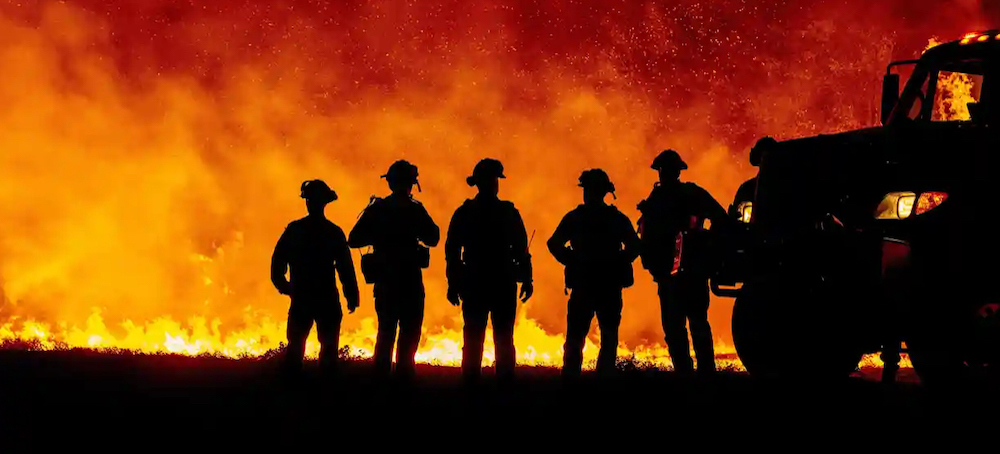 Firefighters tackle a wildfire. (photo: Josh Edelson/AFP/Getty Images)
A new study from University of Hawai‘i researchers links metals found in the ash of the 2023 Maui wildfires with impaired lung function.
A family medicine doctor, Kamaka is one of the physicians helping with the Maui Wildfire Exposure Study, a multi-year effort from the University of Hawai‘i to chronicle the immediate and long-term health impacts of one of the deadliest wildfires in U.S. history. In the months after the August 2023 fires, Kamaka helped study participants understand their results on a range of medical tests, including urine tests for 24 metals. Many of them far exceeded typical levels.
“I don’t think I’ve ever seen one that was really normal,” she said. “It’s not unusual to see them be off-the-chart.”
Now, she is a co-author on a new paper, published Monday in the Proceedings of the National Academy of Sciences, that finds those same heavy metals could be hindering survivors’ breathing.
The Maui wildfires killed at least 102 people, displaced thousands and razed the town of Lahaina—which is still struggling to rebuild three years later. Between six and 18 months after the fires, University of Hawai‘i researchers tested a cohort of 1,400 residents across the island and found that Maui residents had much higher levels of several metals than a national reference, including 40 times the antimony and more than twice the amount of manganese, barium and arsenic.
A higher combined metal exposure was linked to impaired lung function, according to the study. The researchers also found that residents in different parts of the island had different distributions of metal exposures. The metal profile most strongly associated with impaired lung function was found in residents of Lahaina and Kula, which were hit hardest by the fires.
That profile also had substantial overlap with metals found in the wildfire ash, which makes a strong case that the exposure may be related to the fires, said Alika Maunakea, co-director of MauiWES and one of the study’s authors.
“Even though we can’t pinpoint the source to the fires, it would be an odd coincidence,” he said.
The broader effort the paper is part of, which goes by MauiWES for short, has enrolled more than 2,500 participants in three years and shown that the fires are having long-term public health ramifications on an island that already doesn’t have enough doctors.
Kamaka and the other physicians involved with the study said they weren’t previously familiar with the health effects of some heavy metals, or how to talk to patients about what the results could mean for their health. For Kamaka, it exposed a gap in the medical education system.
“The most striking thing for me, being involved with this study, is realizing how ill-prepared the average primary care provider is in dealing with the aftermath of a disaster such as the Lahaina wildfire,” Kamaka said. “It’s not really part of our training.”
Climate change has fueled more intense wildfires and other disasters in Hawai‘i, making research focused on the public health dimensions of recovery even more critical. Last weekend, Hurricane Nolo brought heavy rains, winds and risk of hazardous flash floods; it was the third hurricane to approach the state in weeks. And on Saturday, a brush fire burned through more than 100 acres and prompted temporary evacuation in Olowalu, a West Maui community near Lahaina.
Disasters can introduce new contaminants and dislodge older pollutants, which makes this research increasingly urgent, Maunakea said.
“Maui raises a broader question for, especially, a changing climate,” Maunakea said. “When fires or even floods from the storms that we’ve had move through places with existing contamination, what happens to people’s exposure and health in the years that follow?”
Wildfires in urban developments bring unique health challenges because of the chemical hazards in the possessions they burn—homes, vehicles, electronics and more. The MauiWES researchers emphasized that the metals found in the study likely come from a variety of sources, and some of the exposures may predate the fires.
They also found that local lung health may be affected by sources other than metals. Residents in Wailuku and Kahului, neighboring communities in Central Maui that have more transportation infrastructure and the island’s main airport—both pollution sources—also showed impaired lung function.
U.S. Rep. Jill Tokuda—one of the state’s two congresspeople—said that any finding of elevated levels of heavy metals in wildfire survivors’ bodies warrants further research, regardless of the source.
“We should be digging deeper and testing more,” Tokuda said. “We have not lived through a disaster like this, which means we really don’t know what to expect in the aftermath.”
The next phase of MauiWES, funded by the National Institute of Environmental Health Sciences, will investigate legacy pollutants from decades of agricultural and industrial activity on Maui, including the island’s history of plantations. Researchers are attempting to understand whether wildfires and other disasters can trigger new exposures as they dislodge older contaminants.
“Because of the frequency of these events happening across the country, I think it’s even more urgent to figure this out,” Maunakea said, adding that environmental contaminants are a “hidden problem that future generations are going to have to bear … if we don’t do something about it now.”
Led by Maunakea and Ruben Juarez, both professors at the University of Hawai‘i, MauiWES has shown that survivors across the island are still feeling the wildfire’s effects three years later. The researchers found that depression, anxiety and suicidal ideation are higher both in and outside of the island’s burn zone, compared to elsewhere in the state. Social factors like housing and employment—upended by the disaster—play a significant role.
In the study’s latest report, the researchers emphasized that food, income, housing security, social support and access to healthcare were key factors in determining whether survivors were able to heal and regain stability. They also found that children in particular are continuing to experience emotional distress and physical problems, including elevated blood pressure and poor lung health.
The findings demonstrate how the fires amplified health and resource disparities that predated the disaster, Kamaka said. Native Hawaiians already had higher rates of hypertension and diabetes, for example, which Kamaka saw frequently in survivors participating in the study. And Maui had too few primary care and mental health providers to go around.
“There was already shortages,” Kamaka said. “This just made it really blow up even worse.”
Tokuda said that the researchers’ findings demonstrate how the country and federal government need to rethink disaster management to put more focus beyond the immediate aftermath.
“It’s not just the initial disaster, it’s the disaster after the disaster,” Tokuda said. “There is a huge gap that we have got to bridge and recognize that we have continued responsibility and kuleana to be supporting people.”