Little House on the Stolen Prairie
Kathryn VanArendonk The Vulture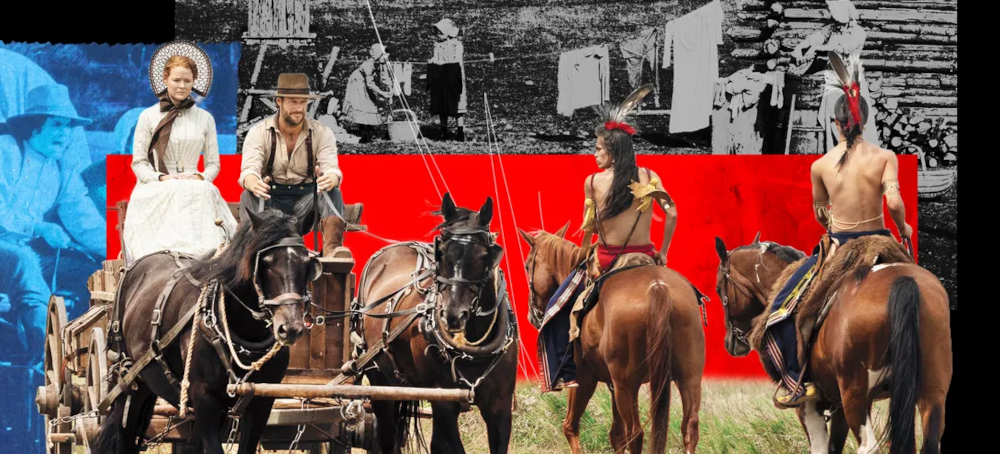 Little House on the Prairie is on Netflix now. (photo: Netflix)
Developed by writer Rebecca Sonnenshine and producer Joy Gorman Wettels, this Little House on the Prairie comes at a weighty moment, days after America’s 250th birthday. The original Little House books, by Laura Ingalls Wilder, were published almost 100 years ago; they are constructed from Wilder’s memories of her childhood as her father, Charles Ingalls, made repeated, frequently failed efforts to build a future for his family on the Great Plains in the 1860s and ’70s. After setting out to build a homestead at the promise of cheap and abundant land, they retreated to Wisconsin as the federal status of the territory they had been trying to claim remained unclear. Depending on your point of view, Wilder’s story is either a grand, hopeful saga of how this country was built or a fraught piece of American propaganda, full of convenient gaps and racist descriptions of the Native Americans whose land the Ingallses are claiming for themselves. The adaptation holds both perspectives, reaching for sweeping romanticism in one moment and somber reconsideration in the next, as much wholesome Dr. Quinn, Medicine Woman as it is grief-filled Killers of the Flower Moon. In places, it’s a deliberately unfaithful adaptation. Its greatest strength is that it often feels like a show at war with itself.
Wilder’s legacy has become so much more fraught in the past few decades. Her books spent many years as political and financial fuel for her daughter, Rose Wilder Lane, a founder of the American libertarian movement; in the 1970s, they became the basis for a long-running hit TV adaptation starring Michael Landon that discarded most of Wilder’s series, centered Pa Ingalls as a font of wisdom, and de-emphasized the novels’ settler ideology and sense of physical precarity. By the ’90s, the Little House books were subject to the widespread cultural reevaluation of Indigenous life in the U.S., criticized for dehumanized depictions of people of color and for the Ingallses’ general colonial cluelessness. In 2018, the American Library Association’s Laura Ingalls Wilder Award, named for Wilder as its first recipient in 1954, was renamed the Children’s Literature Legacy Award. “The author’s legacy is complex and Wilder’s work is not universally embraced,” noted the Association for Library Service to Children.
I grew up in the 1990s listening to my mother read Little House books aloud to me and my younger sister. I loved it intensely for Laura’s confidence and responsibility and the matter-of-fact way she described her world. I relished the detailed accounts of how, exactly, one might erect a log cabin, or how to hang a door so that it swings properly, or how much brown sugar cost. I was just as fascinated by the way my mother read Wilder’s work to us. She paused constantly, interrupting the story and narrating her own feelings about it, asking questions and occasionally voicing her dismay. Why on earth had they decided to homestead so far from everything else? What possessed Pa to keep moving them with all these little kids and no assurance he’d be able to feed them? Wilder’s descriptions of the Indians who come into their home and steal their food — this was not the whole story, my mother told us. Why did the men do that, did we think? Memorably, our reading reached a chapter from The Long Winter, which included an illustration of Pa with a thousand-yard stare, bundled up in many layers of clothing, trying to twist hay stalks into sticks because they’d run out of fuel to burn. “Why won’t this idiot move back to town?” my mother said.
I have not read the books to my own daughters. I have dreaded revisiting them, and I’ve been hesitant about needing to perform an even more antagonistic interrogation of Little House than the one my mother did for me 30 years ago. Did I really want to present my kids with descriptions of “dirty and scowling and mean” Indians, naked except for their skunk-skin loincloths, screaming war cries all night and stealing the Ingallses’ food? Why should I spend hours telling them a story just to explain that the whole thing is blinkered and racist?
The streamer adaptation is neither designed to undermine Wilder’s account nor to discard her child’s-eye point of view. It remains remarkably, improbably hopeful from beginning to end. But its optimism and warmth are not placid, and they’re not easily won. The intent of this adaptation, Gorman Wettels tells me, “is to face the problematic nature of the historical text head-on.” Ma is still terrified of Indians; episode three includes a scene from Wilder’s novel in which two Native Americans storm into the Ingallses’ home while Pa is away and eat all their cornbread. But the whole framing of that scene has shifted. One of the intruders is an Osage man named Little Puma, the uncle of Laura’s best friend, Good Eagle, whose mixed-race family, the Mitchells, are some of the Ingallses’ closest neighbors. This is not the nameless, savage figure of Wilder’s book, and the show takes pains to make clear that his anger and resentment are justified.
Later, the series tackles the chapters in Wilder’s book called “Indian Jamboree” and “Indian War Cry,” in which, in Wilder’s telling, the Ingalls experience several nights of inexplicable howling, rage, and threats of violence from the Indian tribes who seem to surround their home on the prairie. The show tells the same story from the Osage perspective in an episode written by Cherokee Nation screenwriter Tom Hanada and directed by Navajo filmmaker Sydney Freeland. While Pa looks on as a silent witness, representatives from several tribes conduct an emotional meeting to decide whether to sell their land to the federal government, thereby avoiding violence but losing their ancestral home. When Pa and Laura hear drums over the horizon, it’s not a defiant threat as it is in Wilder’s book; it’s understood as the Osage mourning the loss of their sacred spaces.
Wilder’s books do not hide the Osage role in the Ingallses’ lives, and they don’t disguise the hardship of pioneer living. The river-crossing scene comes directly from Wilder’s text, as does an incident in the show where the entire family is stricken with malaria. But the books are written with a child’s view of Manifest Destiny and economic uncertainty. “She was telling the truth, but not the entire truth,” is how Sonnenshine puts it. Wilder was also writing during the Great Depression with the conscious goal of creating a hopeful, aspirational story for children. “That element of making the best of things — that carried her through her life, and she hoped, I think, it would carry people through the dark times she was writing in,” says Sonnenshine.
I watched the first three episodes of Little House and then paused it so I could go back and watch the whole season with my daughters. They were as fascinated by it as I had been by the books when I was their age, and their questions made me realize that my decision to avoid Little House had been an impulse to avoid telling them much of anything about settler colonialism and the pioneer era of American history, aside from an annual tirade on the real story of Thanksgiving. My younger daughter in particular had only the sketchiest sense of this period and was missing precisely the things Wilder’s books are still so good at conveying — the textures and colors of the prairie, the rhythms that shaped 19th-century life, the lack of modern medicine and modern distractions. She wanted to know what malaria was, and why the Ingallses had come to Kansas at all, and why it was so hard for them to get drinkable water. I am glad she has this new version of Little House to show her the dangers of inhaling poisonous gas while digging a well; I am even happier that I can see my own mother’s version of Little House in it, the one that values Wilder’s books while also needing to note, at regular intervals, that this was not the full story of the American West, that things were much more complicated, and by the way, Pa probably could have benefited from some of the modern mental-health services unfortunately unavailable to him out there on the 1870s frontier.