
Lawsuit by Indonesian Villagers Claiming Torture by 'Exxon's Army,' Heads to Trial After 20 Years
Aisyah Llewellyn Nikkei Asia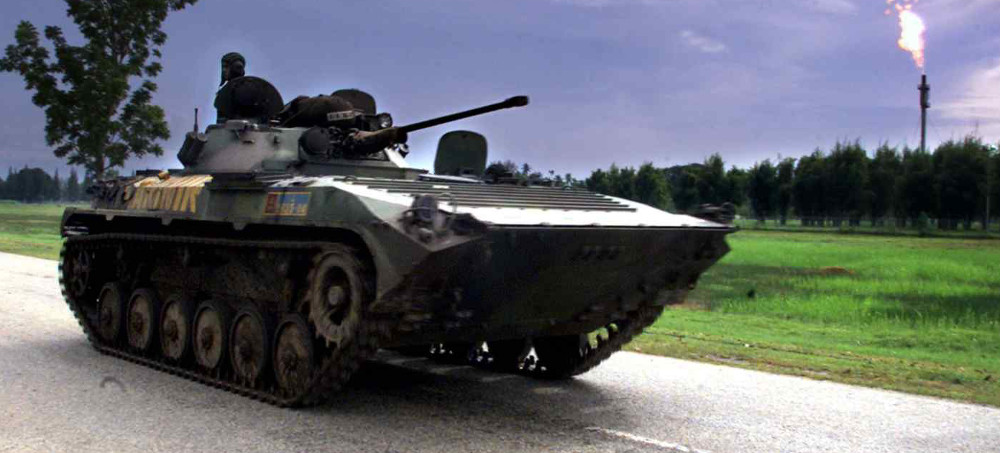 Indonesian soldiers patrol in an armored fighting vehicle at the ExxonMobil Arun natural gas field near Lhokseumawe, in Indonesia's Aceh Province, in April 2001. (photo: AP)
07 January 22
"He was taken by soldiers," one of the 11 plaintiffs in the case, identified only as Jane Doe V, says of her husband, who went missing in January 2001. "Then his hand was cut off and they took his eye."
The lawsuit, which was originally filed in the District Court for the District of Columbia in the U.S. in June 2001, alleges that oil and gas giant ExxonMobil was responsible for human rights violations, including sexual assault, battery and wrongful death, committed by members of the Indonesian military. The soldiers had been hired to guard the ExxonMobil plant in Aceh in the late 1990s and were thus under contract with ExxonMobil when the abuses took place, the lawsuit says.
ExxonMobil has tried to have the plaintiffs' claims dismissed nine times, slowing the legal process to a crawl. The case has dragged through the courts for over 20 years. Now, however, lawyers for the plaintiffs are hoping they will get their long-awaited day in court.
Agnieszka Fryszman, who serves as co-counsel in the case, told Nikkei Asia that the plaintiffs' legal team has filed over 300 pages of factual findings, approximately 400 exhibits and five expert reports. It has conducted around 40 depositions to prepare the case for trial. In November, the team filed a motion to set a trial date, which could happen as soon as this spring, depending on the course of the coronavirus pandemic.
"This case raises important issues. We are confident in the evidence we have presented and look forward to proving the claims in court," she said.
In court documents, ExxonMobil has repeatedly countered that it had no knowledge of any human rights abuses and cannot be held responsible for any violations that may have occurred.
Aceh Province is one of the most resource-rich parts of Indonesia and is known for its large oil and gas reserves.
In 1971, Mobil Oil Indonesia discovered that the area around Lhoksukon was rich in natural gas, which it then moved to extract and liquefy. In its heyday in the late 1990s and early 2000s, the plant at Arun Field, which was part of the wider Lhokseumawe Industrial Zone, generated over $1 billion annually.
In 1999, Exxon bought Mobil Oil and formed ExxonMobil Corp. in Indonesia, which ran the Arun Field until 2001.
"Our case began as an important effort to hold one of the world's largest and most powerful corporations accountable for fundamental human rights violations," said human rights lawyer Terry Collingsworth. "Indeed, the first United States federal judge assigned to the case, Louis F. Oberdorfer, stated in an early ruling, 'The United States, as leader of the free world, has an overarching vital interest in the safety, prosperity and consequences of the behavior of its citizens, particularly its super corporations conducting business in one or more foreign countries.'"
When ExxonMobil came to Aceh, the province was embroiled in a bloody civil war that had raged for decades as the Free Aceh Movement (GAM) battled for independence from Indonesia.
In 1989, Aceh was officially declared "an area of special military operations," and Indonesian troops were dispatched to clamp down on the civil unrest. In the late 1990s and early 2000s, violence regularly erupted in the province, causing ExxonMobil to hire Indonesian soldiers to protect its plant and staff from attacks.
It was at this time, the plaintiffs allege, that the soldiers under contract to ExxonMobil also conducted sweeping raids, torturing villagers whom they incorrectly accused of being separatists, making ExxonMobil potentially responsible for any human rights abuses they committed.
Oberdorfer, who originally presided over the case, died in 2013, as have four of the original 11 plaintiffs.
The remaining plaintiffs told Nikkei that the pressure of having the case hang over them for more than two decades has taken its toll, but they are ready for their voices to be heard.
"We hope they can schedule the trial so that we can finish this quickly," one of the plaintiffs said, speaking on the condition of anonymity. "We need to know the verdict. We want things to be clear, but we are not scared. We faced this torture and we experienced it. We were the ones who were hit and beaten."
The plaintiff said that, when he was taken by soldiers, he lost all hope that he would be released or live to tell his story in court. "I just kept talking to Allah in my heart," he said. "I couldn't do anything. I couldn't resist. There were so many soldiers and they all had weapons."
Another plaintiff, who told Nikkei that he is still traumatized by his abduction and torture at the hands of the "Exxon Army," said that forced disappearances were rife in the area in the early 2000s. "People were buried in unmarked graves and still haven't been found all this time later," he said.
"So many people have died but this case still lives on. We are still alive and we are ready to go to trial."
When contacted for comment on the case, ExxonMobil spokesman Todd Spitler referred Nikkei to a previous statement: "We have fought the baseless claims for many years ... The plaintiffs' claims are without merit. While conducting its business in Indonesia, ExxonMobil has worked for generations to improve the quality of life in Aceh through employment of local workers, provision of health services and extensive community investment. The company strongly condemns human rights violations in any form."

