Law Enforcement May Fully Unleash Its Data Collection Tools on Abortion
Cristiano Lima The Washington Post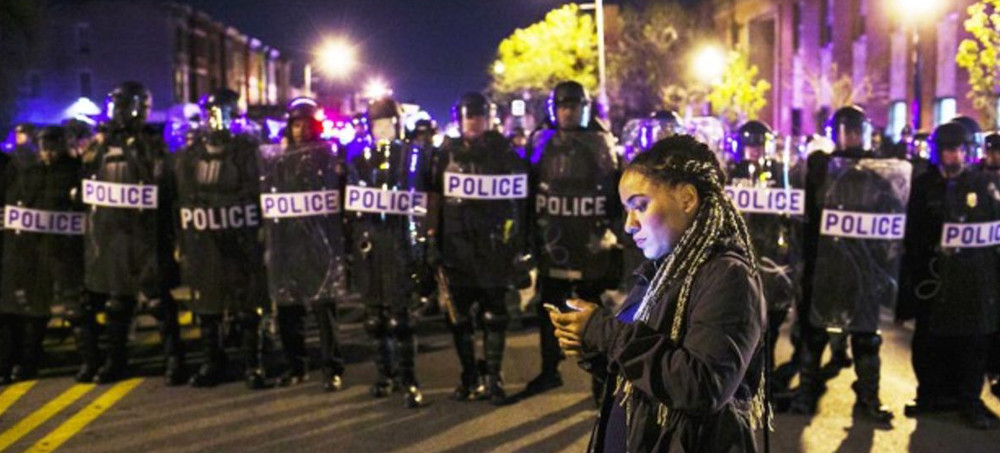 A woman uses a cellphone as Baltimore police officers stand by during a protests connected to the death of Freddie Gray. (photo: Lucas Jackson/Reuters)
06 May 22
If finalized, the leaked opinion, published by Politico on Monday, is expected to trigger a wave of expanded abortion restrictions across the country, which in turn could embolden authorities to step up legal demands for women’s personal data.
One major likely target is the information collected by Internet service providers, which privacy and civil liberties advocates say has historically been used by agencies to identify individuals, verify their location and connect them to relevant groups.
For women who may still seek abortions amid an expected wave of crackdowns later this year, that could mean that logging onto a health-care clinic’s WiFi or browsing related sites from your cellphone or desktop may create an opening for agencies to seize their data and mount a case.
“There's a long history of ISPs working relatively closely with law enforcement,” said Justin Brookman, director of privacy and technology policy at Consumer Reports.
Hayley Tsukayama, a senior legislative activist at the digital rights group the Electronic Frontier Foundation, said law enforcement agencies are no strangers to these practices, but may find additional ways to deploy them as states impose greater restrictions on abortions.
“It's probably less about them specifically gaining more access to some of these private companies or to be able to compel companies to turn over information,” said Tsukayama, a former technology reporter for The Washington Post. Since they already can access user data more broadly, they may use those tactics to obtain abortion data, she added.
The new rules will put a microscope on decisions by telecom giants, including AT…T, Comcast and Verizon, who may find themselves in a political minefield if pressed to fork over data from their customers to build an antiabortion case.
“It's very likely that we'll see more pressure on companies to turn over that data,” Tsukayama said.
That could put telecom giants squarely into the crosshairs of lawmakers in Washington who have typically focused more of their fury on technology giants like Google and Apple who will likely be facing their own data demands.
Cynthia Conti-Cook, a technology fellow at the Ford Foundation, said law enforcement agencies in the past have often used warrants for geofencing data — which can be used to link individuals to a specific location — to connect people to cases. It’s even been used commercially, she noted, including by advertisers targeting people at Planned Parenthood.
Another way in which law enforcement has used data from Internet service providers to build their cases, Conti-Cook said, is to collect information that can link an individual to a specific computer or IP address.
“It's very clear how probable and how accessible a lot of these tools are,” she said.
There are broad sources law enforcement agencies tap into to get data from suspects, including phone carriers, social media platforms, search engines and third-party data brokers. Privacy advocates said they are all likely to see more demands if Roe v. Wade is indeed overturned.
But Conti-Cook said connecting to the Internet through a personal device can pose unique risks because it can connect a web of people to an activity.
That could create heightened legal risks in states that seek to criminalize not only those who get abortions, but also those who provide them or facilitate the process, as Texas’s restrictive law has done.
“The level of risk that digital devices enter into any network that is supporting people, assisting people in seeking abortions, is that once one piece of the puzzle is in the hands of law enforcement … the potential to expose the network is there,” she said.