Jackson Skewers Supreme Court Over Emergency Docket
Josh Gerstein POLITICO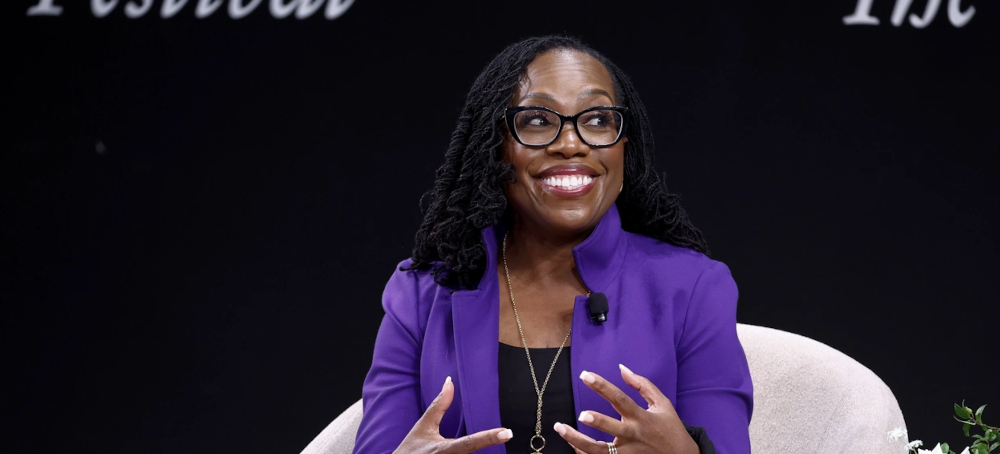 Ketanji Brown Jackson speaks on stage during the "Ketanji Brown Jackson on Lovely One: A Memoir" panel for The Atlantic Festival 2024. (photo: Paul Morigi/Getty)
The liberal justice avoided direct discussion of Trump’s success with urgent high court appeals.
Jackson argued that the high court’s willingness to grant emergency relief in cases at their earliest stages threatens to upset the legal system’s order of operations and transform the Supreme Court’s role.
“Like many exceptions, there is a risk that they'll swallow the rule,” Jackson said during a speech to students and faculty at the University of the District of Columbia School of Law. “If we're not careful, the emergency docket can and will become an end-run around the standard review process.”
Over the past year and a half, there has been no more prolific user of the Supreme Court’s emergency docket than the Trump administration, which has produced an impressive win rate of about 80% on such appeals.
The victories have allowed Trump to implement much of his policy agenda, by firing hundreds of thousands of federal employees, cancelling billions of dollars in federal grants and contracts, and ending legal status for millions of immigrants.
Jackson was circumspect Thursday in how she addressed the government’s lopsided record. Nevertheless, it was clear that the reforms Jackson suggested would have meant stormier seas for the administration’s emergency appeals.
Jackson said the justices should begin their consideration of such appeals by asking whether the harms facing each side are truly urgent and severe. Only then would the justices consider the parties’ relative chance of prevailing on their legal arguments. She argued that approach would mean fewer successful emergency appeals, returning that docket to the sleepier status it had before the last decade or so.
In a speech at Yale in April, Jackson acknowledged that her approach would give less weight to claims by President Donald Trump — or any other president who complained their policy goals were being frustrated for months or years. In her remarks at Yale, Jackson referred to those concerns as “abstract.”
Administration lawyers have said they needed to turn to the Supreme Court on an urgent basis because they faced an unprecedented torrent of litigation over Trump’s policies, with many cases being strategically filed to maximize the chances of drawing aliberal judge.
Jackson did have a few words of praise Thursday for one aspect of the high court’s emergency-docket practices. During an on-stage discussion after her 25-minute speech, she said the court’s decision to more frequently explain its decisions on that docket was a welcome development, although still no substitute for the more thorough opinions issued on the slower-moving regular docket.
“The court has, in recent months, began to explain more,” the court’s newest justice said. ”I think it is a good and positive development.”