It’s Time to Get Trump
Ben Terris New York Magazine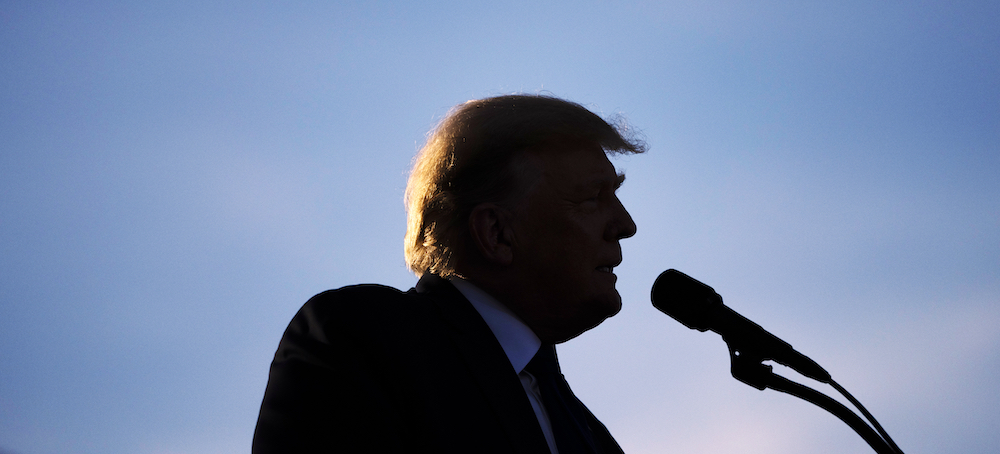 President Donald Trump. (photo: MSNBC)
Robert Garcia of California is sitting in his Capitol Hill office sifting through a stack of papers detailing targets and potential witnesses for the House Oversight Committee, which he will chair come January. It is November 10, the first full day of Congress since Democrats dominated the midterms on Election Night, bringing to Washington an especially muscular check on President Donald Trump. Four framed Superman illustrations hang on Garcia’s wall, including a caricature of the representative pulling open his shirt to reveal the hero’s signature S. Garcia has always related to Superman, he tells me, ever since he was a little boy who ran around wearing a cape. When he took office in 2023, Garcia was sworn in on both the Constitution and an exceptionally rare Superman comic — Action Comics No. 1 — he had borrowed from the Library of Congress. “I grew up with my worldview as always being the good guys versus the bad guys,” he says. “And I kind of still feel like that’s the job I’m doing now.”
As one of several members of Congress leading the effort to hold Trump’s second administration accountable for a cascade of ethical and legal scandals, Garcia is part of the Democratic Party’s version of the Justice League. Now he is figuring out who to send threatening letters to first.
“… For Epstein, I like Blanche, the Bureau of Prisons, and I think you go J. D. Vance and Susie Wiles — they were both in the fucking Situation Room … And under corporate corruption, that’s where you have the ballroom …”
Garcia has already met with the soon-to-be chairman of the House Intelligence Committee, Jim Himes of Connecticut, to divvy up investigations into Trump’s management of oil profits from Venezuela; sat with the expected incoming head of the Homeland Security Committee, Bennie Thompson of Mississippi, to discuss who will get first crack at former Department of Homeland Security members such as Kristi Noem and her alleged partner in chaos, Corey Lewandowski; and huddled with lawyers to determine how to launch yet another round of Epstein-related inquiries (“We should have a survivor or two when we roll this out,” he says). He has been chatting with new members of Congress hoping to get on his committee, more than 25 so far. The newly elected Dan Koh, a former Biden official from Massachusetts, who has said he wants to “subpoena every single person who bent the knee to this president,” is among those making the trek to Garcia’s office. He all but begs for a spot. “I’m hyped for people like you,” Garcia tells him.
The Oversight Committee will be at the center of the next Congress, but it will hardly have a monopoly on the action. Democrats are preparing a massive blitz of investigations. Senator Richard Blumenthal of Connecticut has sent letters to white-shoe law firms that capitulated to Trump. Groundwork Collaborative, a progressive think tank, has begun circulating a 181-page dossier on the Hill listing corporations that have been involved with the administration, including Tesla, Apple, and Paramount (now part of Skydance). Impeachment season has already kicked off, initiated — to Democrats’ delight — by a Republican, Representative Thomas Massie of Kentucky, who introduced eight articles aimed at Secretary of Defense Pete Hegseth for instigating the war with Iran, among other charges. Why stop there? “I’d like to impeach Pete Hegseth,” said incoming New York representative Brad Lander on CNN. “I’d like to impeach Kash Patel. I’d like to impeach RFK Jr. They’ve all sold out the American people.”
The problem facing Democrats is an overwhelming surplus of possible probes. Garcia has been keeping track on a whiteboard in his Long Beach home, an elaborate, color-coded mosaic of ever-changing targets. “It’s a very large board,” he says. In the weeks before the election, Garcia and his senior policy staff shut themselves in a hotel meeting room, ordering takeout while they tried to decide what to do with it all. Some investigations were already well underway, including one into an alleged pay-to-play kickback scheme involving Lewandowski when he was at DHS; Garcia … Co. have a whistleblower cooperating with them on that. There was a consensus that they’d like to get Attorney General Todd Blanche in front of the committee to find out why Jeffrey Epstein’s right-hand woman, Ghislaine Maxwell, was transferred to a Club Fed–style minimum-security prison. And Garcia loves to talk about what he calls Donald Trump Jr.’s “Red Wedding,” the lavish weekend celebration in the Bahamas that ProPublica reported was allegedly underwritten by a Russian businessman with ties to Vladimir Putin. Surely somebody among the dozens of guests would have something interesting to say under oath.
It’s been difficult to know where to begin, particularly since the administration keeps supplying new material. “I can pick up the paper every single day and see 50 terrible things we should focus on,” Garcia’s staff director, Robert Edmonson, tells me. “And having to pick between those is the hardest part of the job.” Case in point: Days after the election, reports emerged that Jensen Huang, the now-former head of the AI-computer-chip giant Nvidia, had been having an affair with a Chinese spy — and that the president knew about it and did nothing. (Trump has denied knowledge of the affair.) It’s the kind of thing Garcia’s committee might want to investigate. But would that mean erasing something else on the whiteboard? What about Guilfoyle, Trump’s former ambassador to Greece and Don Jr.’s former fiancée, who had allegedly asked a wealthy donor to secretly pay off $100,000 in credit-card debt in exchange for political favors? “Honey please,” she had reportedly begged him in a text.
“I 100 percent have had dreams about the investigations,” Garcia says. The question is whether those dreams will comport with reality. For the first time in Trump’s second term, Democrats will control the gavels, giving them the power to compel testimony, subpoena records, and investigate the administration with no holds barred. If witnesses refuse, Democrats can pursue contempt proceedings. They can impeach the president or other federal officials. It’s a moment of extraordinary opportunity. And so, naturally, people are wondering if they’ll find a way to screw it up.
One concern is that Democrats will become so consumed with investigating Trump it will eat up all their time and attention and they’ll forget to do much of anything else. “Trump came to office with a bloodlust and a desire to use investigatory elements of government to punish everyone because he thought he was unjustly probed,” the former Democratic strategist David Axelrod tells me. “If the impression is that Democrats are just doing the same thing and that is their obsession, then I think that is a problem.” There’s also the fatalistic anxiety that comes from spending ten years watching Trump wriggle his way out of trouble as well as the prospect of various committee heads, including Garcia, stepping on one another’s toes in a mad rush to get Trump. The Democrats have to determine which investigations will hit the deepest and the cleanest, mollify the millions of voices on the left calling for heads to roll, and preserve what’s good and decent in the American Republic. Above all, they have to start somewhere.
“I am not concerned about going too hard,” Garcia told me in September when I met him in his Capitol Hill office. A young-looking 48-year-old with dark hair sprouting flecks of gray, Garcia has made the kind of quick rise during his nearly four years in Washington that gets him tagged as a man in a hurry. He leaned back in his chair and bounced his right leg up and down. “Oversight’s jurisdiction is everything,” he said. “We can investigate anything, anyone.”
Others are advising moderation. In July, Norm Eisen, the former House Judiciary Committee special counsel who helped build the case for Trump’s first impeachment, traveled to the Capitol to offer his advice to Democrats: Don’t investigate everything. “You will not kill the corruption with death through a thousand cuts,” he recalls telling them. “You need to focus on a few big issues that galvanize the American people.” He’d seen firsthand how difficult things can become on the Hill when different committees start getting in one another’s way. Eisen once got into a heated debate with lawyers from the Intelligence Committee who had accused the Judiciary Committee of encroaching on their investigation. “I told them to fuck off,” he says.
There have already been territorial disputes. In October, Democrats on the Judiciary Committee released a 52-page staff report on Epstein, which included an accusation that Trump had raped a beauty-pageant contestant in 1993. The report caught some of the Oversight Committee staff by surprise, though Garcia says they were given a heads-up. (The White House previously denied the allegations and said Trump had been “fully exonerated of anything related to Epstein.”) There are 20 standing committees in the House, all with subpoena power, and many of them, admits Representative Jared Huffman of California, the presumptive chair of the Natural Resources Committee, “have interests in some of the same things.” They will all need to find ways to “be team players, to collaborate and share where we can.”
And then, of course, there’s the Senate, where Democrats unexpectedly find themselves with a robust majority. “One of the challenges Garcia and I will have is when we should act together and when the committees should have separate projects,” says Senator Maggie Hassan of New Hampshire, who is poised to chair the Homeland Security and Governmental Affairs Committee. Hassan doesn’t have a whiteboard but has been filling Moleskine notebooks with her own list of priorities. At the top is Lewandowski, whom Oversight Democrats have accused of blatantly using his perch at DHS to dole out lucrative contracts to associates at taxpayer expense — he’s on a lot of people’s lists. “We have already sent letters to Lewandowski asking him to preserve records and the like,” she says. “That’s a good place to start.” (Lewandowski was proudly serving his country in a voluntary capacity and denies any wrongdoing, according to his attorney’s statement to the New York Times.)
Senator Elizabeth Warren of Massachusetts, the likely chair of the Banking Committee, has designs on going after the Trump family’s self-enriching crypto deals. “If you’ve been making your profits by cheating American families and scamming your investors, you better get ready for some investigations, serious ones,” she said on Face the Nation. Delaware senator Chris Coons’s Committee on Foreign Relations will try to get to the bottom of how we ended up in a seemingly endless conflict with Iran. “It’s a target-rich environment,” says Rhode Island senator Sheldon Whitehouse, who will likely serve as the chairman of the Judiciary Committee.
“It’s going to be crazy,” says a Trump-aligned lobbyist who sees investigations coming from both sides of the Capitol. “It’s going to be overdrive. They’ll be heavy-handed. That will cost people like me hundreds of thousands of dollars in legal fees.”
In the House, it will fall to New York representative Hakeem Jeffries, the presumed Speaker-to-be, to keep the investigations from descending into chaos. Much of the discussion about Jeffries has centered on his contentious relationship with his left flank, but a bigger issue may be his ability to manage a sprawling group of attention seekers out for Trump’s blood. Democrats say it’s not clear how good he’ll be at this part of the job. Jeffries has won over members partly by steering clear of intraparty conflicts — proving himself a very able good cop but not yet showing whether he can play traffic cop. “He’s pretty good about listening and including folks,” one Democratic House member tells me. “But when you include a lot of people in the discussion, it makes people wonder, What’s your opinion, what’s your perspective, what initiative are you going to take — separate from what 20 people might want you to do. I don’t know that we’ve truly seen Hakeem yet.” A Jeffries spokesperson says the representative’s had a strong track record of unifying the caucus.
“We have a leader who is of a different generation,” says Himes of the House Intelligence Committee. “Nancy Pelosi came up with the old bulls who had incredible gravitational pull. It was a different dynamic. In some ways, I hate to use the word collaborative, but, you know, it’s a less hierarchical conversation than it was under Pelosi.” A possible early-warning sign of Jeffries’s management style came during Massie’s impeachment effort, which died because 11 Democrats failed to show up for a crucial vote, many of them citing literal traffic problems. “We knew this vote was coming, so people should have gotten their raggedy selves up these steps to vote,” complains Representative Sydney Kamlager-Dove of California.
“One area where I could see Jeffries playing a stronger hand is really thinking about how the inevitable push for impeachment doesn’t detract from the general Oversight agenda,” one longtime Democratic Hill staffer tells me. “There is a huge disagreement in the caucus over the value of impeaching Trump, but we know the base is going to push for it.” Keeping the base happy, the staffer says, might be tricky since those voters either don’t “know who Hakeem Jeffries is or they don’t like him.” For what it’s worth, Garcia is also skeptical about another Trump impeachment. “Donald Trump has clearly committed impeachable offenses, but he’s been impeached twice,” Garcia says. “It makes no sense to spend the next six months to a year putting all our energy into something the Senate is not going to go along with.” (You need a two-thirds supermajority there to remove a president from office.)
Jeffries has already convened meetings with ranking members to discuss their plans. According to a source, Jeffries, Garcia, and incoming Judiciary chairman Jamie Raskin of Maryland have talked about dividing up some of the work. Oversight will take the lead on Epstein while Judiciary will focus on the administration’s weaponization of the Department of Justice to go after Trump’s political enemies. “The Trump corruption part is so hard that we’re both going to be working on that,” Garcia tells me. It helps that Raskin originally recruited Garcia to Oversight and Garcia calls Raskin a mentor and keeps a framed note of encouragement from him in his office.
There’s still a lot to sort out. Raskin has sent nearly 200 letters of inquiry — each of which could turn into its own investigation — concerning everything from Jared Kushner’s Albanian real-estate dealings to the president’s pardoning spree to various mysterious visits Trump has made to medical specialists. The Budget Committee, set to be led by Representative Brendan Boyle of Pennsylvania, wants to investigate what really happened with Elon Musk’s DOGE and to highlight the executive branch’s unprecedented meddling with congressionally approved spending. “Our committee has subpoena power but has never used it before,” Boyle tells me. “I would not shrink from it.”
The Natural Resources Committee has its own lengthy list of potential targets. There’s the Fish and Wildlife Service official who, according to committee staff, fast-tracked a permit for her family’s exotic-animal facility, which breeds and has sold endangered lemurs and other wildlife to zoos or amusement parks. There’s the undersecretary of Agriculture for natural resources and environment, who, according to Washington Post reporting, pressured the Forest Service to deploy air support to put out a fire near his 480-acre ranch in Idaho. There are questions from the committee about the government giving a $620 million loan and $50 million in equity to a then-little-known rare-earth-magnet start-up shortly after Don Jr.’s venture-capital firm invested in it. There are also Trump’s vanity projects — the ballroom, the triumphal arch — which are being constructed on public land without congressional approval and, in the case of the ballroom, have received funds from private investors, including Jensen Huang’s Nvidia and Jeff Bezos’s Amazon. Trump’s botched attempt to clean the reflecting pool on the National Mall was the product of a no-bid contract granted to a firm owned by a cigar-chomping, mustachioed supporter who looks, according to a committee staffer, “like what you’d find if you Googled ‘corrupt villain.’”
“It’s like a corruption banquet,” another committee staffer tells me. And that’s before the new witnesses arrive. Louis Clark, the head of the Government Accountability Project — a nonprofit that provides legal representation and advice for whistleblowers — says his organization is being contacted by around 50 potential informants a week, far and away the most he’s seen in his 47 years on the job. “We are overwhelmed in terms of resources,” he tells me. “But we are not overwhelmed in terms of morale.” He expects the number of would-be whistleblowers to rise significantly now that the House has flipped.
Then there are people like Eric Deters. Deters is the Trump donor who went public with the allegation that Guilfoyle had urged him to pay off her $100,000 American Express bill, which resulted in the end of her ambassadorship. (Guilfoyle has denied any wrongdoing.) Deters tells me that Garcia’s staff has been in touch and that he looks forward to testifying in Congress. “I represent the donor class and the political class,” he says. “I’m not some Podunk person running for city council in some small town without political influence.” He wants me to understand that he is a man of means and influence and that there are many more like him who feel they have been shoved aside in favor of people with even more means and influence: the billionaires. “People like me all across this country have been shit on by President Trump,” he says. “They don’t need the Eric Deters anymore. And guess what’s going to happen? Those Eric Deters, they ain’t happy.”
The logistics are baffling, but they pale next to the political considerations. In mid-September, I visited Himes’s Capitol Hill office. The representative was running late. Before he could talk to me about the investigations Democrats were preparing to launch into Trump, he had to finish a phone call about the investigations Democrats were preparing to launch into Trump. I could hear him from the lobby. “I’m just really sensitive about it,” he was saying in the other room. “I happen to believe that the whole Ukraine-Mueller situation, we made a terrible mistake. We, being the Democrats, made a terrible mistake massively overinflating expectations, so I’m super-careful about that.”
A few moments later, he welcomed me in. Tall and angular with neatly combed hair, Himes has the look of someone who worked at Goldman Sachs for 12 years before coming to Congress, which is precisely what he did. Representing such wealthy Connecticut towns as Greenwich, Darien, and New Canaan, Himes told me his constituents “maybe have more time than they do in more blue-collar communities to think about the descent into authoritarianism.” Even before the election, Himes was worried Democrats were about to spend the next two years talking about the collapse of democracy while voters were wondering how to pay their bills. “There’s a huge tension in the party right now,” he told me. “It’s fucking affordability! And at the same time, there’s a real demand that illegal behavior has to be addressed.”
Other Democrats are also trying to tamp down oversight expectations. “I think there’s a lot of members coming in who are going to say, ‘Yes, I want accountability, but I also need to work to get reelected,’” Senator Ruben Gallego of Arizona tells me. “Some of these districts we are borrowing, and those members are going to work very hard to try and win those back.” Senator Elissa Slotkin of Michigan, who made news before the election saying she wanted to investigate “people who enabled” Trump as a “deterrence message” for individuals considering joining his administration, has also said Democrats shouldn’t make investigations their “whole personality.”
Some party members want to package together the themes of affordability and corruption. It’s an argument probable future Senate majority leader Chuck Schumer of New York makes all the time, most recently at a Center for American Progress postelection event. “Costs are high in no small part because the powerful in this town are too busy helping themselves at your expense,” he said.
But when I mentioned this notion to Himes, he wasn’t buying it. “I could make that argument but not with a lot of conviction,” he said. If investigators uncover some corrupt arrangement that explains why Americans are paying so much more for health insurance, for example, that would be different. “Man, that’s a story you tell,” he said.
Lindsay Owens, the president of Groundwork Collaborative, tells me her nonprofit think tank has been conducting polling and focus-group testing that essentially back up Himes’s concerns. In general, she says, voters don’t rate oversight very high unless they can tie the investigations to their own quality of life. “What I’ve been calling the HGTV hearings — the renovations, the Qatari jet, the ballroom, the reflecting pool — those don’t have resonance beyond the base,” she says. “If you do a hearing on the arch, yeah, you will get booked every night on MS NOW. I mean, if that’s your goal, then maybe you should do that.”
“Remember the shirts that said IT’S MUELLER TIME?” Himes asked me. “People thought he would sit in front of a committee and the president would be done. And we promoted that. One reason a lot of America thinks Democrats are lame is because we allowed expectations to get ahead of what we were ultimately able to deliver.” Himes wants Democrats to be selective. “There’s a million things,” he said. “From a legal, judicial, and justice standpoint, yes, you should address them all. But from a political standpoint, which turns out to be kind of important, you better have a narrative. Because if you’re doing everything, you’re doing nothing. You can’t tell 15 stories.”
Garcia is thinking a lot about how to tell stories. A quarter of his committee’s staff is dedicated to communications work: videographers, rapid response, flacks for new media (like influencers) and traditional press. “It’s much more like a presidential-style communication shop,” Edmonson, the staff director, tells me. “No other committee on either side of the Capitol in either party has invested as much time and resources into communications.” The staff has been thinking about how to package their work for an audience that would never watch a hearing on C-Span but might encounter a clip from one while scrolling through TikTok in bed. “We don’t want to be shouting into the darkness,” Edmonson says.
Garcia tells me he plans on communicating “everywhere,” whether that’s podcasts, Twitch streams, or mainstream media. He’s a regular on cable news and has even appeared on Bravo’s Watch What Happens Live With Andy Cohen, joking that he’d get to the bottom of some Real Housewives drama with a subpoena. (“Go get ’em,” Andy Cohen messaged him after the midterms.) “He’s been so good at getting attention,” says Rob Flaherty, a Democratic consultant who served as deputy campaign manager for both Joe Biden and Kamala Harris. And Flaherty is of the mind that, as long as the Democrats’ energy is focused, there really is no such thing as going overboard. “I do think more shots on goal is great,” he tells me. “You never know what’s going to break out.”
Garcia has a knack for generating buzz, though his flair for the provocative doesn’t land with everyone. After the election, he urged Republicans to “lawyer up,” a statement Trump has cast as a threat. At Crooked Con, a postelection Democratic celebration hosted by the Pod Save America crew, he went semi-viral for quipping, “Maybe it’s because I’m gay, but pettiness is a thing” — a line that got laughs in the room but drew scolding from online critics who found it insufficiently serious. Huffman of the Natural Resources Committee likes Garcia and thinks he’s doing a good job but expressed a general concern about Democrats who may be tempted to grandstand.
“Those who try to be a star in moments like this can sometimes undermine their effectiveness,” he says.
In October, when it was already clear Democrats were likely to seize the House, I met Raskin for a morning walk around the liberal D.C. suburb of Takoma Park. The former constitutional-law professor wore a wrinkled suit but was treated like a knight in shining armor wherever we went. “Keep up the good fight,” one passerby told him. “Keep fighting, we love you,” another called out a car window. The past year has not been a good one for heroes of the first Resistance. Alex Vindman and Dan Goldman saw their appeal fade enough to lose primary elections. But Raskin remains.
“I get more and more determined every day, and I get more and more strength and resolve everywhere I go,” Raskin said. “I have no malaise at all.” It would be hard to blame the guy if he felt at least a little malaise. The incoming Judiciary Committee chairman has spent nearly a decade fighting Trump, most memorably as the lead manager of his second impeachment. And to what end? In the president’s first term, Raskin said, a Chinese delegation booking rooms in the Trump International Hotel constituted a major scandal. But in the first year of Trump’s second term alone, he made around $2.2 billion, mostly through crypto, the representative pointed out.
Despite the great power now in the Democrats’ possession, the Trump administration will have plenty of ways to fight back. In early August, the Department of Justice’s Office of Legal Counsel circulated a memo that said executive privilege could be used to shield the president’s communications with private advisers as long as the messages related to official presidential decision-making. Republicans also control the DoJ for at least the next two years, making any kind of legal accountability at the federal level extremely unlikely. Trump has reportedly promised pardons for anyone “who’s come within 200 feet” of the Oval Office, according to The Wall Street Journal. “I was surprised by how many ways you can protect information,” one Trump-aligned lobbyist tells me. He fully expected Trump’s team to “try and run out the clock.”
The White House has begun gearing up for battle, recently hiring 15 additional people into the counsel’s office. In November, lead counsel Will Scharf sent a legally dubious letter to Garcia accusing him of potential criminal behavior: “We are monitoring the abusive and capricious threats that are now proliferating from Democrat legislators who seek to abuse the legislative process.” (Garcia is unfazed by the various threats that have come his way. “I’m like, Fucking come at me,” he tells me.)
What would success for the Democrats even look like? When I asked Raskin how to define it, he stopped on the sidewalk, seemingly struck mute. “We need to create dynamics of accountability and legislative action that open up new vistas for democratic progress for our people,” he finally said. I pressed him for specifics. Democrats have been calling Trump’s administration the most corrupt in American history. If they really believe that, wouldn’t justice demand something more than hearings and reports? Wouldn’t someone need to go to jail? As Raskin considered his answer, two people approached and thanked him for his work. “That means a lot to me,” he told them. “Hang tough.”
He turned back to me. “Sometimes I’ll be out on the road and people will be like, ‘Prosecute them!’” Raskin said. “A lot of people believe that Congress can just put Donald Trump in jail for 100 different crimes, and Congress cannot do that.”
“Keep it up, Jamie!” another constituent said, crossing the street. Raskin waved.
Weeks later, he was decidedly more upbeat. “I learned that Donald Trump Truth Social’d me a little while ago,” he said on Election Night from the stage during his victory party at the Marriott ballroom in Bethesda, Maryland. “He said the media is paying too much attention to Hakeem Jeffries and Jamie Raskin. And I just want to say, ‘Mr. President, you ain’t seen nothing yet!’”
The crowd was drunk on cheap wine and thrilling election returns. The blue tsunami was crashing across the country, and Raskin was libbing out in ways unseen since the peak Resistance era of Trump’s first term. “Reading the newspaper is not gonna be like The Sopranos anymore,” he said. “We’re not gonna allow the government to be treated as a weapon of Mafia-style revenge for this doddering criminal felon against his perceived political opponents.” He joked that Trump had turned the reflecting pool into “the Strait of Warm Ooze”; that MAHA stood for “Measles Are Here Again”; and that he wrote a letter to U.S. Attorney Jeanine Pirro to let her know “if you’re still looking for a felon scofflaw vandal in the District of Columbia, I’ve got a great lead on the guy who bulldozed the East Wing of the White House and is desecrating the Kennedy Center.”
Afterward, we returned to his war room in the Marriott, which smelled like feet and stale Domino’s pizza (“This is the worst pizza I’ve ever tasted in my life,” he said). He took congratulatory calls from family and supporters and jumped out of his chair more than once at the news of surprising Democratic victories around the country. “We’re still in the fight of our lives,” he told me. “Right now, we’ve just taken back one-half of one-third of the federal government. But it’s like Archimedes said: ‘Give me a place to stand, and I shall move the Earth.’ And we will have a place to stand in Congress.”