Israel’s New President Gives Gadi Eisenkot First Shot at Forming a Government
James Shotter FT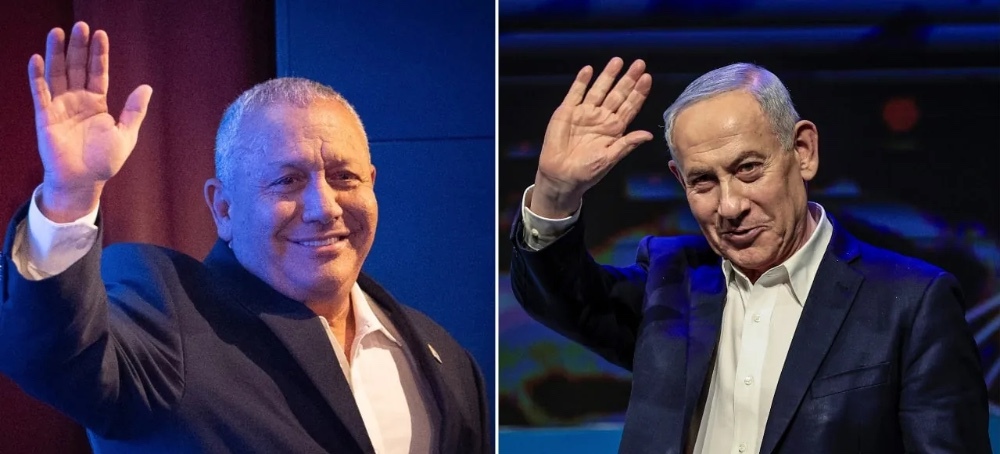 (L-R): Yashar head Gadi Eisenkot; Prime Minister Benjamin Netanyahu. (photo: Flash90)
ALSO SEE: Israeli Opposition Leader Tapped to Try to Form Government
Isaac Herzog’s decision means opposition politician has 28 days to attempt to put together a ruling coalition
Neither the bloc of opposition parties centred around Eisenkot’s Yashar nor Prime Minister Benjamin Netanyahu’s far-right coalition emerged from last week’s vote — widely seen as the most important in Israeli history — with a clear path to forming a governing majority.
But following several days of consultations with all parties that will be represented in the new Knesset, President Isaac Herzog said on Saturday that he had decided to give Eisenkot the first chance to cobble together a coalition.
During the consultations, 67 members of the new parliament recommended Eisenkot, a former general who entered politics in 2022, to form the next government. Netanyahu, whose coalition has ruled Israel for the past four years, was recommended by 46 members.
“The president informed the leader of the Yashar party, Gadi Eisenkot, of his intention to task him with forming a government,” Herzog’s office said in a statement, adding that he had invited Eisenkot to the presidential residence on Sunday for a meeting where he would formally entrust him with the task.
Herzog’s decision means that Eisenkot will have 28 days to attempt to put together a new government. That period can be extended by a further 14 days.
If Eisenkot is unable to form a government in that time, Herzog can give another politician a chance to put together a ruling coalition. In the event that no one is able to form a government, new elections would be called.
The bloc of four Jewish opposition parties headed by Eisenkot’s Yashar, which between them won 48 seats in Israel’s 120-seat parliament in last week’s election, has several ways to form a new government.
However, all of the main options have been ruled out by key members of the bloc — which also includes the centrist B’Yachad group led by Naftali Bennett, Avigdor Lieberman’s rightwing Yisrael Beiteinu and the leftwing Democrats — meaning that parties will have to go back on their pre-election promises if a Yashar-led government is to be formed.
One option for Eisenkot would be to put together a government dependent on the support of Israel’s two Arab parties, which won 19 seats between them. However, both Lieberman and Bennett have said they would not support this, while Eisenkot has set conditions for joining his coalition that would be difficult for the Arab parties to fulfil.
Another possibility would be to rely on the backing of Israel’s two ultra-Orthodox parties, which won 13 seats and have long been allies of Netanyahu but are increasingly frustrated with the veteran premier’s failure to pass legislation exempting their youth from Israel’s compulsory military service.
However, the opposition parties have made conscripting the ultra-Orthodox a key part of their platform, meaning that any agreement would be complicated to reach.
A third option would be a national unity government bringing together Yashar, Netanyahu’s Likud and other Jewish parties.
In a statement on Saturday, Netanyahu — who has relentlessly tried to delegitimise Israel’s Arab parties — sought to pressure Eisenkot into agreeing to a unity government. He said Israel “simply won’t survive” if a government dependent on Arab parties was formed.
Eisenkot’s Yashar party hit back, accusing Netanyahu of hysteria and saying that if Netanyahu’s Likud party wanted to be part of an Eisenkot government it would have to disavow its far-right allies.
“The man who divided Israeli society, tore it apart and sowed discord speaks of ‘unity’ only when he realises that his days in office are numbered. Unity is an important value for Israel. Netanyahu has systematically and resolutely worked against it, even during the most difficult war in our history,” Yashar said.