Is the Democratic Party Facing Its Own Tea Party Moment?
By Lisa Lerer and Katie Glueck The New York Times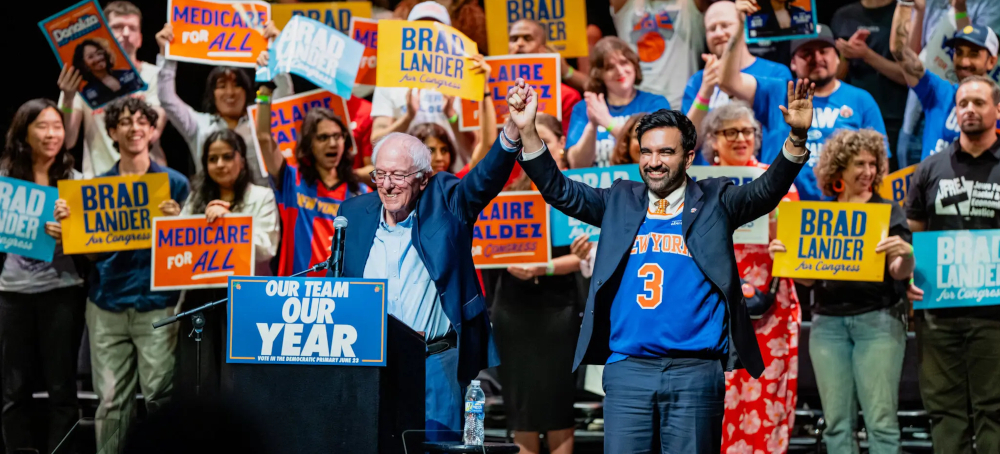 Bernie Sanders and Zohran Mamdani at a rally. (photo: Getty)
A string of primary wins by progressive candidates has revealed the strength of a high-energy insurgent movement but also its potential limitations.
But as primary season winds to a close, the results reveal not only the strength but also the potential limitations of this insurgent movement.
In Minnesota last week, Peggy Flanagan, the lieutenant governor, won a Senate primary by a double-digit margin, pressing a fiercely progressive message to defeat a more moderate opponent. Just a week earlier, Dr. Abdul El-Sayed, a left-leaning Democrat, won a Senate primary in Michigan despite being vastly outspent. And Francesca Hong, a member of the Democratic Socialists of America, came close to winning a primary for governor in Wisconsin, falling short by less than one percentage point.
The results marked a new level of political strength for candidates affiliated with a resurgent, activist left, showing that their movement can be competitive in statewide primaries, well beyond deep-blue House districts.
Yet while a vocal group of strategists, activists and college-educated voters have raced to embrace these pugnacious, boldly liberal — and in some cases untested — candidates, some of the voters who have historically been most crucial to the party’s fortunes remain skeptical.