
Iowans Say Warning Army Is Going to Blow up Degraded Lead Waste Came Too Late
Sarah Kaplan The Washington Post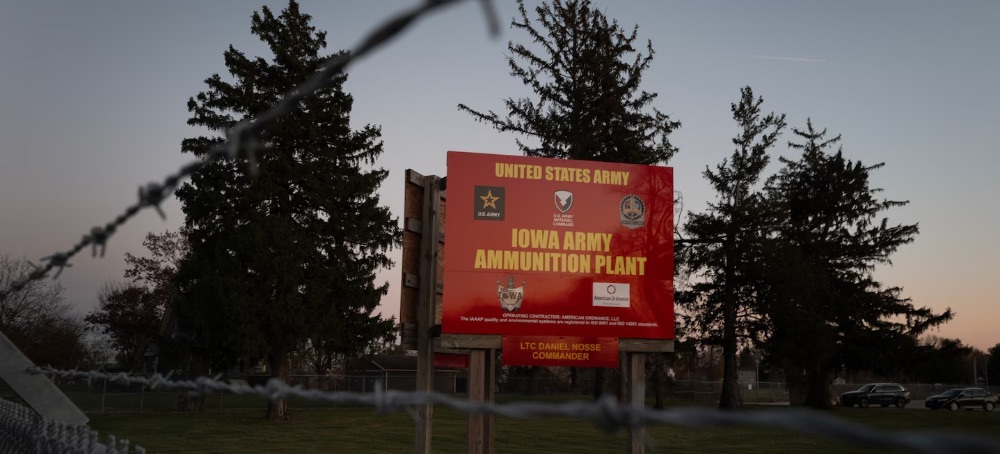 The Iowa Army Ammunition Plant in Middletown, Iowa, on Thursday. (photo: Scott Olson/Getty)
The detonation was postponed after an outcry from residents.
The controlled detonation of degraded lead azide was originally planned for Friday but was pushed to Monday after an outcry from residents and officials, who said they had not been given sufficient warning or input. Though the operation had been in the works for months, it wasn’t until Sunday that the Army notified the public about a resulting plume of lead particles that could extend as far as 100 miles north of the plant.
In a Thursday night post on X announcing the postponement, acting secretary of the Army Adam Telle said the three-day delay was the latest the explosion could be postponed before a forecasted cold snap, which would further destabilize the sensitive material.
Iowa Gov. Kim Reynolds (R) issued a statement soon after saying she had spoken to Telle and had requested the delay. “I’m grateful for his decision to do so,” she said.
Separately, an appeals court on Friday issued an administrative stay in response to a lawsuit from environmental groups challenging the Environmental Protection Agency’s permit for the operation. It is not clear whether the stay will delay the detonation beyond Monday.
But the extra time may not be enough to allay fears of lead contamination in a state where many are already on edge about the nation’s fast-rising cancer rate and potential health effects from pesticide use. Lead is a potent neurotoxin that can cause developmental problems and other health harms if it is inhaled or swallowed, according to the EPA. Infants, children and pregnant women are especially vulnerable, and science has not established any safe level of exposure.
“I understand that it is confusing and obviously this is not something that we wanted to do,” said Army spokeswoman Justine Barati. “But this is a emergent hazard that has to be addressed.”
The degraded lead azide, an explosive used in munitions, has become so unstable it must be destroyed, she said. Officials plan to detonate 68 barrels of the material inside the underground concrete chambers where they have been stored for 20 years. The buried chambers will be covered in two-stories worth of sand and sprayed down with misters in an effort to limit the amount of lead that is released. In an assessment released Wednesday, the Army concluded these measures will ensure the operation has a “less-than-significant impact” on the environment and public health.
The Army posted an advisory this week instructing people to stay indoors with windows closed while the lead is airborne, and to wipe down surfaces that children might touch after the all-clear has been given. In Middletown, a 363-person town immediately next to the plant, some residents were told to evacuate in case the explosion causes windows to shatter.
Yet many Iowans felt the communications around the detonation were too vague and came far too late. Even Reynolds found out about the operation from a public advisory just four days before the Army originally scheduled the operation, according to a spokesperson for the governor.
“It feels very rushed and very short term,” said one nearby resident, who spoke on the condition of anonymity for fear of backlash and because her relative works for the plant. “We’re all like, ‘Okay you’re saying this, but is it true, or how much of it is true?’”
After learning the operation had been postponed, she said it was a “great sign” the Army was listening to residents’ concerns. Yet she and her family plan to leave the area on Monday, and she remains worried about what they will return to. Will her garden be contaminated? Will food grown in the surrounding farmland be safe to eat?
Several Iowa officials, including Gov.-elect Rob Sand (D) and U.S. Sen.-elect Josh Turek (D) also called on the Army to delay the operation until residents’ fears could be addressed.Ask The Post AIDive deeper
Representatives for Sand and Turek did not immediately respond to a request for comment about the Army’s decision to postpone.
Under the terms of the EPA emergency permit, the Iowa Army Ammunitions Plant was required to map where airborne lead concentrations could reach 18 micrograms per cubic meter — a threshold below the federal exposure limit for workplace air. A second required map showed where the plume could deposit lead dust at concentrations of 5 micrograms per square foot (which the EPA considers a hazardous level of lead on floors) and 100 micrograms per square foot (the hazardous level for window troughs).
These maps, released Sunday, showed that surface deposition of lead could extend 30 miles north, reaching the Mississippi River and parts of Illinois.
Neither the Army nor the EPA responded to questions about what the maximum concentrations of lead in the plume are expected to be.
Officials first became aware there was a problem during a regular inspection of the lead azide barrels at the plant this spring, Barati said. The liquid used to stabilize the material had dried out, and the lead azide began to form crystals — a condition that makes it much more likely to spontaneously explode.
The Army is still trying to determine what caused the substance to recrystallize, Barati said.
A team of experts then spent the next several months trying to figure out what to do about it. Chemical neutralization would involve opening the barrels, potentially disturbing the crystals and creating “an extreme and unacceptable risk of fatal accidental detonation,” according to an Army assessment. Moving the barrels, either to an uninhabited area or even a more remote part of the facility, carried the same danger. If they did nothing, the lead azide would be a ticking time bomb — one that cold weather could make even more dangerous.
By September, the Army concluded that a controlled detonation was the only viable option.
The Army informed Middletown emergency services officials in September and held an open house for the town’s residents the following month, according to Barati. Communities beyond Middletown were not initially told about the operation because the lead levels they might be exposed to were thought to be “minuscule,” she said.
But the EPA emergency permit, which was issued Nov. 13, required five day’s notice for anyone living within the plume, so the Army began reaching out to city councils, fire departments and other local officials, she said.
By Monday, the news began trickling out on social media, raising alarm bells across the state.
“When we first found out about it we thought it was fake,” said Cody Smith, a program manager for the Iowa Environmental Council, one of the groups behind the lawsuit challenging the EPA permit. Smith said that local officials he spoke to had received no guidance from the Army or EPA on ways to protect their residents, and many were making decisions on the fly about whether to close schools and other facilities.
The incident also raises questions about whether communities are safe from other hazards connected to the plant, he added.
“Having not discovered this until earlier in the year is deeply concerning and speaks to a level of negligence from the Army itself,” he said.
Barati said the Iowa plant was permitted to store lead azide and conducted inspections every six months to ensure it was safe.
Some of the residents’ fear traces back to past concerns about the World War II-era facility, said Susan Dahl Mattoon, who grew up in the area and still works at Southeastern Community College in nearby Burlington. She recalled hearing the “booms” from ordnance tests and wondering what might be happening behind its gates.
The plant was named a Superfund site in 1990 due to widespread soil and water contamination. About 10 years later, dozens of employees were found to have developed cancers likely related to their work on a nuclear weapons assembly line there.
“Honestly our plant out here has had a reputation for looking the other way in the past,” Mattoon said.
That’s why the short notice and lack of detail about effects has her so concerned, she said.
David Cwiertny, director of the Center for Health Effects of Environmental Contamination at the University of Iowa, said it’s difficult to independently evaluate the possible risks from the detonation without additional information. The permit does not explain what models the Army used to forecast the potential lead dispersion or how they determined that the impact would be “less than significant.”
The Army’s guidance for residents is also confusing, he said. If the level of lead in the plume is insignificant, why advise people to avoid the area and wipe down playground equipment afterward, he asked. If lead deposited on a slide is unsafe, why is it any better to wash it onto the ground where children might also be playing?
Whether or not the detonation presents a major threat, the official messaging around it falls short of the central tenets of public health messaging, Cwiertny said.
“Better engagement, better and clearer communication, focusing on what real public health risks are, explaining expertise and assumptions used to arrive at those conclusions — all of that is needed, else people are just going to fill in the blank with their own thoughts and frustrations,” he said.

