Inside Russia’s New Gulag
Joshua Yaffa The New Yorker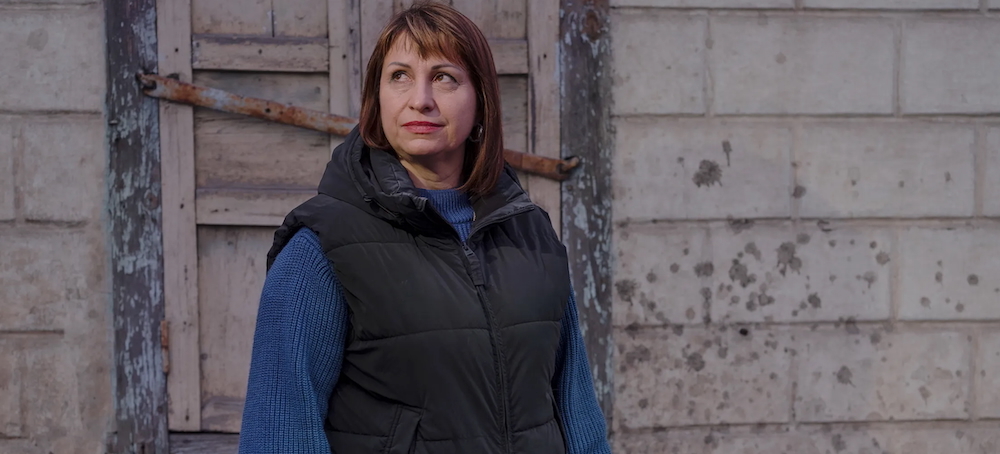 Liliia Prutian, a medic in Ukraine’s armed forces, spent more than two years in Russian jails. “Usually, I don’t want to remember,” she told me. “It’s all very painful.” (photo: Mila Teshaieva/New Yorker)
Human-rights groups estimate that more than ten thousand Ukrainian civilians have disappeared into the Russian prison system. This is the story of one cell.
Liliia Prutian had been at SIZO-1 for a year when, during lunchtime on September 10, 2024, a guard instructed her and about ten other women in her cell to follow him to the medical clinic. Before her capture, Prutian had served as a medic in the Aidar Battalion, a volunteer militia that had been absorbed into the Ukrainian armed forces. She is in her mid-fifties, a mother of three adult children, with a gentle bearing and fine dark-brown hair. Early in the war, she suffered a concussion and lost much of her hearing. The day that she was taken prisoner, on a battlefield near the village of Petrivske, she was raped by a Russian soldier. Three had initially approached her. “You have to understand,” one of them told her. “We’ve been in the field for three months.” Prutian, sobbing, told them, “Please let it be just one of you.” She later said, “You could say they met me halfway.”
Rostov is home to the Southern Military District, a key hub for Russian forces in Ukraine; Prutian had faced trial at the district’s military court. Previously, she had spent more than a year at a jail in Donetsk, an occupied region in eastern Ukraine, where she underwent a series of brutal interrogations. The jail in Rostov was less barbaric but no less stultifying. A Russian human-rights activist who has worked on behalf of Ukrainian inmates told me that conditions often improve for prisoners who are nearing their trial dates: “Defense attorneys are allowed to visit. Inmates receive and write letters. Once they are brought to court, it’s harder to keep outright torture hidden.”
That day, Prutian was led to the jail’s clinic with another former medic from the Aidar Battalion, who’d been captured alongside her. Most of the other women in the group had been cooks for the Azov Brigade, a Ukrainian military unit based in the city of Mariupol. The cooks had been arrested, in the spring of 2022, after Russia seized the Azovstal factory, a vast metallurgical complex that became the last stronghold of Ukrainian troops in the city. For Russian propagandists, the Azov Brigade, which began as a nationalist militia, was shorthand for the supposedly fascist influences from which Vladimir Putin claimed to be liberating Ukraine. Russia considered both Azov and Aidar to be terrorist organizations; the women were charged with, among other things, the illegal armed seizure of power. “Making borscht isn’t some kind of coup,” Natalia Golfiner, one of the Azov cooks, said in court.
At the jail’s clinic, a warren of rooms on the fourth floor, Prutian and the others were told to strip to their underwear. Medical personnel inspected them for bruises or other indications of abuse. If they discovered anything, the prisoner was handed a sheet of paper to sign—a declaration that she had no complaints about her treatment inside. For the women, the sudden interest in their well-being was a welcome sign. Obmin, Ukrainian for “exchange,” had been one of their main preoccupations from nearly the moment they had been captured. Prutian and the others knew that, in early 2024, prisoner swaps between Russia and Ukraine had resumed after a months-long pause. “We were on edge,” Prutian told me. “But also full of anticipation.”
After thirty minutes, guards took the women back to their cell. They were afraid to say anything to their cellmates, a half-dozen other women with whom they had spent the past year in a cramped concrete room, and who now greeted them with nervous, expectant faces. There was Iryna Navalna, a twenty-six-year-old with tattoos covering her arms, gauges in her ears, and a shaved head, who had been arrested on terrorism and explosives charges in Mariupol. Valentina Zayarnaya, a sixty-four-year-old English teacher, was being tried on similar charges. Natalia Vlasova, who’d been arrested in 2019, in Donetsk, was especially fixated on the idea of an obmin. She was forty-three, and among the longest-held Ukrainian civilian prisoners in Russian custody. Her only child, a daughter, was four years old when Vlasova was detained for allegedly taking part in an assassination plot. In Rostov, she kept a bag of clean clothes at the ready. When guards asked what it was for, Vlasova replied, “Obmin.”
The women from the Aidar Battalion and the Azov Brigade were enlisted members of the Ukrainian military, which meant that they had a chance of being included in exchanges as prisoners of war; the others, who were considered civilian criminals, likely did not. A few hours after the guards returned Prutian and the others to the cell, they came back and read out a list of names: all the women from Azov and Aidar would be moved that evening. “That’s when we knew,” Maryna Tekin, an Azov cook in her mid-thirties, said.
They began to pack up their few belongings: clothes, toothbrushes, diaries. The little food they had in the cell—cookies and tea, a few sticks of salami—was left behind for the others. Prutian gave Zayarnaya a bottle of shampoo. Another Azov cook, Iryna Mohitych, who was in her early forties, told Navalna that it was a great joy to have met her, regardless of the circumstances. “I’ll take your example with me,” she said. Vlasova, who during her years in Russian detention had watched countless times as others were freed and she was left behind, wept. “Her heart was heavy and aching,” Tekin said. She gave Vlasova a Ukrainian flag that she had drawn on a sheet of graph paper, telling her, “If I make it back to Ukraine, let this be a symbol that you, too, will soon return.” Vlasova tried to smile.
At three in the morning, after the guards ordered, “S veschami”—“With your belongings”—the selected prisoners exited the cell. For a moment, the women faced each other through the bars of the door. They had been a single group, bound by a shared reality; now a few inches separated those who were about to be free and those who were beginning another morning in captivity. Alyona Avramova, a fifty-one-year-old Azov cook, found it difficult to look the other women in the eye. “I walked out,” she said. “And they stayed behind.”
This spring, I travelled around Ukraine to meet with the women who’d been released from Rostov. I spoke with Tekin at a mall in Kyiv, where she now works at a flower shop; Avramova and I sipped tea at her apartment, in the Kyiv suburbs. In a small industrial city in eastern Ukraine, where a Russian ballistic missile had struck a hospital some months before, I took a long walk through a park with Prutian. She has rejoined the Aidar Battalion, but, owing to the trauma of her experience in prison, she no longer serves near the front line. “Usually, I don’t want to remember,” she told me of her time in jail. “It’s all very painful. I keep having dreams where I end up back in captivity.” Still, she and the others expressed hope that, by describing their time in prison, they could bring attention to the women who are still there. “For them, I’m ready,” Prutian said.
SIZO-1 is a single point in a constellation of detention centers and prison camps across Russia, a new Gulag that extends from the border with Ukraine to the permafrost zone above the Arctic Circle. In more than four years of war, roughly fifteen thousand Ukrainian soldiers have been taken prisoner; about two-thirds of them have been released in periodic exchanges between Ukraine and Russia. But women like Navalna, Vlasova, and Zayarnaya represent something else: the unknowable number of civilians who have been detained or arrested in occupied territory and taken into Russian custody. In some places, they are held with Russian inmates; in others, they are kept isolated, hidden not just from the outside world but from the rest of the prison population. At least thirteen hundred Ukrainian civilians have been formally charged with specific crimes, according to researchers. A larger number, believed to be more than ten thousand, have effectively disappeared—that is, been detained without any legal process or acknowledgment of their status. As one report last year by a Ukrainian parliamentary commission noted, “Civilians are taken from their homes—without trial, without explanation, without the right to make a phone call.”
Legally speaking, the very idea of a civilian prisoner in wartime is a contradiction. The Geneva Conventions, a set of treaties governing the conduct of warring parties, which were ratified in the aftermath of the Second World War, forbid the arbitrary detention of civilians. “This category shouldn’t exist in the first place,” Bohdan Okhrimenko, the head of the secretariat of Ukraine’s Coordination Headquarters for the Treatment of Prisoners of War, said. While in Kyiv, I visited the headquarters, a nineteenth-century brick building that has been refashioned into a nondescript suite of offices. Most days, the lobby is bustling with relatives of the imprisoned or vanished hoping for a meeting or some news of their loved ones. The official Ukrainian position on civilians held in Russia is clear. Okhrimenko told me, “They should not be exchanged but, rather, immediately released and returned home.”
According to Russia, civilians from Ukraine are not prisoners of armed conflict; they are individuals charged and tried for alleged crimes. “For Ukraine, these are illegally detained persons,” Andriy Yusov, the deputy head of the coördination headquarters, said. “But Russian officials cannot acknowledge the existence of such a category. Otherwise, they would be publicly admitting to their own war crime.” In other words, by processing such detainees through the judicial system, the Russian state has found a way to legalize the illegal. Ukrainian civilians have been tried in courtrooms in cities occupied and annexed by Russia—from Donetsk to Sevastopol—as well as those farther afield, in Moscow, St. Petersburg, and the Southern District Military Court, in Rostov.
I exchanged letters with several women from the Rostov cell who remain in Russian custody. Vlasova told me that her experience in Russian jails and detention centers has been so varied, “in terms of the conditions, the attitude of the staff, and the community of fellow-inmates,” that it belied easy description. “And I couldn’t share everything here”—in a letter—“anyway.” Zayarnaya, the English teacher, called prison “a school of survival, a test of the humanity and decency in each of us.”
Iryna Kulish spent the better part of a year in Rostov. She is from a small village in the Zaporizhzhia region, where she used to sell vegetables at a local market. After the region was seized by Russian forces, she was reported to the occupation authorities for her pro-Ukrainian views. Russian prosecutors accused her of plotting a bomb attack. Kulish is in her mid-fifties and has Parkinson’s. In prison, her condition has deteriorated. The tremors in her hands are so intense that she has trouble sleeping. “Please don’t think they have broken me,” she wrote to me in a letter. “But I nonetheless want to share the particular pain in my soul.” Kulish has been shuttled nearly non-stop between more than twenty detention facilities. She wrote to me from a jail in Crimea. “When and where they will transfer me next I still don’t know,” she said. “For now, I am sitting here, waiting.”
Kateryna Korovina, twenty-nine, slight and soft-spoken, is from the town of Starobilsk, in the Luhansk region, which was occupied in the early weeks of the war. Two years later, she was arrested for making a series of small donations, totalling the equivalent of twelve U.S. dollars, to Ukrainian accounts. Korovina said that they were for humanitarian causes, to help civilians affected by the war. Russia’s main intelligence agency, the F.S.B., claimed that the money went to the military and charged her with “financing terrorism.” She arrived in Rostov in 2024, and was ultimately sentenced to ten years in prison. “That is how they valued my love for my native country,” she wrote to me.
Korovina said that, in the Rostov jail, she and her cellmates had been “something like a slightly mad family.” They could be silly, funny, even joyous, singing folk songs and dancing around the cell. Over time, she said, “people here change, grow distant from civilization, and build their own little comfortable world as best they can.” She also started writing poetry; her verses reflected the bewildering situation in which she found herself. “Ideas for new poems were in the air all around me,” she said. “Lines poured out like music.” She shared one with me: “We are all orphans without our Motherland, but we have one another, which means we will not be lost; after all, even flowers torn from the ground can be woven into garlands, and we will get through everything.”
Ukrainian civilians are arrested by the Russian military or security forces for any number of supposed offenses. A secret Presidential decree, signed by Putin soon after the war began, allows for the indefinite detention of anyone “resisting the ‘special military operation.’ ” Many are initially held in improvised settings—a garage, a cellar, an empty warehouse—then moved to a larger facility in occupied territory. Several of the women in Rostov first met one another at the jail in the so-called Donetsk People’s Republic, a proxy enclave that Russia formally annexed in 2022. The jail’s main structure was built in the waning years of the Russian Empire, with tall concrete-and-barbed-wire walls added during the Soviet era. In the early days of the war, the jail became so overcrowded with Ukrainian prisoners that many inmates had to sleep in shifts, or even take turns standing up. “A cruel, terrible place where helplessness and despair wear you down,” Tekin, one of the Azov cooks, told me.
After Russian forces seized Mariupol, Tekin voluntarily went to a so-called filtration center, a processing facility meant to root out those whom Russia considered dangerous, or merely pro-Ukrainian. Russian messaging encouraged Mariupol residents to “come and surrender and you’ll go home,” Tekin said. Instead, armed men—military or Russian intelligence, she didn’t know which—threatened to cut off her fingers if she didn’t confess to being a fascist. She was held in several detention centers in occupied Ukraine before she was brought to Donetsk.
There, guards forced her and the other Azov women onto the ground and told them to crawl across the concrete floor and into their cell, a basement smaller than a studio apartment, with a sliver of window just above ground level. The space was dark and squalid. On the floor were six cots and a couple of mattresses, stained and foul-smelling. More than ten other Ukrainian women were already being held there. They told the new arrivals to quickly memorize the words to the Russian national anthem. The guards would soon return and demand that everyone stand and sing. A single mistake, the cellmates warned, and the guards would strike the offender with steel-reinforced rubber batons. “It didn’t matter if you had been there one hour or one month,” Tekin told me.
Each day, the women were woken at six, with the sounds of stomping boots and barking dogs. Guards worked their way down the corridor, randomly striking prisoners. One morning, Tekin overheard a guard complain to his colleagues, “I’m fucking exhausted of beating so many of them.” Another time, Tekin and the other women listened as guards bludgeoned a Ukrainian soldier in a cell across the hall. They couldn’t see anything, but they heard hard rubber hitting flesh and the man’s cries of pain. After the guards left, the man continued to moan; his cellmates called for a doctor. “Give a knock when he dies,” one of the guards answered. The next day, Tekin looked through the peephole of her cell door and saw guards dragging out a corpse.
The basement cell had no sink or running water; the toilet was a drainpipe in the floor. “The stench was so acrid, it stung our eyes,” Prutian, who arrived at the Donetsk jail shortly after Tekin, told me. The women learned to save some of the borscht that they were given for lunch so that they could pour the liquid down the soiled drainpipe. They fashioned menstrual pads by ripping up their own T-shirts, and passed one another shards of soap to share, though the guards rarely took the women for showers. After a week, many of them developed festering sores on their arms, legs, and hands. Mohitych, one of the Azov cooks, told me, “We were rotting alive.” She begged for a doctor to visit the cell. A nurse on staff at the jail told her to forget about it. “Doctors aren’t provided in a concentration camp,” she said.
The female prisoners were overseen by a Donetsk local in her forties named Ludmila Valerievna. “She had a thing about smothering you with a bag over your head,” Mohitych said. “And telling you over and over that you’re about to be taken out and shot.” The women were routinely marched to an interrogation room. Tekin recalled, “You so much as squirm in the chair and there’s a man standing above you, waiting to pummel you: kidneys, head, you never knew where the blows will land.” Like Ludmila Valerievna, the guards were from Donetsk, and Tekin once asked them, “Why are you doing this to us? You’re Ukrainians, too.” They refused to answer.
After a few months, Navalna, the twenty-six-year-old from Mariupol, was brought into the cell with a bag over her head. Purple bruises covered her back and buttocks. “She was in a daze, frightened, shaking all over,” Prutian said. The women tried to calm her. Navalna told them that the Russian state had labelled her a terrorist. That made the others laugh. “Us, too!” Mohitych told her. “You’ve landed among your own people.”
In the spring of 2022, Navalna had fled Mariupol with her mother, Oleksandra, settling in Berdychiv, a midsize city a hundred miles west of Kyiv. Her grandmother, who was seventy, had opted to stay put. She lived on the seventh floor of a Soviet-era apartment block that had been without electricity since the start of the war. That summer, Navalna returned to Mariupol to help her. On the day that she was due to leave the city, according to Russian prosecutors, she planted a bomb at a municipal building where residents were voting in a staged referendum to pave the way for Russian annexation. Hours later, Russian state news agencies posted a clip of Navalna’s confession, in which she said that she had accepted an explosive device from an unknown handler. Navalna later described being beaten and shocked with a stun gun during the interrogation; her captors threatened to harm her mother and grandmother if she didn’t coöperate. “In the end,” she said, “I agreed to incriminate myself to save my life and the lives of my loved ones.”
In Donetsk, Navalna became close to the other women. Tekin called her “talented, smart—brilliant, even—with a very sensitive nature.” Avramova said that she was “full of spunk and attitude.” Occasionally, Navalna’s grandmother, who was still living in Mariupol, came to drop off a care package, which sometimes contained hard candies. The women used small stones to carefully break apart each piece. “We passed them around,” Prutian told me. “Just enough for everyone to have a taste.”
One morning, guards came to the cell and told the women to line up and face the wall—standard protocol for when a new prisoner was being admitted. After they turned back around, they saw Zayarnaya, the English teacher, who was wearing eyeglasses and slippers. Out of a sense of respect, the other women came to address their new cellmate by her name and patronymic, Valentina Ivanovna. “She presented as a very intelligent person,” Prutian said. “Someone who manages to find her way in every situation.” In a letter to me, Zayarnaya described that first meeting: “The girls turned toward me and I saw young, pale, thin faces with lively, attentive eyes.”
After fourteen months in the Donetsk basement, the Azov women got word that they were being moved. A transport vehicle drove them to Rostov, a hundred and seventy miles away. The bus pulled up to SIZO-1 late at night. The women were prodded into a small holding cell, known as a stakan, or “the cup,” and told to line up against a wall. A phalanx of guards surrounded them. In Russian prison slang, priyomka, which means “intake” or “reception,” refers to the rough welcome that prisoners often receive at a new facility. It usually involves verbal abuse, humiliation, and beatings.
The women tensed when the deputy warden of the Rostov jail, a curt, imperious man with a heavy-footed gait, walked in. “He came to scream at us, to call us names,” Avramova said. “But then, when he saw our sorry state, he was speechless.” The women looked terrible—bruised and sallow—and smelled even worse. The warden told guards to take them for a hot shower, and to give them a proper meal: soup with tinned fish and fresh bread. The smokers got cigarettes. “We hadn’t seen anything like that in over a year,” Avramova told me. “It was a shock.” Tekin said of the warden, “In his mind, he probably saw this deed as a great act of chivalry. You do something noble for a woman, keep an eye on her—which is also a way of possessing her.” But, she added, “let’s not forget he is, after all, a total monster.”
The women’s new cell was also in a basement, but it had running water and a working toilet cordoned off by a plywood door. “After a year in a cellar, any jail cell will feel great,” the Russian human-rights activist said. Prutian, Zayarnaya, and Navalna soon arrived from Donetsk for their own trials. Wake-up was at seven, announced with a shout from the guard on duty: “Podyem!”—Russian for “Rise!” Prisoners had to quickly make their beds, tucking the corners tight. At eight, guards slid trays with breakfast into the cell. Around nine, the women did a daily exercise routine, a circuit of stretching and light calisthenics. Afterward, they cleared their one small table, and Zayarnaya led whoever was interested in English lessons. In a letter to me, she described a study guide that she had managed to get sent to her in jail. “We covered everyday topics,” she wrote. “About Myself, Family, My Home and City.” She still had the heart of a schoolteacher. “I have tried not to single anyone out,” she said. “They all deserve praise simply because they want to learn.”
Zayarnaya is from Amvrosiivka, a small city near Donetsk. Two months into the war, she received a call from an old acquaintance, a former Ukrainian border guard roughly her son’s age, whom she knew only as Dima. He said that his house had been destroyed and that he was stuck in Mariupol. “How could I leave him there?” Zayarnaya later told her cellmates. She drove ninety miles, through multiple Russian checkpoints, to pick him up. Dima was famished and weak, and Zayarnaya nursed him back to health. With time, he began doing odd jobs around her house and working in the garden. He ended up staying for a year.
One day, he asked Zayarnaya to pick up a package for him at an address in Donetsk. When she arrived, F.S.B. officers were waiting and quickly arrested her. Dima fled, only to be detained ten days later. Under questioning, Zayarnaya learned the full truth about him. His real name was Denys Storozhuk. He was a lieutenant colonel in the Ukrainian military, and he’d fought during the siege of Azovstal. Before Ukrainian forces surrendered, Storozhuk had managed to escape. That meant, as F.S.B. interrogators informed Zayarnaya, she had harbored an enemy soldier. They also alleged that the package Storozhuk was meant to pick up contained explosives. She was charged as an accomplice to terrorism.
Zayarnaya’s cellmates expressed frustration that Storozhuk had concealed his identity. But, Mohitych told me, “she always defended him.” Zayarnaya and Storozhuk were often brought to court together, and Zayarnaya tried to collect candies or other treats to give to him. Later, in a letter to me, she called Storozhuk “Dimochka,” an affectionate version of Dima, and referred to him as a second son, saying, “The most important thing is that my boys are alive and free.”
Afternoons in Rostov were for playing backgammon, reading books, and writing letters. The women were able to receive packages from the outside, and an informal network of volunteer activists in Russia sent them everything from toothpaste to crossword puzzles. Mohitych told me about a recipe that she developed in prison for morkovcha, a marinated-carrot salad popularized by ethnic Koreans in the Soviet Union. Tekin passed the time inventing intricate plots for imaginary films and narrating them aloud: a historical thriller, a lesbian romance, a drama about a virus that wipes out much of humanity. Once a day for an hour, guards took the women to the exercise yard, which was essentially a jail cell with an open roof. Tekin and Navalna liked to sing pop ballads and theme songs from old movies, as loudly as they could. Some guards told them to knock it off; others ignored them. A few smiled.
Life in the cell created an unavoidable intimacy. Mohitych told me that she and Navalna spent hours lying on their bunks, telling stories, gossiping, and laughing. “We talked about all sorts of things,” she said. “Our families, plans, dreams, the past, the future.” Mohitych could sense when Navalna was struggling: she became quiet and withdrawn as she turned over a difficult or painful thought. “In those moments,” Mohitych told me, “I simply walked up to her and said, ‘Ira, let’s talk some more,’ and she opened up, letting out everything that was bottled up inside.” Mohitych said that Navalna did the same for her: when Mohitych was agonizing about being separated from her daughter, who was twenty-three, Navalna would offer a kind word or a hug. “She was just a young girl caught in this impossible situation,” Mohitych said. “But she displayed such bravery.”
Sometimes the mood turned bitter, with fights erupting over insignificant matters. One person might open the small window; another wanted it closed. Someone wanted to read a book that another thought belonged to her. “Every one of us lived inside our own sorrow,” Avramova said. “And each was convinced that her suffering was the most painful.”
For birthdays, the women would make an improvised cake, spreading thick ribbons of condensed milk over stacks of cookies. They poured tea and took turns making toasts. “It was touching,” Avramova said. On her fiftieth birthday, her cellmates handed her a card written by a fellow-prisoner, a Ukrainian woman in her late sixties, who had spent less than a week in the cell. The woman had been on etap, a word in the Russian prison lexicon which refers to the convoluted transfer process between detention centers. During etap, a prisoner can make half a dozen stops over as many weeks before reaching her destination. Avramova remembered only the woman’s first name, Alla, and that she was on her way to a prison colony, where she would serve a sentence of more than ten years. The card, Avramova said, had a hand-drawn picture of a horse, and a message inside read, “May you celebrate your next birthday in a place you love with all your heart.” Avramova asked a guard if he knew where Alla was headed. “She got a one-way ticket,” he answered. Avramova understood the implication: “Wherever she was going, she was unlikely to survive.”
Vlasova arrived at SIZO-1 in June, 2023. During her priyomka, guards confiscated a small photo album containing a few pictures of her daughter, who was then eight, which they never returned. “The ladies gave me a warm welcome,” she said in a letter. She had overlapped with many of them in Donetsk, but she had been held in a different cell. Her transfer to Rostov, she told me, felt like a chance to exhale, “as if a plotline that had held me in its mercilessly tight grip finally loosened, and a ghostly hope that I might survive after all began to take shape.”
In Rostov, Vlasova treated every court hearing as a chance to dress up—it was an expression of pride and dignity, akin to “stepping out into society,” she said. “And I didn’t want to be seen always wearing the same thing.” The cellmates shared whatever basic cosmetics they had, and traded outfits, including any new items of clothing that had come in care packages. Vlasova would stage an “obligatory fitting and runway show” for the other women—her “fashion critics”—so that they could “deliver their verdict.” Once, a guard asked where she got her clothes from. Vlasova answered, deadpan, “From my collection.”
The trial itself was filled with all manner of inconsistencies and contradictions. Vlasova had been arrested at a Russian checkpoint, in Donetsk, in March of 2019. She said that she and a man named Viktor Shydlovsky were pretending to be a married couple and travelling with fake passports. They had instructions from the S.B.U., Ukraine’s security service, to determine whether one of the agency’s assets had flipped and was working as a double agent. Russian prosecutors claimed that Vlasova and Shydlovsky were on an assassination mission, intending to kill a high-ranking officer in the Donetsk militia forces. Vlasova had confessed as much during her interrogation, but in court she recanted her prior statements, saying that they were extracted under torture. According to Ukrainian activists and journalists, officials in the Donetsk People’s Republic often manufactured assassination plots to retroactively justify a person’s arrest or mistreatment. “Officially, the court follows the two-sided adversarial principle,” the Russian human-rights activist said. “We know perfectly well none of it matters.”
A year into Vlasova’s trial, she was given a chance to address the court. “You will have time,” one of three judges on a panel overseeing her case said. “Prepare.” Vlasova told her cellmates that she was ready to reveal, plainly and clearly, the story of her imprisonment. Tekin said, “She told us directly: ‘I want to be heard, noticed—and I hope that helps get me out of here.’ ”
Whatever the true nature of Vlasova’s mission in Donetsk, she had soon found herself in the region’s most notorious detention center: Izolyatsia, a former factory built in the fifties to manufacture insulation materials which, after the Soviet collapse, became a center for contemporary art. Russian proxy forces had seized the complex in 2014 and turned it into a secret prison. A 2021 report by the Office of the U.N. High Commissioner for Human Rights compiled dozens of instances of abuse inside Izolyatsia; one prisoner called it “the worst place on earth,” and described his captors wrapping wires around his fingers, toes, and genitals and then turning on an electric current. Once, they put a wire in his anus. According to the report, “The victim also described a mock execution in which he was forced to stay inside a closed coffin placed in a dugout grave for six hours.” Another man passed out after a wire with an electric current was fixed to his ear. His cellmate advised him to confess to anything, because “there was no other way” to stay alive.
In court, Vlasova called Izolyatsia “the death factory,” run by “merciless bandits” with “an obvious pathology.” “They were sadists in the strict clinical sense of the word,” she said. “They stripped me, bound me with tape, poured water over me, and gave me electric shocks. If I didn’t scream enough, they increased the electric current, and the blows became more frenzied.” The louder her screams, the more satisfied they seemed. “They needed a reaction,” she said. During many of these torture sessions, a doctor was present. When she lost consciousness, he revived her by shoving a cotton ball doused in ammonia up her nose. “Afterward,” she went on, “they chained me up overnight in a narrow standing cell with my arms raised.”
Before long, Vlasova lost any awareness of time and space. There was darkness, and then the sound of jangling keys, which induced terror. “That never meant anything good,” she said. One time, she was brought to a shower and was told that fifteen soldiers were getting ready to rape her; they changed their minds only when they discovered that she was menstruating. “As usual, they were drunk,” she said. “At some point, indifference sets in and you no longer care what is happening or what will happen next. My fate is not in my hands. My body does not belong to me.”
She identified a man named Vasily Yevdokimov, who had the call sign Lenin, as the overseer of Izolyatsia. (Yevdokimov was also the supposed target of Vlasova’s alleged assassination attempt.) In court, she recounted her own grim run-ins with him: “He personally filed my teeth with a metal file, twisted my nipples, and tried to force a bottle into my vagina.” At a certain point, when the torture became unbearable, she begged her captors to stage an escape attempt and to shoot her in the process. They refused, because, she recalled, “Yevdokimov said I had to suffer.”
The trial was open to the public, and a few journalists and activists attended. One of them recalled being surprised that the judges never interrupted Vlasova’s speech to declare that it didn’t pertain to the narrow matter under consideration. Instead, they mostly listened in silence. When Vlasova was finished, a judge asked if she wanted to enter her written notes into the court record. “We were in shock,” the person in court that day said. The judge’s reaction seemed to be a quiet signal. “It was a gesture on the scale he was allowed,” the person said.
Tekin told me that, after the court hearing, the women greeted Vlasova with applause. “We were proud of her,” she said. In a letter, I told Vlasova that I imagined her testimony required great courage. “I’m pleased that I come across as courageous and strong, but that’s not how I view myself,” she wrote. “It’s just that, in a place like this, there aren’t many chances to show weakness—though I’d like to.” Five months later, the panel of judges found Vlasova guilty, and sentenced her to eighteen years in prison.
Most months, a procession of buses, vans, and ambulances from Russia make their way across Belarusian territory, delivering the latest round of freed prisoners to the Ukrainian border. Depending on the exchange, anywhere from a dozen to more than a hundred Ukrainian prisoners get out, and board a different set of buses. The next stop is often a regional hospital in Chernihiv, a Ukrainian city thirty-five miles from the border with Belarus, where they are given checkups and medical care. A crowd of relatives typically gathers outside—eager to see their loved ones, or, just as often, to show returnees a picture of a husband or a son and ask whether they had encountered him in captivity.
To date, more than nine thousand Ukrainian soldiers have been released in nearly eighty separate exchanges. “We have found a mechanism, a channel of dialogue, to talk about combatants who took part in armed conflict,” Okhrimenko, the head of the secretariat of coördination headquarters, told me. Since 2022, a much smaller number of civilians—around four hundred and thirty—have been freed from Russia. At least a quarter of them were not war-related hostages but, rather, Ukrainian citizens who had committed criminal offenses in Russia and were already awaiting deportation. In some cases, Ukraine didn’t know whom Russia was handing over until after the exchange. “Of course, it’s difficult to carry out negotiations with the Russian side,” Okhrimenko said. But, he went on, “we have to keep up this communication, so I don’t want to say anything negative.”
International law and Ukraine’s own policies forbid trading P.O.W.s for civilians. “That would make us the rule-breakers,” Okhrimenko said. When he has raised the question of civilian prisoners with his counterparts in Russia—representatives from the country’s Ministry of Defense—the conversation has generally gone nowhere. “They tell us they are responsible only for military detainees, not civilians,” he said. “We’ve come to the conclusion that, on the Russian side, there simply isn’t anyone able to deal with civilian prisoners.” Oleg Orlov, a founder of Memorial, a Russian human-rights organization, which is now based abroad, told me that Russia considers civilians who resist or subvert Russian authority more culpable than traditional P.O.W.s. The country’s position, he said, is that “this is not a soldier in uniform who was ordered into battle. This is a person who made a deliberate choice to harm us. So screw them. Let them rot away.”
In occupied territories, many Ukrainian civilians have obtained Russian passports—accessing much of daily life, such as banking and housing, is nearly impossible without one. “The Russian state considers such people their own citizens, whom they are under no obligation to hand over or repatriate to a third country,” Viktoria Petruk, an analyst at the prisoner-coördination headquarters, told me. Over time, Russian prosecutors have begun to charge more of these Ukrainians with treason—for the crime of betraying Russia—rather than with harming the interests of a foreign state.
In negotiations, the Ukrainian side doesn’t present specific people to be included in exchanges but instead proposes freeing certain categories of prisoners. “We regularly tell them, for example, ‘Look, you’re still holding our women captive—let’s resolve this,’ ” Okhrimenko said. Oftentimes, there’s no response. In the case of the Azov and Aidar women, Russian negotiators were willing to consider their release, given that none of them had taken part in any direct fighting and that Russian investigators had finished interrogating them. But, when Ukrainian negotiators push for more detainees, their Russian counterparts tend to respond coolly. “We aren’t ready to discuss the others right now,” Okhrimenko said, recounting the common Russian response. “If you don’t like it, we won’t exchange these ones, either.”
The coördination headquarters routinely holds meetings with the families of civilian prisoners. Navalna’s mother, Oleksandra, has attended many of them. “But, frankly, I don’t really see the point,” she told me. “All you hear are empty platitudes.” The usual refrain, she said, was a promise that representatives were “working on developing a mechanism, but for now it doesn’t exist.” Yusov, the deputy head of the coördination headquarters, said that he understood these family members’ anguish. “They are a very emotionally vulnerable group of people,” he said. But, he went on, Ukraine wasn’t responsible for the impasse. “This is not a question for us, about whether we are willing to release this person or to try and get back that person,” he said. “This is Russia’s responsibility. They effectively kidnapped these people and refuse to hand them over.”
Ukraine is working on a few creative solutions to help free more civilians in Russian prisons. A project called Hochu k Svoim, or I Want to Join My Own Kind, allows Ukrainians who were convicted of collaborating with Russian military forces or occupation authorities to volunteer to be transferred to Russia; Russia, in turn, sends back an equal number of Ukrainian civilian prisoners. This is considered not a prisoner exchange but, as Yusov put it, a “mutual return of civilians.” According to officials in Ukraine, several hundred Ukrainian citizens serving sentences for collaboration and similar offenses have expressed willingness to be sent to Russia. But only seventy have made the trip, with a commensurate number of detained Ukrainian civilians freed in the process. Russia has so far refused to accept the rest. “We can release these people, take them to the border, and tell them, ‘Go on,’ ” Okhrimenko said. “But there’s nothing we can do if Russia doesn’t let them in.”
Orlov, the Memorial co-founder, spent nearly half a year in Russian prison—for the crime of having “discredited” the Russian military—before he was freed in an exchange, in 2024. “I have a feeling I was granted a chance to try and do something,” he told me. Last year, he helped launch People First, a lobbying effort to get Western officials and diplomats to include the topic of civilian prisoners in any peace negotiations. The idea is that these third-party powers will have the best chance of insuring that Russia and Ukraine agree on a so-called all-for-all exchange, which would free all remaining prisoners—military and civilian—as part of the war’s end. “If we don’t speak about civilian prisoners now, they risk being left behind later,” Orlov told me. “And then simply falling through the cracks forever.”
One afternoon in Kyiv, I met up with Vlasova’s husband, Oleksii, and their daughter, Yulia, who is now eleven years old. By then, Vlasova had been detained for more than seven years. Yulia was mostly silent during the couple of hours that I spent with her and her father. (An acquaintance of the family had prepared me for this. “She has withdrawn into herself,” the acquaintance said. “And it’s not clear how to get her out.”) Oleksii, who is forty-nine, gentle and warm, turned to Yulia, who had just finished school for the day, and explained, “He’s here to write about Mom.” Yulia picked quietly at a plate of French fries. My only exchange with her was brief. “What would you like to do with your mom when she comes home?” I asked. “Go on walks,” she said, so quietly that I had to lean in to hear. “Hug.”
Oleksii and other family members had tried to keep Yulia from seeing news of her mother’s torture. But, within days of Vlasova’s testimony, Yulia had read the coverage of it. She had only one question: “What are nipples?” Last year, Yulia took part in an action, held in Kyiv’s Independence Square, to call attention to Ukrainian women held prisoner in Russia. She brought a sign that referred to one of her last memories of Vlasova: “Mom, remember you promised me a kitten?”
Oleksii expressed disbelief that Vlasova hadn’t been included in an exchange long ago. “Given that by this point she’s been locked up longer than anyone, we figured the chance of her being freed was that much higher,” he said. He and Vlasova’s supporters write appeals—to the Administrations of Volodymyr Zelensky and Donald Trump, to the Vatican—advocating for her release. The prisoner-coördination headquarters routinely asks Oleksii to verify Vlasova’s info on file. “And each year,” he said, “they confirm that she’s eligible to be exchanged—and that’s it.” There’s also a password, known only to him and Vlasova’s sister, that he can use to access the limited information that Ukrainian authorities have about her whereabouts. This spring, she was sent to a prison colony in Kemerovo, a coal-mining region in Siberia.
The trial of Navalna, who was accused of planting a bomb at the municipal building in Mariupol, had concluded two months before Vlasova’s. I spoke with her lawyer, Ivan Bondarenko, who told me about a number of inconsistencies in the prosecution’s case. For example, a police witness had initially claimed that he saw Navalna throw a bag on the ground at the municipal building; in court, the witness said that he didn’t see anything himself and had merely heard these details later. In October, 2024, Navalna was found guilty, but of a lesser category of terrorist plotting, and sentenced to eight years in prison, rather than the fifteen that the prosecution had requested. Bondarenko called the ruling a “small victory.” The judge, he said, “made clear that our words had reached him. But, in these circumstances, he couldn’t do anything more.” Navalna is now in a prison camp in a village near Russia’s border with Kazakhstan.
Zayarnaya’s trial ended in December, 2025. Prosecutors had argued that she and Denys Storozhuk, the man she knew as Dima, were accomplices in an assassination plot. Zayarnaya had confessed but told the court that she did so under duress. F.S.B. officers had beaten Zayarnaya’s son and threatened to send him to a mental hospital if she didn’t provide the testimony they needed. After she signed the confession, she tried to kill herself by swallowing a handful of pills for high blood pressure. She survived, and was sent to the Rostov cell. In closing arguments, prosecutors asked for a twenty-year sentence. Zayarnaya called the request “godless,” telling the Russian lawyers, “It will be on your conscience.” The judge gave her twelve years. “I won’t lie: it is very hard for me here,” she wrote in one of her letters to me. But, she added, “I refuse to give up, nor will I play by the rules of the morally dishonest.”
One of the darker ironies of Zayarnaya’s case is that Storozhuk was freed in the same exchange as the Aidar and Azov women. Prutian saw him on the bus that delivered the prisoners, via Belarus, to Ukrainian territory. “Here we are, being driven to the exchange point,” she told me, “and sitting right behind me is Dima—the person who Valentina Ivanovna was constantly talking about.”
I met Storozhuk this spring in Kyiv. He is thirty-eight, affable and charming, and has a military build. He told me that, in May, 2022, as Russian forces were bearing down on the Azovstal plant, he collected supplies—weapons, food, water, a phone—and descended into a utility shaft deep within the factory complex, where he remained hidden for the next three weeks. Eventually, he fashioned an improvised raft from the tube of a car tire and donned a wrestling singlet that he’d coated in silicone sealant. His plan was to launch into the Sea of Azov, under the cover of night, and swim to a village behind enemy lines. “Nothing better came to mind,” he said. He swam several hundred feet from shore, heard gunshots, and ended up at a fishing dock on the outskirts of Mariupol. He called Zayarnaya. She had a “distinct sense of loneliness,” he said, and lacked an “object for her maternal care.”
After a month at Zayarnaya’s house, Storozhuk got in touch with an officer in Ukraine’s military intelligence agency, whom he called Severny. Storozhuk told Zayarnaya nothing. “I figured that she’d be in danger only if she helped me knowingly,” Storozhuk said. “So you could call it deception on my part, but she had no idea. I judged that she’d be safer that way.”
One day, in March, 2023, Severny sent Storozhuk a package containing a false passport, which he could use to travel freely within Russian-controlled territory. But Storozhuk would have to go to Donetsk to pick it up, an hour-long drive that required passing through several checkpoints. Instead, he asked Zayarnaya if she’d do it for him. “I played the fool,” he told me. “Acting like I initially wanted to go with her, but then something came up—I couldn’t make the trip. Could she manage on her own?” Zayarnaya agreed. The next place the two saw each other was at an F.S.B. regional headquarters, in Donetsk. Storozhuk recalled that Zayarnaya, who was clearly terrified, had asked how he was holding up. Storozhuk told me, “Obviously, this is all because of me that our paths crossed at some point.”
Not long ago, I got a letter from Zayarnaya, who is now in Novocherkassk, near the Black Sea. She described watching the seasons change in jail. “It is very warm, and green trees and grass are already visible from my cell window,” she wrote. “This makes it all that much harder to bear.”