If Netanyahu Loses the Election, Will He Go Full Trump?
Joshua Leifer Haaretz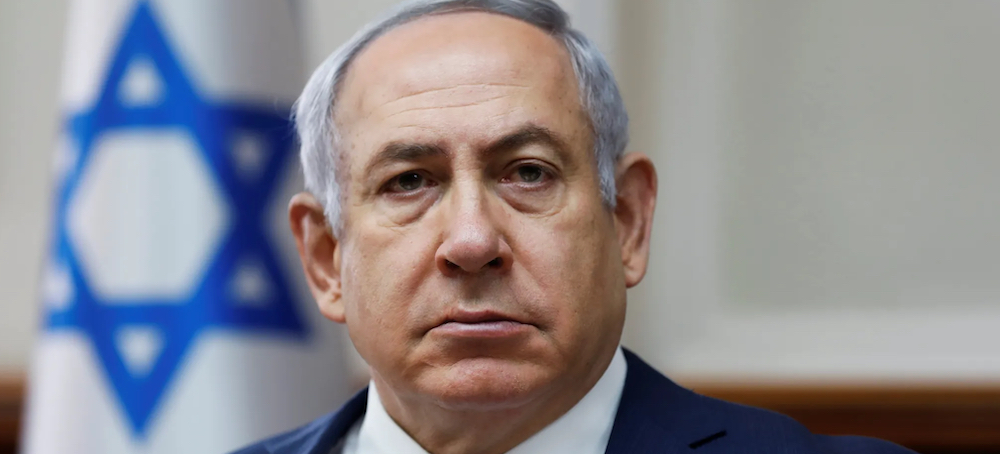 Israeli Prime Minister Benjamin Netanyahu. (photo: Brookings)
Netanyahu's mimicry of Trump has already shown itself in myriad ways, but the biggest test will be whether a defeated Netanyahu can contain the insurrectionary impulses already rife among his camp
Trump's perverse mimetic aura has reconfigured the use of language – and, because of the hegemony of English-language media, the world's speech, too – injecting his malapropisms, neologisms and free-style inventions into the flow of everyday life, warping all of our thought to the chop-and-flow rhythm of his endless stream of talking and posting.
No less significant, Trump's mode and methods of politics – his frontal attacks on the legitimacy of the judiciary, designation of his opponents as enemies of the people and the country, and rejection of unfavorable election results – have become part of the populist right's playbook, deployed by Trump-loving leaders from Latin America to Central Europe to Southeast Asia.
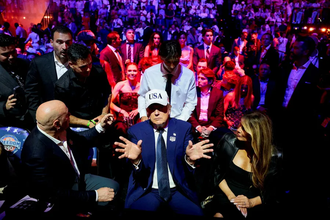
U.S. President Donald Trump, the global populist right's model for imitation, at a martial arts event to mark America's 250th anniversary last month.
Credit: Evan Vucci/ Reuters
While as of late, Israeli Prime Minister Benjamin Netanyahu's relationship with Trump has soured over the debacle of the war in Iran, Netanyahu remains one of the American president's most studious emulators.
Netanyahu has borrowed from Trump in ways trivial and dangerous – from figures of speech ("the deep state") and the embrace of an AI-slop aesthetic to his willingness to defy procedural norms and even break the law in pursuit of his personal and political interests. Since Trump's return to office in 2025, Netanyahu has been emboldened by the U.S. president, taking from him new cues for consolidating authoritarian populist rule.
Now, with elections looming in the fall, and Netanyahu's Likud now trailing Gadi Eisenkot's party in the polls, the question is whether there are any limits to how far the Israeli prime minister will go in his mimicry of the American president.
Of particular concern is the possibility that Netanyahu might refuse, à la Trump, to accept the results of an election that would remove him from power.
In 2021, when the Bennett-Lapid government briefly displaced him, Netanyahu and allies charged that the new coalition was a "fraud" because it included Mansour Abbas's United Arab List, a move which Bennett had publicly promised not to make in the preceding campaign.
At the time, Netanyahu-aligned commentators in outlets like Channel 14, roughly Israel's Fox News equivalent, trumpeted the narrative that a coalition that depended on an Arab-led party was illegitimate and an usurpation of the Jewish public's sovereign will – a narrative that they continue to pump out at an even greater volume today. Yet, against the backdrop of Shin Bet warnings that such rhetoric risked sparking unrest and even violence, Netanyahu and the rest of the right stopped just short of adopting a Trumpian "stop-the-steal" narrative.
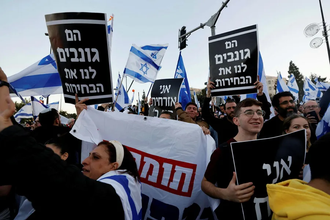
Supporters of the Netanyahu government's judicial overhaul protest in Jerusalem with signs reading "They're stealing our election," a day after Netanyahu fired then-Defense Minister Yoav Gallant for calling to halt the legislation, in 2023.
Credit: Olivier Fitoussi
It is far from clear the Netanyahuist right will exhibit the same restraint this coming fall.
Through more than four years of incessant attacks on the rule of law, the judiciary and the attorney general, they have hammered into Israel's public sphere the notion that there is a large-scale conspiracy coming from within the state to subvert the democratic process and remove the right from power – "to cancel the will of the voter," as Sara Netanyahu herself put it. Justice Minister Yariv Levin has accused the Supreme Court of "crushing the will of the people," while Communications Minister Shlomo Karhi has charged that the attorney general is aiming to "empty Israeli democracy of all meaning."
To be sure, Netanyahu has not – or not yet – explicitly alleged a Trumpian "big lie" about a stolen election. But the constant allegations that the will of right-wing voters is being obstructed have laid the groundwork for one. Even more than in 2021, the current coalition's voters have been primed not to accept a loss.
Throughout the current government's tenure, norms of conduct have been shattered in previously unthinkable ways, and red lines continue to be crossed. The 2024 far-right riots at the Sde Teiman prison and Beit Lid military court, in which sitting MKs and government ministers participated – what many called "Israel's January 6" – demonstrated an unprecedented willingness on the part of the right to attack state institutions. More recently, right-wing political violence, while always present on the margins, is becoming commonplace in the form of attacks on the houses of judges, police officials and other procedural gatekeepers.
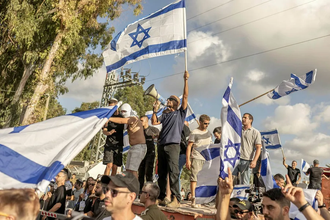
Far-right protest outside the Beit Lid military base, 2024. The riots were described by many as "Israel's January 6."
Credit: Avishag Shaar-Yashuv
Perhaps most worrisome, the current coalition has openly defied Supreme Court rulings more than once – refusing to carry out legally mandated Red Cross visits to Palestinian prisoners held in Israeli jails and, now, disobeying a court order to hold new elections for the state comptroller. Not only has Netanyahu intentionally ignited a constitutional crisis during the election campaign, he has also normalized the idea that adherence to the rule of law is a matter of choice.
Already, Israel's election watchdog is worried by the violent energy roiling right-wing politics. Last week, Dean Livne, acting director general of Israel's Central Elections Committee, suggested during an interview at a conference hosted by the Netanyahu-aligned tabloid Israel Hayom that the counting of the votes could be livestreamed to dispel conspiracies. Yet that will matter little if Netanyahu and his supporters go "full-Trump" and claim that the vote was "rigged."

Vote counting in Israel's 2022 election. The possibility of violence during the vote – whether as a pretext to delegitimize the results or in response – is no longer far-fetched.
Credit: Emil Salman
Meanwhile, in parts of the anti-Netanyahu opposition, there is much whispering about the need to prepare for such an eventuality. Some have suggested deploying poll watchers. Yet here the danger is that such a move would almost certainly be countered by the right and increase the likelihood of election-day mayhem. In an intensely polarized climate, there is a certain centripetal logic that causes any charge of unfair play by one side to be mirrored and escalated by the opposing side. The possibility of violence during the vote – whether as pretext to delegitimize the results or in response – is no longer far-fetched.
The future of what remains of Israel's democracy, then, seemingly now depends on whether Netanyahu, in the event of a loss, is willing to accept the results and pull back the insurrectionary impulses on the right that he has fed. In light of Netanyahu's track record, that is a grim place to be.