ICE Is Hoping You Won’t Notice the Man Agents Killed In Texas
Melissa Gira Grant The New Republic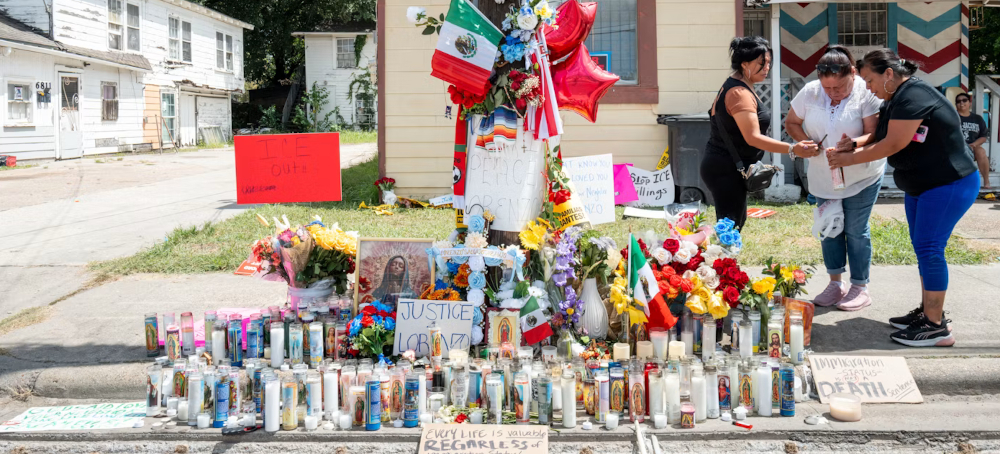 People paid their respects at the site where ICE agents shot and killed Lorenzo Salgado Araujo on July 7. (photo: Brandon Bell/Getty)
The administration may have changed its P.R. strategy for Trump’s mass deportation campaign. The violence hasn’t changed at all.
For ICE’s mission of mass deportations, controlling the narrative is as critical as filling detention centers at record rates. The hospital where Salgado Araujo was taken would not tell his son Ronaldo Salgado what happened to his father, nor would law enforcement, he said at a press conference Wednesday. Instead, he learned that his father had died from a video he saw on social media, he said. He recognized his father by his voice. Predictably, the Department of Homeland Security told reporters that the killing was an act of “self-defense” by ICE agents who had feared for their safety. This is a story they have told many times before. Since Trump returned to office, Lorenzo Salgado Araujo is the tenth person federal immigration agents have shot and killed.
After Trump ordered mass deportations and officers with ICE, Customs and Border Protection, and other federal agencies descended on and occupied neighborhoods in Los Angeles, Chicago, and Minneapolis, among other cities, their showy, high-profile operations and violent arrests drew fierce public opposition. Residents put themselves in the way of ICE, defended their immigrant neighbors, and organized to shut down detention camps. In January, when immigration officers killed two Minneapolis residents in the street, surrounded by witnesses, officials claimed they were dangerous terrorists. Their lies did not succeed; the public grief and anger did not abate. Apparently to signal that things had changed, the man who had been mass deportation’s most brutal face, Border Patrol’s Gregory Bovino, disappeared from the front lines. In March, Trump replaced DHS head Kristi Noem with Markwayne Mullen. With these personnel shifts, the administration was perhaps trying to indicate a new approach. But it was doing so without any acknowledgment that it had done anything wrong.
If the withdrawal marked a shift in public relations, it did not, importantly, mark a shift in enforcement. Indeed, the violence resulting from those operations may be escalating: ICE shootings and killings in 2026 are already outpacing those in 2025. And mass deportation operations have expanded: In five days this June, federal immigration agents reportedly arrested 10,000 people—doubling their usual daily rate of arrests. They are still terrorizing neighborhoods: A recent raid in Virginia Beach involved agents chasing people through backyards, “searching everywhere,” from boats to trash bins, one resident said. They just aren’t marketing it as they once were.
Mass arrests lead to more killings, not only in the streets but also in detention camps. During this Trump administration, more than 50 people have died while in ICE custody, research by Human Rights Watch and Physicians for Human Rights has found. “The mortality rate of deaths in ICE custody is at its highest level in over a decade and has more than doubled since Trump’s second term began,” their report stated. At the same time, these may be undercounts: DHS has lagged behind on reporting detention data and no longer reports deaths of those recently released. The lack of transparency is systemic, leaving the work of investigating anti-immigration operations, from detention centers to deportation flights, to nongovernmental organizations and neighbors.
So far, since the killing of Lorenzo Salgado Araujo in Houston this week, federal law enforcement has shut out the Harris County District Attorney’s Office from the federal investigation, with “access to key evidence” under “federal control,” according to the district attorney’s spokesperson. Past investigations, meanwhile, have proved somewhat meaningless; before getting the results of 16 federal investigations into fatal and nonfatal shooting by DHS officers, the Trump administration declared the shootings were justified. These include incidents where video evidence is ample and public, such as in the killings of Renee Good and Alex Pretti in Minneapolis earlier this year. When it comes to Salgado Araujo, whose killing was already on social media before members of his family had been officially informed of his death, the narrative set by DHS in the immediate aftermath will likely be what the administration hews to, even when thoroughly challenged by the evidence.
As of Thursday, the three surviving witnesses to the shooting, Salgado Araujo’s co-workers, were still in immigration detention, under pressure from officials, as my colleague Greg Sargent reported. “These men hold the key to what actually happened,” said Juan Proaño, a representative for the families and CEO of the League of United Latin American Citizens. Now, Proaño said, they’ve learned from the men’s families that officials are trying to get them to leave the country, through what the administration euphemizes as “self-deportation,” apparently before they could say anything that might challenge the DHS narrative.
Lorenzo Salgado Araujo’s story, however, is available to us. “That’s how I want the world to know my father, not as someone who got shot and killed,” his son Ronaldo told reporters. “He worked for thirty years building homes in the Houston suburbs.” After working on hundreds of homes for others, he dreamed of building one for his own family—“one he could call our home, and he did.” In the evenings, after work, “that’s where you could find him,” Ronaldo said, “resting on his porch, listening to music, petting his dog.” Lorenzo Salgado Araujo, he said, “did not deserve to be reduced to a headline of Mexican man shot and killed by ICE.”
Joining the local calls for a full investigation were Representatives Sylvia Garcia and Christian Menefee. “What other profession has the power to take somebody’s life in the middle of a street,” Menefee said, “and meanwhile, our administration is in court fighting to make sure people like Ronaldo and Lorenzo Jr. can’t be citizens in this country?” This is the Trump administration’s ethos in a nutshell: The lives of people who aren’t worthy of citizenship have no value. When ICE kills someone, when the administration rewrites the truth to exonerate the killers, that drive to dehumanize cannot be covered up.