How Vance and Thiel Get the Antichrist Backwards
Matthew D. Taylor The Bulwark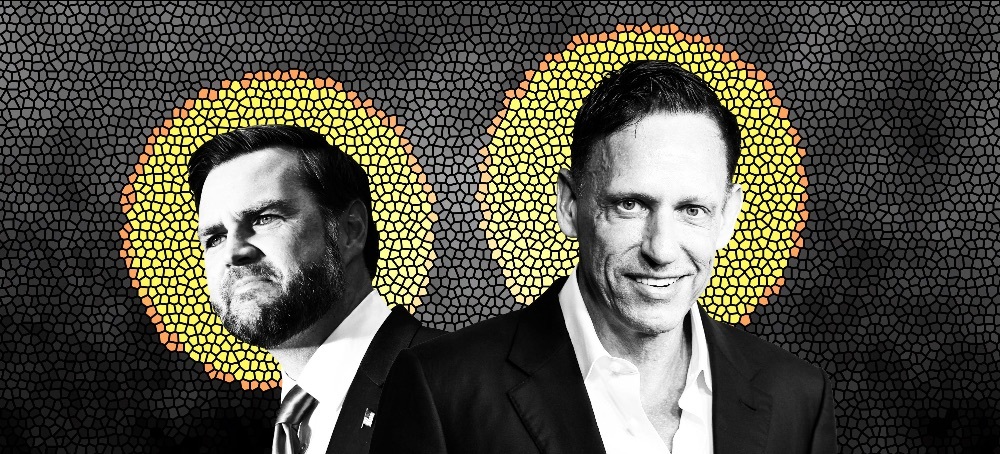 Vice President JD Vance and Right-Wing billionaire Peter Theil. (photo: Bill Kuchman/The Bulwark)
One is doing a bit of cynical pandering, the other is condemning anyone opposed to the tech future—and neither is willing to look in the mirror.
Relatedly, this summer, Silicon Valley billionaire Peter Thiel—Vance’s mentor and sponsor—published an essay he’d coauthored in the right-wing religious journal First Things titled “The Pope and the Antichrist.” This was Thiel’s follow-up to a series of secretive, “off-the-record” lectures on the Antichrist that he has taken on tour over the past year.
Thiel’s obsession with the Antichrist merits close examination. He is the first outside investor in Facebook and belonged to the infamous PayPal Mafia, a real Silicon Valley mover and shaker. And Thiel is JD Vance’s moneybags patron, donating $15 million to a super PAC backing Vance’s 2022 Ohio Senate campaign, setting a record at the time. Vance would be nowhere near his present high office without Thiel’s patronage and mentorship.
Why all this Antichrist speculation, and why now? On one level, we shouldn’t be surprised—Antichrist chatter has been a near-constant refrain of Christian discourse since the earliest centuries, particularly in tumultuous times.
But in our own apocalyptic-feeling moment—with its AI-doomsday predictions and the accelerating global depredations of climate change—it behooves us to understand why these two thought leaders of the American right have fixed their minds on the Antichrist specifically.
Notably, Thiel and Vance both have the Antichrist entirely upside down: speaking from positions of immense power, they are using the idea as a tool to further their own power—precisely what the concept is meant to warn against.
VANCE’S ANTICHRIST SPECULATIONS are far less original or interesting than those of his mentor. The vice president has been weighing in on faith topics a lot to promote his Catholic-come-lately conversion memoir, Communion. It was during a conversation with Bryce Crawford, a popular 22-year-old evangelical podcaster, that Vance offered his ruminations about the Antichrist and the end times. As with many things Vance has done recently—including a brush-back pitch at the pope for criticizing the war in Iran—his comments set many lifelong Catholics’ teeth on edge.
Within Western (as in, Protestant and Catholic) Christianity, there are, generally speaking, two major theologies of the end of the world, also known as eschatologies: millenarian and non-millenarian. For many non-millenarian strands of Christianity, adherents foster a spiritual hope in Christ’s return to earth, but they generally refrain from speculating about specific timelines or attaching the prospect of the Second Coming to current events. All of history since Pentecost could technically be classified as the “end times” in this view, because the Church has been awaiting Jesus’ return since his ascension into heaven. Across the Christian tradition writ large, this is the mainstream position, one held today by most Catholics and many old-school confessional Protestants.
But we Protestants are weird. From the sixteenth century to the present, the Reformers’ core doctrine of sola scriptura—which calls for reading the Bible against itself rather than through the stacked lenses of inherited traditions of Christian authority—lent Protestant eschatology a somewhat tumultuous character. That doctrine and its American evangelical corollary, Bible-onlyism, have driven generation after generation back to the Good Book for fresh interpretations of the end of the world. So it is primarily Protestants who’ve developed the many manias of millenarianism, including the more raucous contemporary ones that have become culturally predominant within evangelicalism during this century.
What made cradle Catholics wince was that Vance was steering back into all of the assumptions and fixations of his Protestant evangelical youth despite his avowed turn toward a hardline Catholic identity in recent years. Speculating about which living world leader might be the Antichrist and connecting current events to biblical imagery of the end of the world—that’s a millenarian (specifically, premillennial) hobbyhorse, familiar to many (including me) who grew up in American evangelical churches.
Some Catholic critics read the whole episode as a sign of Vance being inauthentically Catholic—“three evangelicals in a trench coat” was how one X user sardonically described him. But Vance’s religious blundering can be better read as an expression of his ambition to inherit the mantle of Donald Trump, the unlikely carnival-barker king of the American evangelicals. Vance knows that evangelicals are the vulnerable right flank he’ll need to shore up for his presidential ambitions to remain viable.
BUT VANCE’S SPECULATIVE PODCASTING about the Antichrist looks like meager apprentice work when compared to the bold-letter, years-long obsession of Thiel, who moonlights as a theologian and a philosopher. These deeper interests are part of what drew Vance to Thiel in the first place. A lecture the PayPal mafioso delivered at Yale Law School in 2011, Vance has written, awakened the future vice president from his atheistic slumber: Thiel was “possibly the smartest person I’d ever met, but he was also a Christian.”
Thiel is fixated on the Antichrist as a concept. That’s unremarkable for an evangelical—but Thiel, although raised in an evangelical family, can hardly be said to embrace standard-issue evangelicalism today. He’s a gay man whose marriage enjoys legal protections most evangelicals fought against and continue to oppose, but he nonetheless collaborates with evangelical groups to get his message out. Thiel has described himself as a “heterodox Christian,” which is another way of saying that he has made a self-aware break with traditional Christian orthodoxy on at least some matters of theological significance.
The heterodoxy is flashing red in Thiel’s understanding of his core subject. Tellingly, his lectures and public writing on the Antichrist have very little to do with Christ himself. Jesus seems mostly absent from Thiel’s eschatology and his theology in general. Surely, if the word means anything, antichristos signals the opposite of christos. What gives?
In truth, even calling Thiel’s Antichrist interpretation “theological” or “biblical” is a bit of a stretch. His account is fundamentally eclectic, stitching together his own Protestant upbringing, his ideology of techno-libertarian power, Carl Schmitt’s Nazi political theory, and ideas he has adapted from the French theorist René Girard, who taught at Stanford while Thiel was a student there. In his First Things essay, Thiel warns that the real harbinger of the apocalypse is any move toward “totalitarian peace and safety.” And where other religious thinkers might ask how it is possible to uphold faith in God today, Thiel’s guiding question is: “Facing the hour of darkness, how can we recover faith in the future?” Many Christians throughout history have longed for the return of Christ. (The Book of Revelation famously comes to a close with an expression of this longing: “Amen. Come, Lord Jesus.”) But for Thiel, the hope is less to be able to welcome Christ than to forestall Antichrist.
The rising threat of Antichrist, for Thiel, is not a person. Nor is it the uncontrolled and unprecedented expansion of AI integration or the rising tide of global authoritarianism. He fears the opposite: the liberalizing tendency within Catholic theology that might attempt to unite humanity against such dangers. Thiel’s larger vision comes down to his belief in the unmitigated and unregulated growth of technology, superintended by exceptional (Christian) humans like Peter Thiel. Our salvation lies, Thiel might say, in technological progress.
The implication of this narcissistic revision of Christianity should be clear: The Antichrist is anyone who might get in the way of Peter Thiel. In the tech investor’s telling, the Antichrist makes his presence known through a style of politics that attempts to forge new alliances and collaborations for the sake of humanity. Thiel’s greatest worry is a unified humanity that will regulate AI and refuse to cede the future to tech futurists like him. That is his Antichrist.
Hence Thiel’s antipathy to Pope Leo XIV, whose recent encyclical Magnifica humanitas offers a theological vision for constraining AI based on Catholic social teaching. Thiel comes right up to the line of accusing Pope Leo of representing the Antichrist. (He settles for the more worldly if no less implausible claim that the leader of the Catholic Church is an agent of the Chinese Communist Party.) But Pope Leo is hardly the only public figure to elicit Thiel’s apocalyptic condemnation: He’s also labeled the climate activist Greta Thunberg a “legionnaire of the Antichrist” because she is diabolically working to unite humanity around curbing fossil fuels. The philosopher Nick Bostrom, an AI “doomer” who has presciently warned against the possible downfalls of digital superintelligence, also shows us a face of the Antichrist, in Thiel’s view, for his call for a global government that might restrain the tech sector.
Thiel’s Antichrist crusade is sub-Christian—“heterodox” at best—for its lack of interest in (or even a meaningful role in his larger paradigm for) Jesus Christ, the person at the heart of the faith for the rest of us. During his earthly ministry, Jesus lived among, blessed, and sided with the powerless.
In Thiel’s scandalous revision, he himself takes the position normally reserved for Christ, with a few important lifestyle tweaks. Discarding the dust and discomfort of peripatetic life, Thiel comes to us as a beleaguered techno-libertarian billionaire, ensconced in unfathomable luxury, who would save the world—while acquiring even more money and power himself—if the damned regulators would only get out of his way. (If they won’t, well, perhaps they, too, are Antichrist.)
In scripture, the word “antichrist” occurs only in a rarely visited corner of the New Testament: the back-of-your-Bible epistles of I and II John. The key verse is: “Dear children, this is the last hour; and as you have heard that the antichrist is coming, even now many antichrists have come. This is how we know it is the last hour” (I John 2:18 NIV, emphasis mine).
Importantly, in view of the original biblical context of the word, it’s reasonable to infer that there could potentially be a singular Antichrist out there to come—but the more pressing concern in the present moment, not in some distant apocalyptic future, is the profusion of antichrists plural.
In my new book, I argue that a close reading of the biblical text shows that the “antichrists” this passage refers to are actually a group of breakaway Christians. They have harmed other members of the community, asserted their own superiority, and claimed power in the name of Jesus christos, doing the opposite of the other-centeredness that Jesus modeled—and so they are the antichristoi, the antichrists. Antichrists promote their own control and harm others in the name of Jesus.
In other words, what the biblical concept of antichrists warns about is exactly the theological offense Vance and Thiel commit in their ruminations on the Antichrist: They co-opt the empathetic and self-sacrificial vision of the kingdom of God and twist it to mask their own selfish ambitions. They build new authoritarian systems, justify violence and the dehumanization of migrant communities, embrace the way of a conquering empire, and call it gospel. As Thiel himself once put it, “Perhaps if you talk too much about Armageddon, you are secretly pushing the agenda of the Antichrist.” We would do well to take him at his word. Thiel and his acolyte’s very manner of speaking about the Antichrist suggests that they are walking that path themselves.