How Trump ‘Outrage’ Is Driving Retired Americans to Take Action
Akaya Windwood and Bill McKibben Rolling Stone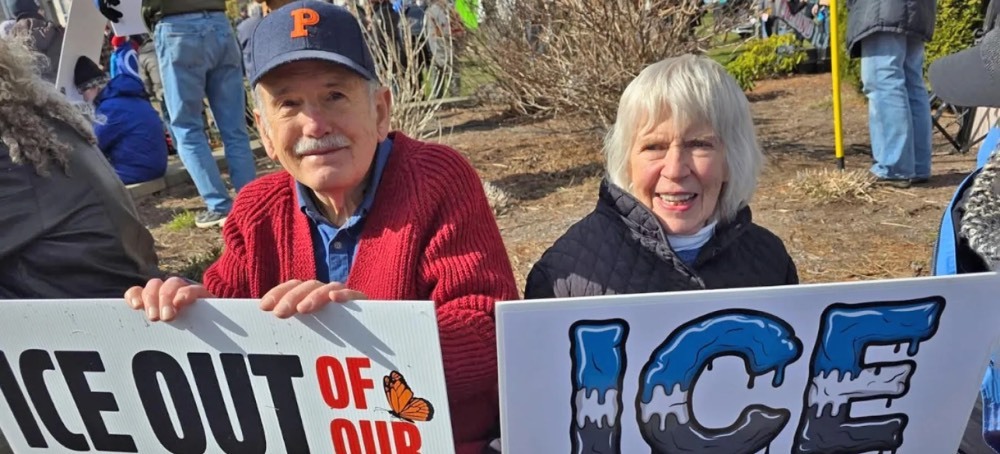 “It’s not normal. But if it is designed to make us shut up, it’s not working” (photo: THIRD ACT)
“It’s not normal. But if it is designed to make us shut up, it’s not working”
Now, a caveat. Third Act, which we launched five years to organize older Americans to protect our climate and our democracy, skews left. But then, so do older Americans generally. A new New York Times/Siena poll found that 46 percent of senior Americans strongly disapproved of President Trump’s performance, compared with only 36 percent who strongly approve. If you want to know why the group long considered most conservative in our country feels this way, listen to a few voices.
There’s Barbara Silverstone, for instance, who just turned 95, which means she was born two years before FDR moved to the White House. In those days, she recalls, the country was plagued by “the spread of diseases that took the lives of children and adults. These included polio, measles, mumps, and influenza to name a few. Most children survived measles and mumps, and some died. My younger sister was stricken with polio.” Silverstone’s kids were the first generation to benefit from vaccines. So it comes as no great surprise that she’s aghast to find herself living in a moment when the CDC is messing around with this great public health triumph, and when measles is spreading fast again in many regions. “I fear for my great grandchildren.”
Or consider Murphy Sewall, born three months after Pearl Harbor, and who took his commission as a naval officer 60 years ago. “I am outraged by the sight of armed masked men breaking into cars and homes in American cities. Their behavior is remarkably similar to 1930s fascism.”
Karen Slaney was born during wartime too, and had “nightmares when I was a girl about Nazis.” Now the nightmares are coming back in new form. She quoted from The Diary of Anne Frank, a book that pretty much every literate person in these generations read in school (and which is now routinely banned in rightwing library purges). “’Terrible things are happening outside. Poor helpless people are being dragged out of their homes. Families are torn apart. Men, women, and children are separated. Children come home from school to find that their parents have disappeared.’ “I find it hard to believe that’s happening in America,” Slaney says, “but then I turn on the news.”
It’s not that we think America used to be great and then came Trump. Heck, one of us had to integrate her elementary school in the 1960s, and it was an ordeal. We lived through Watergate, so we’re not innocents about corruption. But once upon a time the courts helped end official segregation, and Richard Nixon was driven from office for his crimes. (And the scale was so different — in 1952 Nixon’s vice-presidential campaign was bedeviled by a slush fund set up by wealthy supporters. It was $18,000, not the $1.8 billion in the new fund that taxpayers were going to deliver to January 6 insurrectionists and others “victims of lawfare” before the administration backed off the plan.)
The point is, we thought we lived in an extraordinary country that was at least at work on its problems, and trending however haltingly in the direction of greater freedom, a broader franchise, and a raft of other advances like cleaner air. And we knew we lived in a country where presidents and other leaders at least paid lip service to decency, to decorum, and to the idea that they served all Americans. Now we’re overturning environmental regulations, rolling back civil rights laws, and turning our back on poor people around the country and the planet. Now we’re planning cage fights for the White House lawn and the president, who pretends he might be Jesus, has made it clear that he holds at least half the country in contempt.
Those things should — and do — anger Americans of all ages. But if young people look at them with the dread of realizing how circumscribed their life choices may be on a hot, divided earth, older people look at them with a different kind of sadness. We’re forced to grapple with the fact that history’s long arc may not bend towards justice and liberation, but toward greed and domination.
We haven’t given up, however. If you’ve been to a No Kings demonstration in these last months, you may have noticed just how much gray hair was on display; it’s worth remembering that people in their third act now saw up close and often personally in the 1960s and 1970s that Americans truly could rally together to shape public policy. That muscle memory gives us a residual faith in our collective power that may be harder to come by for younger people. We’ll be sharing the videos from what we’ve been calling the “One-Third Project” around our networks (and in many cases our retirement communities) in the months ahead. And we’ll be encouraging others to chime in (it’s a good project for kids and grandkids to help with). We want to let elders who are dismayed by the world Trump is building know that they are in the majority, and that they can and should vote against MAGAism when the midterms roll around.
And we will vote. As the Times poll suggested, 54 percent of seniors are “almost certain” to vote in the fall, twice the percentage for younger voters. That should make the right wing, who have always counted on older, whiter voters for their margins, very nervous indeed. As Barbara Green, 92, put it, “I wake up every morning with a feeling of dread, wondering what the president has done or said while I was sleeping. It’s not normal. But if it is designed to make us shut up, it’s not working.”