How the Trump Administration Is Eroding Airline Passengers’ Rights
Christine Chung The New York Times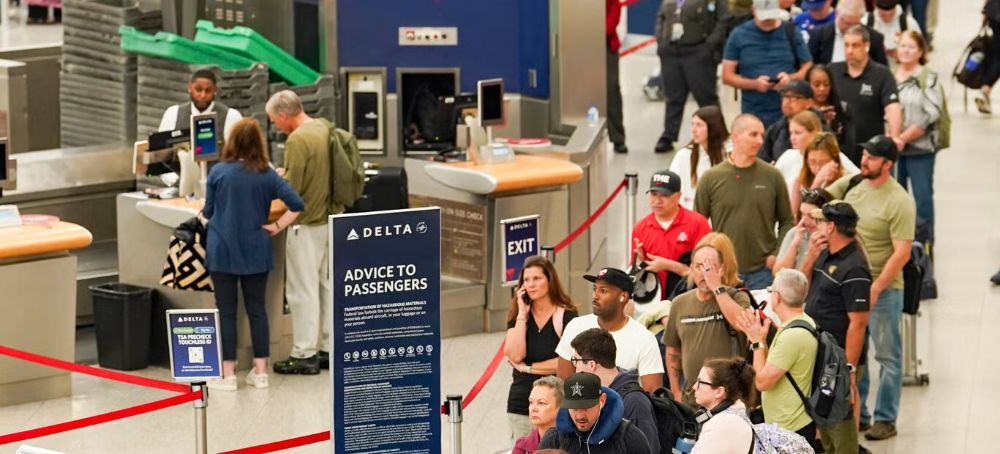 During President Trump’s second term, the Department of Transportation has, among other things, dropped an initiative to force airlines to pay customers cash for some flight disruptions. (photo: Megan Varner/Getty)
Under Sean Duffy, the Transportation Department has worked to roll back consumer protections. Passenger advocates say the changes favor airlines.
The Department of Transportation is aiming to water down longstanding passenger protections, pushing, for example, to change how prominently airlines display prices in advertising and to clamp down on compensation for disrupted flights.
These recent steps have alarmed consumer groups and elected officials, with some saying that the proposals tilt the scales in favor of the airline industry. In addition, they say, the department is steadily taking a more hands-off approach to policing airlines, and that could end up hurting passengers.
“We’re in really new territory with consumer protection regulations,” said Paul Hudson, the president of FlyersRights.org, one of the largest U.S. advocacy groups for air travelers. “It’s shaping up to be a wholesale reversal of consumer protection for airline passengers.”
When Sean Duffy was sworn in as transportation secretary in January 2025, he pledged to help usher in a “golden age” of transportation by immediately taking action to remove what he called government overreach.
Since then, advocates say, the department has consistently worked to roll back passenger rights in areas like cash compensation, wheelchair handling and hidden, or “junk,” fees. It has also adopted a markedly gentler approach for addressing bad behavior by airlines compared with previous administrations: Under Mr. Duffy, the department has not yet issued a single fine to an airline.
In a statement, the Transportation Department rebutted the claims. “No passenger rights have been diminished,” a spokesperson wrote.
Font Sizes and Hidden Fees
Two of the biggest changes have taken place in how the Transportation Department aims to regulate junk fees and pricing information.
In June, the department abandoned a Biden-era rule on hidden fees that would have forced airlines to show charges for extras like checked bags and ticket changes alongside the full fare during the booking process. Airlines sued in 2024 to block the rule, which a federal court later vacated on procedural grounds.
A month later, the department moved to undo a 15-year-old requirement that airlines display a ticket’s final price more prominently and in a larger font size than other components of the price, such as taxes and fees.
“The department proposed a common-sense adjustment to protect passengers from misleading pricing information by allowing parts of airfare, such as government taxes, to be displayed just as prominently as the total price, but not more so,” the department spokesperson said, adding that public comments are currently being reviewed.
In September, Senator Richard Blumenthal, Democrat of Connecticut, sent a letter of opposition to Mr. Duffy, stating that the new rule would allow airlines to advertise “false or misleading ticket prices.”
“If the rule is implemented, it is inevitable that more consumers will need to invest additional time searching for the full fare or government charges, and will be surprised by unexpected, mandatory fees,” he wrote.
The department has taken steps to undo other rules drafted under former Transportation Secretary Pete Buttigieg. It has dropped early-stage efforts to let families sit together at no extra charge and to make airlines pay passengers cash for significant flight disruptions. And it has carved out more exceptions for flight disruptions in which airlines would not need to compensate travelers.
It has also repeatedly delayed enforcement of a landmark rule that expands the rights of disabled travelers, including making airlines liable for mishandled wheelchairs. Airlines sued over that rule, and the department has pushed back the enforcement of key sections of it to next year.
Backing Away From Fines
Past administrations have made headlines for penalizing airlines with hefty fines for failures like delays on the tarmac, false advertising of fares and mistreatment of passengers who use wheelchairs.
Each year from 2002 to 2025, the Transportation Department assessed at least half a million dollars in fines against airlines. But in the two years since Mr. Duffy took over, the department has not issued any against them.
Three previous transportation secretaries — Ray LaHood, Anthony Foxx and Mr. Buttigieg — said in interviews that they used fines as a way to keep airlines accountable.
“We leveled tough, stiff penalties,” said Mr. LaHood, a Republican who served as transportation secretary during President Barack Obama’s first term. “It sends a loud message that the D.O.T. is serious about the No. 1 priority, which is safety.”
Under Mr. Duffy, the department has walked away from its own investigations into airlines for operational and customer service failures. Last May, it dropped a lawsuit against Southwest Airlines, in which it accused the carrier of illegally operating chronically delayed flights in 2022. A month later, it ended an inquiry into Delta Air Lines stemming from the 2024 CrowdStrike software meltdown.
The department also waived at least $25 million in fines owed by airlines, softening the impact of penalties like a $50 million fine against American Airlines for its “undignified” treatment of passengers with disabilities and a record $140 million fine against Southwest for an operational debacle in 2022.
Asked about its view on enforcement, a department spokesperson said in a statement that “fines are only one tool” and that the department “focuses on airlines fixing the root causes of travel disruptions.”
Others have a different view.
“Simply not enforcing anything is like a backdoor way of repealing regulations,” said Mr. Hudson, of FlyersRights.org.
A ‘Dark Period’ for Passengers
At the same time that the Transportation Department is loosening up on airlines, its relationship with the industry appears to be growing more harmonious.
“The airlines never really loved the rules we were putting forth and in some cases litigated against some of the rules,” Mr. Foxx said.
Several of the department’s recently proposed rules and actions appeared on a list of recommendations from Airlines for America, the industry trade association. These include undoing the junk-fee rule, changing the font size and prominence of fees, and contesting liability for mishandled wheelchairs.
Several Democratic lawmakers have questioned Mr. Duffy’s relationship with the airlines, noting his time as an airline lobbyist for BGR Group in 2020. Last December, a group including Representative Jerrold Nadler, of New York; Senator Elizabeth Warren, of Massachusetts; and Mr. Blumenthal wrote a letter to the Transportation Department’s Office of Inspector General to request an investigation into whether Mr. Duffy had violated federal ethics law by “improperly assisting” an industry he had previously lobbied for.
“We are very concerned that Secretary Duffy may have eliminated protections for American travelers not based on impartial policy assessments and the good of the flying public, but, at least in part, as a result of conflicts of interest and potential bias related to his former client’s airline members,” the lawmakers wrote.
A spokesperson for the department’s Office of Inspector General declined to comment.
Mr. Buttigieg, whose department levied the most fines against airlines by a significant amount, said consumer protections are either being “quietly picked apart or just not enforced.”
A Transportation Department spokesperson said that Mr. Duffy had briefly represented the Partnership for Open Skies, a coalition of domestic carriers funded by United Airlines, American Airlines and Delta Air Lines. He worked to encourage “access for U.S. carriers into foreign markets,” not on domestic aviation policy, the spokesperson added.
The secretary has taken “clear, decisive regulatory actions” to hold airlines accountable, the spokesperson said.
Consumer rights advocates say the department’s stance is costing passengers money, even as some aspects of flying have significantly deteriorated. Last year, a combination of cancellations and delays led to the industry’s worst on-time performance since 2014, according to a report by the U.S. PIRG Education Fund, a nonprofit consumer advocacy group. There were more tarmac delays last year than in any year since 2010.
The department is currently tracking 90 tarmac delay incidents for potential violations, a spokesperson said.
“It’s a really dark period for airline passengers right now as far as consumer rights,” said William McGee, a senior fellow for aviation at the American Economic Liberties Project, a progressive-leaning nonprofit research and advocacy group.
“Clearly, the big airlines have access,” he added. “They have the ear of the department, and the interests of consumers are not being heard.”