How Texas Turned Blue
Matt Viser and Nick Miroff The Atlantic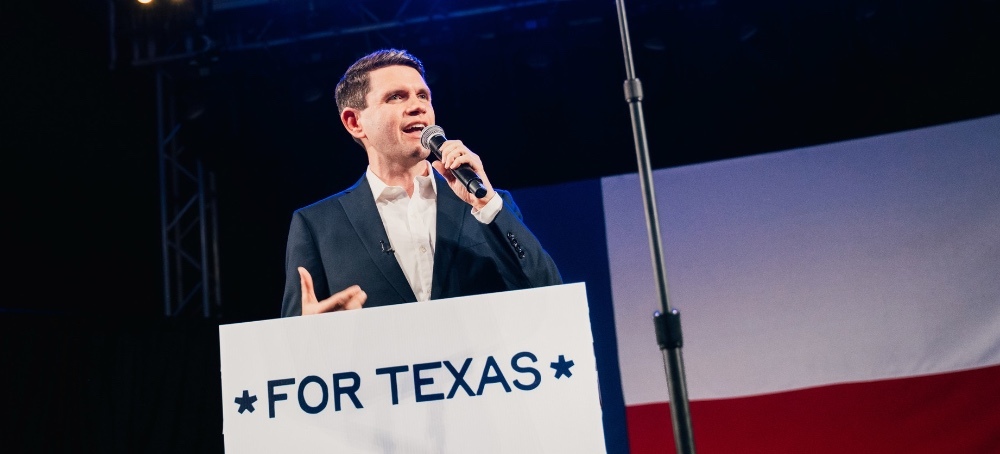 James Talarico speaking at a podium in front of a sign reading “for Texas” (photo: The Atlantic)
ALSO SEE: Democrat Gina Hinojosa Elected Texas’ First Latina Governor, Ousts Republican Incumbent Greg Abbott
An impossible Democratic dream has finally come true.
Whether or not Texas is truly a battleground state now, a few things have become clear. Republicans can no longer take Texas voters for granted. Donald Trump harmed his party’s chances by propping up a weak Senate candidate in Attorney General Ken Paxton. And even Elon Musk, the world’s first trillionaire, couldn’t buy the result he wanted.
Heading into Election Day, polls showed Talarico with a modest lead over Paxton, while the incumbent Republican governor, Greg Abbott, was favored to fend off Hinojosa. But not long after the polls closed, it became clear that both Talarico and Hinojosa would win comfortably.
The Talarico Election Night party was jubilant: Cheers erupted every few minutes as new races were called for Democrats and updated results continued showing him with a sizable lead. James Edge, a Republican mayor pro tem from Bryan, Texas, stood eating a cookie and enjoying what he was seeing. He had endorsed Talarico just after Labor Day. “My party, the Republican Party, needed a kick in the pants,” he said. “This is uncharted waters. If it holds, it’s an earthquake like we’ve never seen.”
At Paxton’s Election Night event in Dallas, party activists groaned as Fox News updated its ballot totals and the magnitude of the loss began to sink in. The Democrats even won the race for Texas railroad commissioner—a job held by Republicans for the past 36 years—as Jon Rosenthal easily defeated Bo French, who ran a race-baiting campaign that outraged the state’s growing Indian American population. Jarrod Atkinson, a Dallas-area Republican activist, walked out of the ballroom where Paxton was scheduled to speak, looking stunned. He laid the blame squarely on Trump. “The fact that he keeps telling everyone to vote like he’s on the ballot is absolutely insane,” he said. “He has said some of the dumbest things that have ever been uttered.”
before tonight, Texas had not elected a Democrat to statewide office since 1994, and had not chosen a Democrat for the U.S. Senate since Lloyd Bentsen, in 1988. But the state’s shifting demographics have nurtured Democratic hopes of a comeback for years. Texas, which Trump won by nearly 14 points in 2024, has grown significantly wealthier, more urban, and more racially diverse even as Republicans have dominated its politics. In fact, the shift traces in part to some of the very pro-business policies that have made Texas so appealing to large corporations. During the past three decades of GOP rule, the state has offered itself as a foil to New York and California, with cheaper housing, more job opportunities, lower taxes, and less red tape. The state’s population has grown more than 8 percent since 2020, absorbing more new residents than any other. More than 300 companies have relocated their corporate headquarters to Texas since 2015, including Tesla, Oracle, and Charles Schwab. Tech employment has been growing faster in Austin than in Silicon Valley.
Republicans like to think of the influx as a political endorsement of GOP rule. But the newcomers are more racially diverse and more likely to be college-educated than the average Texan. Over the past decade, the percentage of adults in the state with a bachelor’s degree or higher—a group that has shifted decisively to the Democratic coalition—rose from 28 to 35 percent. Hispanics, who made up 40.9 percent of the population in 2025, are now a plurality of the state’s residents.
Demographic change alone was not enough to deliver a statewide election to Democrats. But Republicans entered this cycle with at least two additional disadvantages. The first was broad discontent about the rising cost of living, which voters seem to have directed not just at Donald Trump but also at Texas’s ruling class. Republicans of yore had campaigned on the “Texas Miracle,” touting broad economic growth. That case became harder to make amid rising prices for groceries, gas, health care, and housing. “It felt like everything was on the upswing for a long time,” Nancy Zdunkewicz, an Austin-based Democratic pollster, told us. “The bill is now due.”
Mike Madrid, a political consultant who studies Hispanic-voting trends, told us that the percentage of early votes in the state included more ballots cast by Hispanic voters than any other group, including white voters. “That is something I have not seen in 35 years,” Madrid said. “If the economy were doing really well right now, we would not be seeing this.” In 2024, Hispanic Texans swung heavily toward Trump. This year, they appear to have shifted right back. Madrid argues that Hispanic voters are an emerging swing demographic, more populist than ideological, and that this year they’re mad about inflation. The lesson for Democrats, he said, is that the party needs a pro-growth message and a “new southern strategy” tailored to working-class Hispanic voters across the Sun Belt states, with Texas at the center.
In the Senate race, Republicans compounded their disadvantages by nominating a deeply flawed candidate, while Democrats nominated one who positioned himself as the morally upstanding alternative. Paxton, whom Trump endorsed in the primary over the incumbent, John Cornyn, was known for a list of legal, ethical, and personal scandals far too extensive to summarize here. Dan Jackson, a truck driver and three-time Trump voter in Plano, said he “had some trouble” sorting out all the negative ads he’d seen this year. Ultimately, he voted for Abbott for governor—a safe choice, he reasoned—but went for Talarico for Senate because he doesn’t trust Paxton.
“You’ve got, in Paxton, the worst statewide candidate to top the Republican ticket in the entire history of Republican hegemony in the state,” James Henson, the director of the Texas Politics Project at UT Austin, told us. “And then an unusually skilled Democratic candidate in Talarico, who came along at the right moment and has been able to execute better than any Democrat before him.”
when gina hinojosa was considering whether to run for governor, she met with Beto O’Rourke, whose campaigns for Senate and governor had electrified a hopeful Democratic base only to end in disappointment on Election Day. Someone needed to run against Abbott, the entrenched and powerful incumbent, Hinojosa told him. Should she do it? One comment stood out: “Not one person can win Texas,” he told her, according to someone familiar with their conversation. “It has to be two.” O’Rourke told her that both times he was running statewide, he felt that his campaign would have benefited from a stronger ticket.
The dynamic that emerged in 2026 was one in which Hinojosa and Talarico could work in tandem, sharing a similar message while energizing different pockets of the state. Talarico spoke openly about his faith, and had a sunny disposition that played well in rural areas. Hinojosa, a Latina woman, targeted the conservative suburban women known as MAGA moms who shared her concern about privatizing public schools.
Talarico, in particular, ran as that rare political breed: a Democrat who seems genuinely comfortable talking about his Christian faith. He was willing to mix it up with Joe Rogan and Fox News hosts. He was careful not to mention Trump, lest he alienate the many Texans who had voted for the president but whose votes he would need.
Talarico’s final rally, held in an outdoor amphitheater filled with nearly 2,000 people, was an anxiety-filled dose of optimism. “I’m a worrywart,” Pauline Bryson, an Austin resident attending the rally, said. “But a very hopeful worrywart.” Some recalled bawling when Beto O’Rourke lost in 2018; they questioned whether it was okay to be hopeful. But this time felt different—right? Right? Through a hoarse voice, Talarico asked the crowd to be the “slingshot” to help his David beat the Paxton Goliath.
Some 225 miles away, Paxton’s campaign sputtered to a close. Paxton’s team had planned to end his campaign with a rally at the Alamo Monday evening. They canceled the event with no explanation, and Paxton’s finale took place instead at Matt’s Rancho Martinez, a Tex-Mex restaurant next to a Quality Inn on the side of the expressway north of Dallas. About 150 supporters showed up, helping themselves to free nachos and margaritas, and the NRA handed out trucker caps and stickers. Paxton had spent the final stretch traveling the state on what he called the “Come and Take It” tour, speaking at restaurants and other relatively small venues. His slogan and the cannon imagery on the side of his tour bus were meant to channel the defenders of the Alamo, and the breakaway defiance that produced the state’s independence. But it sounded like he was inviting Democrats to take the Senate seat.
Local Republican officials warmed up the crowd with warnings that the state was on the cusp of disaster. One praised Paxton for helping defeat “the Bush cartel,” a reference to the state’s pre-Trump Republican establishment. A lot of the red-meat rhetoric was over the top, as communism, Sharia law, and forced vegetarianism loomed over the taco bar. “If Texas turns blue, it’s our children and grandchildren who will be enslaved with it,” State Senator Bob Hall told the crowd. The Turkish former NBA player and political stuntman Enes Kanter, who has changed his name to Enes Kanter Freedom and more recently declared himself a woman who wants to play in the WNBA, came out to introduce Paxton. He told the audience to “close your eyes and think about your daughter being in the same locker room with biological males.” There were gasps.
Frank DeSimone, a software developer and local Republican precinct official who attended the Paxton rally, told us the booming suburbs north of Dallas, where he lived, were facing “a paradox.” Rapid growth brings rapid change, he said, jeopardizing the same things that attracted so many transplants—safe neighborhoods, good schools—in the first place. It was up to Republicans to stand for a set of “Texas values” that would win suburban voters over. DeSimone said he wanted to help grow the party by defining that in a big-tent way. Did he think Texas would be an up-for-grabs purple state in ’28? “It already is,” he said.
for all his weaknesses, Paxton entered the general election with a not-so-secret weapon. Elon Musk poured almost $200 million into the state, the bulk of it to boost Paxton’s Senate bid. Musk’s home base is in the state, and he has located many of his businesses in Texas, with all the tax breaks and political connections that flow from that. On Monday morning, we paid a visit to a corner of Bastrop, Texas, that has become so identified with Musk that locals call it “Elon Land.” His tunnel-digging business, the Boring Company, is here, along with SpaceX and Starlink. Those companies have made some residents rich. But even in Elon Land, we found signs that his political reach is limited.
Sebastyon Champion, a 38-year-old senior project manager working on the SpaceX facility, wore a Carhartt hat and a silver cross as he finished a pulled-pork sandwich at the Boring Bodega, a combination of a market, bar, and hair salon. He is well paid, living in an apartment complex so new that most units haven’t yet been sold, but he also noted that he paid $100 to put three-quarters of a tank into his truck that morning. He’s a conservative voter—“We have a saying here: Don’t California my Texas”—but was turned off by Paxton and his history of corruption. “Ken Paxton should be in jail,” he said. “I wouldn’t piss on him if he was on fire.” He voted for Abbott, but when it came to the Senate race, he went for a third-party candidate. In fact, over the course of several hours, in conversations with more than a dozen Texans whose livelihood depends on Musk—and in a setting directly across from a mammoth manufacturing plant the tech mogul is constructing—we could find no one who was supporting the candidate he had spent so much money to prop up.
The lingering question, which will be litigated in election cycles to come, is whether a generational political realignment is taking place in one of the nation’s largest states—or whether Democrats just got lucky this time. “People who win think it’s about them. It’s always about their opponent,” Bill Miller, a lobbyist in Austin with connections to both parties, told us. “People vote against people. That’s our culture now. If Democrats think it’s because they got all the issues, they don’t. It’s the issues that Republicans are carrying are turning people off.”
That might be true—but in two years, the GOP will still be defined by an incumbent president who is currently the most unpopular in the history of polling. Texas will be worth 40 electoral votes in the next presidential election, and there are few plausible Republican roads to victory without it. The last Democratic presidential candidate to win the state was Jimmy Carter in 1976. Heading into 2028, Texas Democrats won’t be able to stop themselves from dreaming big.