How China Won the Iran War
Paul Krugman Substack Paul Krugman. (photo: SGMK)
Trump has shattered American power, and Beijing is picking up the pieces
The disintegration of U.S. power was well underway before Trump started his war on Iran, but the pace of decline has accelerated sharply since the magnitude of our defeat started becoming apparent.
And when future historians write about this tale of self-immolation, they may well do so in Mandarin.
China hasn’t been a direct combatant in the third Gulf war, and its support for Iran has, until recently, been discreet. (China is now reportedly preparing to send Iran advanced munitions — Phillips O’Brien suggests that it is “going in for the kill.”) But China has clearly relished our humiliation. And both the way the war has played out and China’s role have drastically shifted the global balance of power in China’s favor.
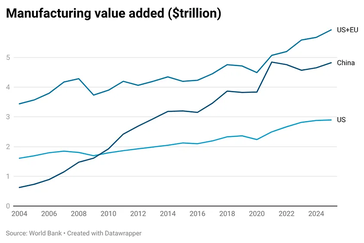
China has been a serious geopolitical rival to the United States for some time. China’s manufacturing sector overtook the US in 2010, and the gap has continued to grow (I’ll explain the line labeled “US+EU” shortly):
Source: World bank - Created with Datawrapper
And China’s role as the workshop of the world inevitably gives it a great deal of geopolitical influence.
However, there were a number of factors that, two years ago, arguably still gave an America a power advantage despite China’s economic weight and manufacturing prowess. These factors included:
· America still led the world in science and cutting-edge technology
· The U.S. military appeared to have vastly better weapons and leadership than any other nation’s
· The dollar’s dominant role in international transactions gave the United States enormous financial clout, including the ability to cut other nations out of the global payments system
· Above all, the U.S. wasn’t alone. We were the leader of history’s most successful alliance system, nations bound together not just by mutual interests but by shared democratic values
Yet Trump and his lackeys have quickly squandered all of these advantages.
A great deal has been written about the Trump administration’s attack on science, which is a topic largely separate from the Iran war. As one recent discussion put it, Trump officials
have orchestrated a series of attacks on scientists and their laboratories, implemented through funding cuts, grant interruptions, and immigration restrictions. Scientists are gravitating to Canada, Europe, and China, and we are rapidly losing the depth of our innovative and essential scientific community.
The undermining of other U.S. sources of strength was also underway before the Iran war, but the war has accelerated the downward spiral.
Even before the bombing of Iran began, some observers worried about the state of the U.S. military. Had U.S. military leaders adapted to the new world — revealed by the war in Ukraine — of cheap, ubiquitous drones? How much damage had the pro-testosterone, anti-intellectual leadership of Pete Hegseth already done? Now we know the answers to these questions, and America’s military reputation has nose-dived.
Oh, and as a December 2025 report from the Center for Strategic and International Studies points out, a Chinese supply chain underpins “the architecture of modern drone warfare.”
America’s dollar-linked financial power has also sharply declined. True, as I wrote a month ago, “The dollar’s role as the dominant currency for ordinary business is not under threat.” However, the war has demonstrated that, thanks in large part to China’s underlying economic power, America’s ability to weaponize the dollar has been greatly reduced:
Iran was able to continue selling oil (until the U.S. temporarily imposed a military blockade) and buying essential imports, despite U.S. financial sanctions, by taking payment in yuan and using those yuan to buy Chinese goods. Ships that paid Iran for safe passage through the Strait of Hormuz also paid in yuan (or in cryptocurrency, whose only real use case remains criminal activity.) The details are complicated, but using yuan essentially allows those designated by the U.S. government as rogue actors to fly under our financial radar.
Finally, the war has really put the nail in the coffin of the U.S.-centered alliance system.
America’s alliances have been a fundamental source of global strength since World War II. The line labeled “US+EU” in the chart on manufacturing value added is an indication of how much these alliances used to strengthen us: It shows that even now the US and the democracies of the European Union combined produce more manufactured goods than China, a lead that would be larger if I included the UK, Japan, Canada, etc.
But Trump began torpedoing our alliances on day one. Discussions of the Trump tariffs, even critical ones, don’t emphasize enough the fact that every one of these tariffs broke international agreements made by the United States in the past. So Trumpian tariff policy, by itself, was an announcement to the world that agreements with the U.S. government are worthless. Add to this the demands that Canada become the 51st state, that Denmark hand over Greenland, and so on, and America had thoroughly lost the trust of its former friends even before the Iran war.
Then came the war. And in the past five months the U.S. has shown itself both erratic and ineffectual. Trump launched a war that, in addition to creating death and destruction, cut off much of the world’s oil supply without so much as consulting other nations. Once the war began, America proved both incapable of imposing its will on Iran and unable either to open the Strait of Hormuz or to protect regional allies.
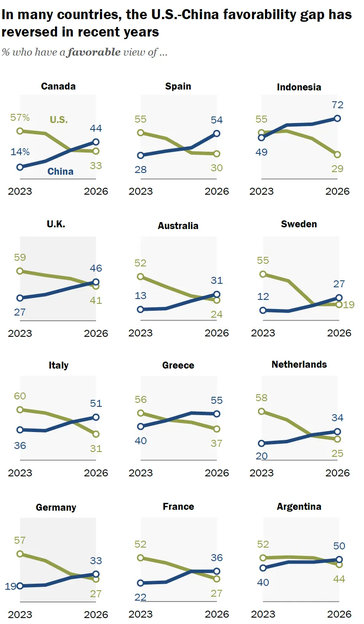
So now the world neither trusts nor fears us. The chart at the top of this post, drawn from the Pew survey of global attitudes, shows views of the US and China in multiple countries. Even many of our oldest allies, the nations that helped us win World War II and the Cold War, now have a more favorable opinion of China than they do of us.
Let’s be clear: The end of U.S. leadership and China’s growing geopolitical ascendancy are bad things. China is a corrupt autocracy, with little respect for human rights and none at all for democratic values.
But people around the world have concluded that the Chinese are serious people, and that we are not. So America lost the war — and China won.