How a 25-Cent Cancer Pill Became a Hundred-Billion-Dollar Business
Jessica Lussenhop and David Armstrong ProPublica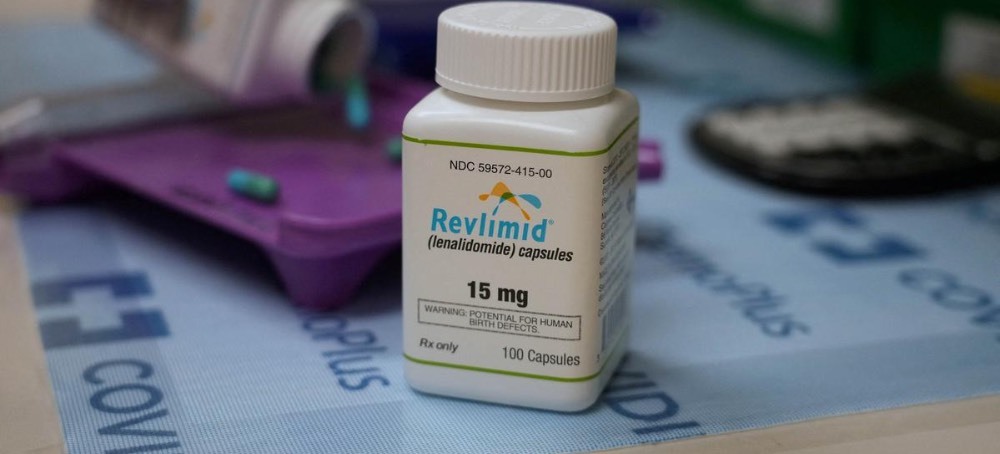 A bottle of Revlimid seen at a store in Utah. (photo: Reuters)
Reporter David Armstrong was diagnosed with cancer and soon learned that one of his drugs sold for almost $1,000 per pill — despite the fact it cost just pennies to make. What he found out helps explain why our healthcare system is the most expensive in the world.
Transcript
Editor’s Note: “Paper Trail” is produced as an audio series. If you are able, we encourage you to listen to the series. Transcripts are for reference only and may contain typos. Please confirm accuracy before quoting.
Jessica Lussenhop: ProPublica. Investigative journalism in the public interest.
Have you ever tried asking your doctor how much a procedure is going to cost? They never know, and I always feel stupid for asking. But, let’s be real, I already know the answer: expensive. Expensive is going to be the cost. Even if my health insurance covers it, and I don’t wind up paying out of pocket for it … somebody is.
We have the most expensive healthcare system in the world. But it’s really hard for somebody like me to understand why. Why things are priced the way they are, and why it has to be this way.
David Armstrong: I had never kept a journal before. But, you know, after I got back from the hospital, I was there a few days, I started to write.
Lussenhop: OK. Is the February 17th, 2023? Is that the first one?
Armstrong: Yes.
Lussenhop: I for sure wanna hear that one if you’re up for it.
Armstrong: Yeah, OK.
Lussenhop: My colleague David Armstrong has been doing some reporting that actually, for the first time, helped me understand how things can get so expensive. David is one of the best healthcare reporters in the country. He’s spent decades covering the medical industrial complex and Big Pharma.
Armstrong: OK. “A male nurse checked me in. I told them GP sent me, was going to call ahead …”
Lussenhop: But this did not begin as a reporting project.
Armstrong: “Said, ‘You’re gonna be here all day for something your primary could have handled.’ The ER was busy …”
Lussenhop: It started when he woke up one morning and was having this intense pain. He could barely stand up, and he went straight to the ER.
Armstrong: “About an hour or so later, saw ER doc.”
Lussenhop: He started keeping a journal to document what was happening to him.
Armstrong: “Said he thought might be muscle strain. I said, ‘I don’t think so.’”
Lussenhop: And he kept writing after he received some terrible news.
Armstrong: “He said the concern was multiple myeloma. And then after multiple myeloma, he added the word ‘cancer.’ I said I need to get some air, walked outside, said, ‘Fuck me,’ and started googling. First thing I saw was a link to average lifespan of three to five years. I stopped Googling and didn’t start again for many days.” I could get rid of “Fuck me,” I’m sorry.
Lussenhop: Oh, I think that’s great.
Armstrong: Yeah. You know, I, I, I was essentially believing I was reading a, a death sentence. And I had a hospitalist who was overseeing my care, and at one point he asked me, you know, if I told my children yet about this, and I, I said, no, I, I couldn’t even contemplate that at the time. And, uh, you know, I started to get emotional and, and I think sensing that he said, “Well, you know, a lot’s changed in multiple myeloma.” And I told him about the link that I saw. And he said, “That’s no longer the case. Most patients can live a long life with treatment.”
Lussenhop: That treatment was a cocktail of drugs. But the game changer was called Revlimid. It was a relatively simple drug that had completely changed the life expectancy of patients like David. The catch was he would need to take it almost every day for the foreseeable future.
Armstrong: So, Revlimid was a drug I take 21 days out of 28 days. So basically three weeks out of the month, and it’s a pill. And I started to get explanation of benefits in the mail after I started my treatment, and I saw what my health plan was paying, and saw that the cost was nearly a thousand dollars a pill. That’s what my health insurance plan was actually paying. That’s not a marked up price. That is a real price.
Lussenhop: I mean, what was your reaction to that?
Armstrong: I was really shocked, and, and I say that as somebody who’s not naive to the workings of healthcare in this country. I knew that prescription drugs in this country were more expensive than anywhere else in the world, including other developed countries. I was aware that there was, you know, not a lot of regulation, but, you know, I wasn’t intimately aware of the details of how this worked. So that’s initially what triggered my interest as a journalist.
Lussenhop: Do you have, are they, do you have the pills with you right now?
Armstrong: I do. So this is a, almost a thousand-dollar pill, this little thing.
Lussenhop: You are holding a thousand dollars in your, in your fingertips right now.
Armstrong: Yes. And there have been times where I’ve dropped these and, and caused panic because, you know, need to find the drug, because you’ve just dropped a thousand dollars that might be now behind a couch or, you know, down a drain or something like that.
Lussenhop: And so when you’re looking at that bill and you see that giant sticker price, like you can’t just open that bill and be like, “Whew, I’m OK. That’s, that’s the end of that.”
Armstrong: I think that’s a common reaction that people say, “Oh, jeez, thank God my health plan is covering most of this cost. It’s not gonna affect me so much.” Well, it does affect you. Rare is the person in this country who’s not paying more year-over-year for their health plan, and it’s usually way in excess of inflation, and there’s a reason for that. And that’s the cost of your care continue to go up. So in the case of Revlimid, there were some cancer patients and are some cancer patients that faced extraordinary out-of-pocket costs to pay for the drug. But even for those of us who are fortunate enough to not have to pay, we all pay. And that’s one of the things that intrigued me once I saw the price of Revlimid. I just wanted to know: How does this happen?
Lussenhop: So as David is taking the drug and it’s attacking the cancer in his body, he was also researching the company that produced it. He dove into thousands of pages of court documents and financial filings, and interviewed cancer researchers and patients about how a cheap, easy-to-make pill came to cost so much.
He got the bottom of why and how the company raised the price over and over again, how the federal government had tried and failed to stop it, and how all of this helps explain why our healthcare costs continue ballooning out of control.
Armstrong: This is the story of how a drug becomes a hundred-billion-dollar blockbuster.
Lussenhop: From ProPublica, I’m Jessica Lussenhop. And this is “Paper Trail.”
Armstrong: “April 10th. Talked to a colleague today who was a minister before becoming a journalist. He urged me to get right with God and said he would pray for me …
“April 17th. Didn’t ask for this situation. Really don’t want it. No one does …
“August 25th. As I have since the start, I’m acutely aware of my own mortality and my age. Every tingle pain brings a new worry …”
Lussenhop: Unsurprisingly, David had a lot of questions after his diagnosis.
One of the first? Why was this disease causing him so much pain? He started researching and learned that tens of thousands of people in the U.S. alone are diagnosed with multiple myeloma every year. A lot of the time, the first indication that something is wrong is a broken bone.
Armstrong: You know, it’s a really insidious disease when it comes to the bones. You know, one doctor described it as, like, moths creating holes in your bones. For me, I had, they used the phrase “innumerable lesions” from my, basically the base of my neck to my legs. And turns out that I had broken ribs.
Lussenhop: Those lesions are, are they just weakening your bone to the point where even without a fall or an accident that can happen?
Armstrong: That’s exactly right. Yeah, they were breaking on their own, essentially.
Lussenhop: The drugs David was prescribed were intended to stop the cancer from eating away at his bones. David learned that the especially expensive one, Revlimid, was actually a new version of a very old drug called thalidomide.
Armstrong: I knew the story of thalidomide. At least, I thought I did. You know, this was a disgraced drug that did horrific damage to babies and fetuses across the world in the 1950s and 1960s. It killed a lot of babies and left the ones who survived with, you know, pretty horrific disfigurements and other ailments that made their lives very difficult. And after this happened, the drug was widely banned. I mean, this was a drug, as far as I was concerned, was dead and buried in the pharmaceutical graveyard. I had no idea, and I should have, I guess, given my history of looking into healthcare, that this drug had somehow come back from the dead as a cancer fighter. I was gobsmacked. And at that point, I knew I needed to know more. As a patient, I wanted to know as much as I could, and then as a journalist, you know, of course, right away as soon as he told me that I just needed to know the story.
Lussenhop: David started reading everything he could about this drug. And he found out that thalidomide really had been in the pharmaceutical graveyard for decades … until 1992. That year, a small chemical company based in New Jersey called Celgene bought the rights almost as a lark, just to experiment with expanding into pharmaceuticals. For the first several years … it was not going well.
Armstrong: They initially purchased the rights to the drug thinking that it might be beneficial to AIDS patients. It turns out, they were able to get thalidomide approved for sale in the United States as a treatment for a side effect of leprosy. Now, leprosy is very uncommon in the United States. But for Celgene, they viewed it as an exercise in “Look, we’ve never gotten a drug approved before. It’s a good thing for us to try.” So they did it. At the time, this company was nearly bankrupt. You know, they were fighting for their life. They were losing money at an unbelievable clip. They had very little revenue. One of the top executives there told me when he arrived around this time, he was told the company had a couple months of funding left, and if they didn’t raise new money, they were gonna close the doors. So it was really, you know, a company on life support.
Lussenhop: But something was about to happen that would change the course of the company and hundreds of thousands of people’s lives. It started with a love story between a young cardiologist and a lawyer, Ira and Beth Wollmer.
Armstrong: Beth and Ira had met, um, basically set up by friends, and were just were just starting their life together. They had a young child when they learned that Ira had multiple myeloma. And this was the late 1990s, and at that time there was truly very little to be done for multiple myeloma patients. And even though they had been confronted with this reality, they refused to believe that. And they decided to try and find somebody somewhere that could give them more hope and optimism than they were getting at some of the leading cancer institutes in the country. They traveled everywhere, and they ended up in Arkansas, where there was a really brash, innovative oncologist named Bart Barlogie.
Lussenhop: This was sort of a speciality of his?
Armstrong: Yes, he was a specialist in multiple myeloma, but he felt at the time that doctors sort of accepted myeloma as this incurable, untreatable disease and that was kind of the way it was, and he just refused to believe that. Beth Wolmer told me that when she and Ira met Bart Barlogie, he was the first doctor to tell them, “I’m going to help you,” the first one to offer them any hope.
Lussenhop: The doctor starts to experiment with different kinds of treatment. Ira gets high-dose chemotherapy and three bone marrow transplants, trying to replace his sick cells with healthy ones, but nothing works. And Ira is getting sicker and sicker.
Armstrong: It becomes clear that he’s run out of options. Now, Beth, of course, refuses to accept this, and she, every day she’s taking medical journals out of the doctor’s lounge. She’s calling researchers all over the world. And it was through doing this that she reached a researcher at Cornell who said there’s a guy in Boston named Judah Folkman who’s doing some really interesting things. Basically, he had a theory that if you can block the growth of new blood vessels, you could block the growth of tumors. And so she called him. And eventually he tells her, “You know, we’re studying thalidomide in my lab. I think you should try it.”
Jessica Lussenhop: The theory was that the thing that had been so devastating for developing fetuses — stunting or blocking the growth of new blood vessels — that was exactly what was needed to stop a tumor from growing. Beth tells Bart Barlogie. He doesn’t think it’s gonna work. But he agrees to give it a try. Ira is extremely sick at this point, and the thalidomide is not gonna be what kills him. So Barlogie gets approval for a tiny trial.
Armstrong: So Ira starts taking the drug before Christmas in 1997. And unfortunately, it becomes clear pretty early on that the drug’s having no effect. He’s just getting sicker. And in March of 1998, he passes away at, um, at the hospital in Arkansas.
Lussenhop: But all of the work that Beth had done for her husband, researching, connecting with doctors, pushing for treatment … it wasn’t all for nothing. There were two other people in this trial. David couldn’t find out much about the second patient or what happened to that person. But the third patient, a man being treated at the same hospital, named Jimmy — something remarkable happened to Jimmy.
Armstrong: Jimmy starts responding to the drug. His blood markers measuring the cancer in his system start to decrease. The doctor who’s treating him had been on vacation when he started and comes back and sees lab results for him in her inbox. And she frankly can’t believe he’s still alive. He was near death when she left. She sits there for 20 minutes to half an hour reviewing this blood work, because she just can’t understand what’s happening. She just didn’t think it would work, and when she realizes it works, she runs down to Barlogie’s office to tell him, and he grabs her hand, opens a window and shouts, “Thank God!”
Lussenhop: These results from just one patient kicked off a much larger clinical trial in Arkansas. And it confirms that yes, thalidomide is an effective treatment. The doctors running this trial go to a conference in 1998, and they present what they’ve found.
Armstrong: A room full of oncologists, when they hear this news, break out into applause. It was just such a dramatic event in the history of this disease to finally have a drug that was doing what thalidomide was doing with multiple myeloma patients.
Lussenhop: The prospects for patients almost instantly turned around. Multiple myeloma went from incurable to, for many patients, manageable. This was as close to a miracle as you can get in pharmaceutical research. But it was also a miracle for Celgene, the struggling company that owned thalidomide. And it came just in time.
Armstrong: They had about $27 million in losses on a million dollars in revenue the year that the thalidomide discovery was made. One of the CEOs told me that, you know, they had violent arguments about whether or not to charge employees for coffee. So all of a sudden, they learn about the results in Arkansas. That multiple myeloma patients appear to be benefiting from the drug, and this was just an incredible break that, frankly, other than donating the drug to be tested on the three patients in Arkansas, they had nothing to do with.
Lussenhop: Sales skyrocket. At this point, Celgene was selling the pill for $7.50 a pop.
Armstrong: They immediately hire a sales staff with the idea that we’re gonna market this drug to oncologists. We’re a cancer company now. And it instantly changed the course of the company.
Lussenhop: But thalidomide isn’t perfect: The side effects for some patients were so severe that they couldn’t tolerate the drug. So Celgene tweaked the formula, which mitigated some side effects, and got FDA approval for this new version in 2005. They called it Revlimid.
Armstrong: Revlimid becomes a huge success. It’s one of the best selling drugs of all time.
Lussenhop: In 2005, the list price was $218 per pill.
Armstrong: So I started at the beginning …
Lussenhop: Seven months later, $280.
Armstrong: … And what I did is, I just went back in time.
Lussenhop: 2014, $469.
Armstrong: And started to chart it and start to go through the company’s filings.
Lussenhop: 2017, $662.
Armstrong: Any time they mentioned a price increase or justification for it, I would look at that.
Lussenhop: 2020, $763.
Armstrong: You know, kind of meticulously going through every sort of record or document I could find about what happened with the pricing of this drug.
Lussenhop: 2024, $892.
Armstrong: You know, does this drug justify this price?
Lussenhop: That’s next.
Armstrong: “April 26th. Pain overall much improved. It doesn’t hurt to get outta bed anymore, like in past weeks.
“September 11th. Went on five-mile-plus hike up and around Bar Hill. Hard but good.
“July 14th, 2025. Reducing Revlimid. Definitely a better month. More energy, less days feeling like crap.”
Lussenhop: This amazing discovery that turned Celgene into a cancer company had extended many patients’ lives. And now it was helping David. After a few months on Revlimid, he started feeling a lot better. But every time he refilled his prescription, he was aware that every bottle cost his health insurance company the equivalent of a new car.
What David didn’t know at first, and what almost no one outside of the company knew, was what it cost Celgene to manufacture the drug. What did it cost Celgene to make one pill?
Armstrong: It was a really hard answer to get. It wasn’t anything disclosed in, you know, the company’s filings with the Securities and Exchange Commission. I didn’t see it anywhere else in the various discussions about the price of this drug.
Lussenhop: He started going deep on Celgene and found out that they’ve been sued a lot. They’ve been sued by competitors, by their own former employees — though those were later dismissed. And he started searching those court documents for the answer to his question.
Armstrong: And I just happened to find it. There was a lawsuit that a, um, generic drug company filed against Celgene, and buried in thousands of pages was a excerpt of a deposition of Celgene’s head of manufacturing. And a lawyer asked him flat out, “What does it cost to make this drug?” And he said 25 cents. And I remember the moment I saw that, I, I knew that it was a big markup involved, but when he said that the cost was 25 cents a pill, and it had always been 25 cents a pill, and it’s still 25 cents a pill, I was just really floored by that.
Lussenhop: This discovery led David to another question: Why was this generic drug company suing Celgene in the first place?
Armstrong: Yeah, so the name of the game for a lot of these brand-name drugs is to keep competition at bay for as long as you can. Now, the FDA granted the company a seven-year exclusivity arrangement because they developed this drug for what is considered a rare cancer. So they had that period of time.
Lussenhop: In theory, after those seven years, generic drugmakers could copy Revlimid and sell it at a lower price. Which would obviously take a huge bite out of Celgene’s profits, potentially lowering the price of the drug by as much as 85%.
Armstrong: They fought like heck to make sure that competition was neutralized, that they had this market to themselves. So Celgene controlled the sale of the drug. You had to get it from Celgene or get Celgene’s approval. Well, generic companies need a small amount of the drug to test against their generics. Celgene wouldn’t sell it to them.
Lussenhop: Are they allowed to do that? Are they allowed to just refuse to allow their competitors access to the drug, to, to study it?
Armstrong: So this prompted a big government investigation. The Food and Drug Administration and the Federal Trade Commission both sent notices to Celgene saying, you have to sell this drug to these competitors. You know, there’s no reason for you to withhold this drug. You know, you just can’t do it. But Celgene, they essentially dared the government to take action or hold them accountable for this.
Lussenhop: Celgene gives their reasons: The drug causes birth defects. It’s dangerous, and these generic companies needed to elevate their safety standards. But the feds weren’t buying it. They point out that Celgene was happily selling the drug to universities for research. So the FTC launched an investigation.
Armstrong: They spent millions of dollars. They deposed Celgene executives. They hired experts to review the financials, and it all came to a head when the staff of the Federal Trade Commission, who was investigating Celgene, determined that the agency should take legal action.
Lussenhop: This should have been a scary moment for Celgene. The federal government was coming at them saying, our investigators believe you are engaged in unfair business dealings and we could punish you for it. Celgene tries to fight it off but finally they say, OK, we don’t agree with what you’re saying, but we will give our competitors what they need to make a generic. Pinky promise.
Armstrong: And that’s not what happened.
Lussenhop: After Celgene promised to sell the drug, the FTC called off the dogs, and some of the federal commissioners lost interest. One of them told David that they would have kept going if they’d known what was going to happen next. Which was that Celgene went right back to what they were doing. A Celgene CEO later told Congress that they were worried about their own legal exposure with a drug with so many serious side effects, and the generic companies didn’t meet their safety standards. Even though the FDA told Celgene one of them definitely did. But by the time it became clear they were still avoiding selling the samples, it was over.
Armstrong: You know, nothing happened at the end of the day.
Lussenhop: It’s, it’s so interesting that the agencies who are supposed to be overseeing this, they’re supposed to be the watchdogs here. The company just kind of called their bluff or decided that the time that it would take to have this fight was worth it. Is that essentially what happened?
Armstrong: I think so. They, they clearly called their bluff. They continued to refuse to sell the drug even after government interventions, you know, ordering them to do so. But there was no consequence. So this went on for years, this fighting. All the while, the price of the drug is increasing. The company has the market to itself. One of the former sales officials said that internally they thought they could charge whatever they wanted, that cancer patients will pay whatever price the company put on this pill. So there were, from the time Revlimid was approved by the FDA in 2005 to current day, 26 price hikes. So it was a bluff that was called. And for Celgene, it was an incredibly lucrative bet that they made.
Lussenhop: David started zooming in on some of these price increases, trying to figure out what Celgene’s logic was. He found a whistleblower lawsuit in the federal court docket that hadn’t gotten much attention. It was filed and then later dismissed by a former vice president of the company. In the lawsuit documents, David read her claims, which the company denied. She said that she’d tried to stop the company from going through with some very dramatic price increases in 2017.
Armstrong: There was three that year, and it cumulatively raised the price of the drug by 20%, and that made it the most expensive drug for Medicare that year. Medicare paid more for Revlimid in 2017 than any other drug.
Lussenhop: As far as you could tell, what was going on in 2017?
Armstrong: What was happening in 2017 was Celgene was struggling in other aspects of their business. They had tried for years to come up with a drug that would be as profitable and successful as Revlimid, but they were having a hard time doing that. So really, the effort to raise the price of Revlimid was to cover revenue shortfalls in other areas. And this was something that you see over and over again with the company. You know, Revlimid was essentially a piggy bank that could be tapped whenever the company needed that money.
Lussenhop: And not to belabor the point, but it’s not as if these patients are getting a better version of Revlimid after 2017. It’s the same drug, right?
Armstrong: It’s absolutely the same drug, taken the same way. There was nothing, nothing different about it other than the cost.
U.S. HOUSE OVERSIGHT AND REFORM COMMITTEE, Rep. Carolyn Maloney: Welcome to today’s hybrid hearing. Pursuant to House rules, some members …
Lussenhop: A former Celgene executive admitted as much in front of a 2020 House Oversight Committee hearing.
U.S. HOUSE OVERSIGHT AND REFORM COMMITTEE, Rep. Elijah Cummings: We’ve seen time after time, the drug companies make money hand over fist by raising the prices of their drugs …
Lussenhop: Celgene was in good company. The committee dragged six Big Pharma CEOs in and grilled them about why drug prices keep rising a lot faster than the rate of inflation.
U.S. HOUSE OVERSIGHT AND REFORM COMMITTEE, Rep. Katie Porter: Do you know what the price of Revlimid was when it first hit the market in 2005?
U.S. HOUSE OVERSIGHT AND REFORM COMMITTEE, Mark Alles: I, I don’t remember the number, but it was, uh …
Lussenhop: This is former California House Representative Katie Porter questioning a former CEO of Celgene.
U.S. HOUSE OVERSIGHT AND REFORM COMMITTEE, Porter: Reclaiming my time. It was $215 for one pill.
Lussenhop: She’s asking him how he could possibly justify these price increases.
U.S. HOUSE OVERSIGHT AND REFORM COMMITTEE, Porter: What I’m trying to understand from you is, how did the drug improve? If I were to look at a pill and analyze it from 2005, when it cost 215, and I was — looked today at when it cost 763, would that pill be the same?
U.S. HOUSE OVERSIGHT AND REFORM COMMITTEE, Alles: I understand your question about the pill. The pill, the manufacturing for it would be the same.
U.S. HOUSE OVERSIGHT AND REFORM COMMITTEE, Porter: Great, thank you.
Lussenhop: At one point, she writes the number $13 million on a whiteboard.
U.S. HOUSE OVERSIGHT AND REFORM COMMITTEE, Porter: Do you know what this number is?
U.S. HOUSE OVERSIGHT AND REFORM COMMITTEE, Alles: I …
U.S. HOUSE OVERSIGHT AND REFORM COMMITTEE, Porter: Does it ring any bells?
U.S. HOUSE OVERSIGHT AND REFORM COMMITTEE, Alles: I think you’re referring to my compensation in some way.
Lussenhop: It was the kind of made-for-virality House grilling that can get traction on social media. But there’s only so much a viral grilling can do. Sort of like the end of the FDA and FTC investigations, the House Oversight Committee hearing didn’t amount to much more than a brief public embarrassment. Despite the public scrutiny, despite all the lawsuits, the company continued to do what it wanted with the price.
U.S. HOUSE OVERSIGHT AND REFORM COMMITTEE, Porter: So to recap here, the drug didn’t get any better. The cancer patients didn’t get any better. You just got better at making money.
Lussenhop: The years of the fight with the federal government, do you have a sense, ballpark, of how much money the company would’ve made in those years?
Armstrong: Tens of billions of dollars.
Lussenhop: Tens of billions of dollars.
Armstrong: In sales. You know, we estimated that this hundred billion dollars in sales was about $22 billion in profit.
Lussenhop: Where is that money going?
Armstrong: So the money is going to shareholders of Celgene, and it also went to executives. The people who ran Celgene were incredibly well compensated, tens of millions of dollars in pay each year. And among the people who benefited were salespeople almost from the start, and as early as 2005 or 6, salespeople were making a million dollars or more.
Lussenhop: Wow.
Armstrong: And you know, that really struck me because even today, you know, the average oncologist pay is half of that or less. I mean, one sales rep from New Orleans, only a couple years into the thalidomide Revlimid sales, quit. He had made so much money, he just retired early.
Lussenhop: How are you reacting to it as you’re learning these things?
Armstrong: You know, it was, it was, it was hard to read these things and to realize what was happening here because at the same time, I’m talking to patients who have struggled to pay for the drug, some who stopped taking it because their obligation under their insurance plan was just too prohibitive for them to pay or people who, you know, skipped groceries or took out a loan or borrowed from family. So it’s hard to realize that’s going on at the same time. All this money is being spent elsewhere and that the cost of the drug just keeps going up and up and up.
Lussenhop: Sure.
Armstrong: You know, I think, to be honest, the reason that they were able to get away with it, is that it’s a cancer drug, you know?
Lussenhop: Well, people are desperate to live.
Armstrong: Yes. And you know, we should say that Celgene had a program it funded — where they would provide some financial aid for patients. Not every patient qualified for this. But there were patients who I spoke with, I remember a gentleman in Texas whose copay obligation for the year was more than $10,000, and he just quit taking it. He couldn’t afford that. I talked to, um, somebody else who said he moved to England because the drug is free there. And I think that’s what’s really frustrating about this is, you know, cancer’s hard enough. People are sick. They’re dealing with the stress of this. They’re not at their best. And then you have to kind of grapple with how you’re gonna pay for care that you need to keep you alive. And to me, that’s just a system that’s not humane. It’s not sustainable. And it’s not right.
Lussenhop: David reached out to Celgene — or actually, to the company that bought Celgene a couple years ago. Bristol Myers Squibb. They sent a statement. They said the pricing “reflects the continued clinical benefit Revlimid brings to patients, along with other economic factors.” The company said it is “committed to achieving unfettered patient access to our medicines” and provides some financial support for eligible patients. “While BMS develops prices for its medicines, we do not determine what patients will pay out of pocket.” David also called up some former Celgene employees to try to get answers, too.
Armstrong: A couple of the former chief executives spoke with me. They were really taken aback by my questioning. You know, this is a drug that unquestionably has done a lot of good, helped to change the treatment paradigm in multiple myeloma, and I got a sense that they couldn’t believe that I was asking questions about the price, about where the money went, about how and why this drug was so expensive. It was almost, you know, how dare you?
Lussenhop: I suppose, as a reporter asking these questions, you’re in a strange position because you’re on this drug and it is personally benefiting you, and you’ve got these guys being a bit incredulous. Why did you feel like it was important to keep pushing and to still get the answers to your questions?
Armstrong: You know, it’s a good question because initially I thought to myself, well, the system’s working for me, so you know, why should I write about it? I guess my hope in doing this was that. By bringing attention to it, it might result in some changes down the road that didn’t make it so difficult for patients or cost the system so much money. Look at the impact healthcare costs are having on the economy right now. You know, it is a major problem in this country, the cost of healthcare. It’s why there’s a debate about funding the ACA. It’s why some companies are struggling to hire people. It’s because of higher health insurance costs in some of those cases. You’re seeing municipal governments in school districts across the country facing budget crises in part because it costs so much for their employees’ healthcare. So it, it’s, it’s not a system with unlimited funds. So grappling with this is tough, but I would say that the story of Revlimid is also one of hope. Because the discovery that thalidomide is a cancer fighter has led to all sorts of other research producing other drugs, like the ones I’m taking.
Lussenhop: Well, to bring it back to you, um, if you don’t mind my asking, how are you feeling?
Armstrong: So I’m feeling pretty good, thank you. I, I am in remission. As of today, there’s no detectable cancer in my body. Um, you know, I’m still in treatment. I probably will be for, for a while, you know, a long time, perhaps, but you know, that’s a pretty good trade-off for being here today, talking to you and feeling pretty good.
Lussenhop: Are you still on Revlimid?
Armstrong: I am on the generic version of Revlimid now, called Lenalidomide, but yes, I still take it. Uh, I took it today.
Lussenhop: A generic. After Celgene was sued by generic drugmakers, they settled the cases with a deal: Celgene agreed that a generic could come to market, but not until 2022, and even then, the generic would need to take up less than 10% of the market in the first year and gradually increase its market share after that. Which meant that last year, David’s generic Revlimid still cost over $800 per pill.
Armstrong: Generic companies did fabulously well in this arrangement because they were charging such a high price for the drug.
Lussenhop: That’s fascinating. So, so it’s almost like, you know, the generic drugs are not really — it’s not like the generic companies came riding in to save us all some money here.
Armstrong: And this happens often that, you know, these pay to, pay-to-delay deals, they call them, where in some cases generic companies are paid just to stay out of the marketplace altogether. The generic companies are not exactly the white knights a lot of the time.
Lussenhop: Then, earlier this year, in accordance with the deal, all limits on competition were lifted. The price of brand-name Revlimid hasn’t come down significantly … but the generics?
Armstrong: In just the past couple of months, there’s been a dramatic decrease in the price of generic Revlimid. So for instance, um, the generic that I take has gone from $15,000 for a monthly supply of 21 pills, to $250.
Lussenhop: Oh my God.
Armstrong: Yes, and some of the other generic versions have declined even more markedly. It’s about $6 a pill now, but obviously that is a, a pretty incredible decline from the nearly $1,000 a pill.
Lussenhop: There’s sort of a devil’s advocate way of looking at this, like saying, “Oh, like, so Celgene didn’t do anything wrong, and we wound up where we needed to be in terms of the price. And so see, the, the whole system worked exactly the way it’s supposed to.”
Armstrong: That’s not what happened here because the system, if it worked as it was intended, should have introduced generic competition, full generic competition years ago. This should have been cheaper to patients and to health payers years earlier. It is now, but this is after billions of dollars have been spent that arguably shouldn’t have been.
Both generic Revlimid and its sister drug, Thalomid, are very cheap to get now, uh, and that’s wonderful. But what’s gonna happen when the next brand-name cancer drug comes on the market? Will it be more of the same?
Lussenhop: What would you say that the story of this drug tells us about the pharmaceutical industry in general?
Armstrong: I think it tells us that in this country we have a system that’s lightly regulated, prone to exploitation. The pharmaceutical industry does a lot of great things. I’m here to tell you that, because I’m benefiting from those things. But it’s also big business. It’s a lobby in Washington that’s as big as the lobby for defense contractors. And the impact on patients is, you know, immense. I think that four out of 10 people in a survey I saw recently said they can’t afford the drugs or were skipping the drugs that they were prescribed because they can’t pay for them, you know? So what good is a life-changing drug if people can’t afford it?
Lussenhop: This episode was produced by Katherine Wells and Gabrielle Berbey. David Herman and Erica Huang mixed the episode. Music by Julian Sartorius, Filippo Ansaldi and Simone Sims Longo, with additional music from Epidemic Sound.
The audio of the House Oversight Committee hearing came from CSPAN. The rest of our team is Julia Longoria and Sabby Robinson.
And one final thing before we go.
Lussenhop: I, I believe you’re on leave right now, and not because of your health, thank goodness. But, uh, can you tell me what that’s about?
Armstrong: Yeah, so I’m on leave to write a book about what we’re talking about, and that is the history of this drug …
Lussenhop: David is writing a book about all of this, going even more in depth into the history of Revlimid and how its astronomical price rise was allowed to happen.
Lussenhop: So safe to say the reporting is ongoing?
Armstrong: Very safe to say.