Her Childhood Photo. Thousands of Explicit Images. One Woman’s Nightmare.
Nitasha Tiku and Faiz Siddiqui The Washington Post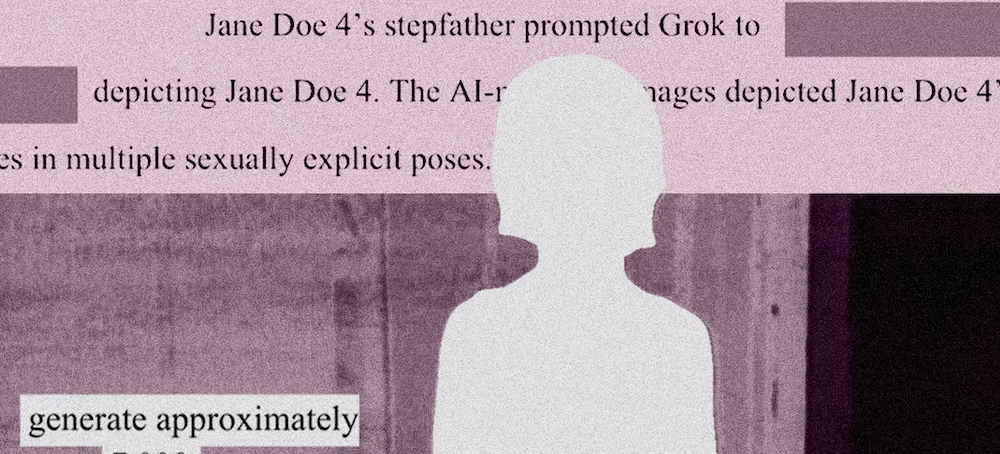 "A Wyoming woman alleges in a federal lawsuit that her stepfather used the Grok chatbot to transform a childhood photo into child sexual abuse material." (image: Tilde Oyster/WP/iStock)
A Wyoming woman alleges in a federal lawsuit that her stepfather used the Grok chatbot to transform a childhood photo into child sexual abuse material.
A man who flashed a badge told Jane he had a warrant to search her stepfather’s electronic devices for child sexual abuse material, she said. A technician looking for a hard drive with family photos said it had something to do with artificial intelligence, she said.
Jane later learned that her stepfather had created thousands of sexually explicit images of her as a child and traded them online, she said. He manipulated a photo taken when she was about 11, showing her lying on a couch in an oversize T-shirt, the filings claim, transforming it into graphic fake images. One was captioned “stepdad rapes her,” the documents said.
Jane’s stepfather made the more than 7,000 fake explicit images of her using the AI chatbot Grok, released by Elon Musk’s company xAI, according to the documents she filed last month in a federal lawsuit against the company.
Two days after the raid, her stepfather was found dead by suicide inside his car, Jane said. It was parked in her hometown, where she and her partner had recently bought a house.
“My life was completely normal,” Jane said, speaking on the condition that she be identified by the name used in court filings. “Not even 48 hours after that it was a literal nightmare.”
Jane’s experience, publicly described by her for the first time, shows some of the potential consequences from a growing form of sexual abuse enabled by AI apps that make it easy to create fake but highly realistic child sexual abuse material of a person from a single photo.
She now feels more anxious about keeping her own child safe and warned that AI images can cause real harm. “Limitless access to these tools is spreading so quickly,” Jane said. “It is taking everyday life and turning it into child sexual abuse.”
In July, Jane joined a federal lawsuit that was filed against xAI in March by three Tennessee teenagers, two still minors, identified as Jane Does 1, 2 and 3. They alleged that Grok had been used to sexualize photos of them taken when they were younger.
The expanded suit, filed last month in the U.S. District Court for the Northern District of California, alleged that xAI had produced, possessed and distributed AI-enabled child sexual abuse material. It seeks class-action status on behalf of anyone who had photos of themselves as minors altered by xAI into sexually explicit content in which they are still recognizable.
The lawsuits came after Musk’s decision last year to make xAI an outlier among major AI companies and promote use of Grok to create sexual content. He has boosted the chatbot’s ability to generate and manipulate images and video by posting depictions of sexualized young women to his millions of followers on X.
xAI, now part of Musk’s conglomerate SpaceX, did not respond to a request for comment, and the company has not responded to the federal lawsuit in court. Musk has said Grok is supposed to allow “upper body nudity of imaginary adult humans,” similar to R-rated television shows.
Grok Imagine pic.twitter.com/jpVBakZYqt
— Elon Musk (@elonmusk) May 17, 2026
The plaintiffs are seeking damages under “Masha’s Law,” a federal statute that allows victims of child pornography to sue. The lawsuit also makes product liability claims against xAI for negligence and defective design, similar to wrongful-death suits filed against AI companies by the families of young users who died by suicide.
Lawmakers in the United States and Europe moved to investigate xAI earlier this year, after it allowed the chatbot to publicly post sexualized images on Musk’s social network X in response to requests from users to alter photos to remove subjects’ clothing. Over an 11-day period, the Grok account on X posted about 3 million sexualized images, 23,000 of them depicting children, according to the Center for Countering Digital Hate, a nonprofit organization that pressures tech firms to clean up their platforms.
Musk said in a post on X at the time that he was “not aware of any naked underage images generated by Grok” and that the chatbot would “refuse to produce anything illegal.”
Within weeks, Jane Doe 4’s stepfather first uploaded the photo of her as a child to Grok, which sent back fake images showing her nude, the lawsuit says.
A couple of weeks after Jane Doe 4 joined the federal lawsuit, xAI sued Minnesota over a new law that bans distribution of nonconsensual nude images of real people made with AI, claiming it would restrict constitutionally protected content.
“xAI’s strategy seems to be: We want to make sure that we allow people to generate anything that is legal,” said David Thiel, an information security researcher and former chief technology officer for the Stanford Internet Observatory. That requires xAI’s technology to reliably draw the line between content that is abusive or merely provocative, he said.
System under strain
For 20 years, major internet companies have used an automated system managed by the nonprofit National Center for Missing & Exploited Children for reporting and removing child sexual abuse material.
Firms report suspected abuse material to NCMEC’s CyberTipline and use digital fingerprints or “hashes” of confirmed abuse images to automatically detect and remove them.
That system is now being challenged by AI image tools, NCMEC said in a letter this year to Sen. Chuck Grassley (R-Iowa).
AI apps, including specialized tools dubbed “nudifiers,” allow anyone to rapidly produce large numbers of new, highly realistic child abuse imagery that cannot be matched against NCMEC’s database.
Generative AI models’ ability to remix and combine different visual concepts and styles makes them potent tools for abuse, said Thiel, the online safety expert. In the same way an AI model can generate a birthday party invitation in the style of a Marvel comic, it can also remove the clothing from an image of a child.
AI models, trained on troves of data scraped from the web, have ingested “plenty of imagery of explicit content, plenty of imagery of children,” said Thiel, who wrote a 2023 report that found child sexual abuse material in a widely used dataset for developing AI image tools.
The lawsuit against xAI also names Stability AI, which makes an open-source, customizable AI image generator called Stable Diffusion. Researchers from Germany’s CISPA Helmholtz Center for Information Security recently estimated the software is behind more than 40 percent of AI-generated nonconsensual intimate imagery of real people.
Stability AI did not respond to a request for comment. The company has said it tests AI models for child safety and adds protections before they are released. It has not responded to the lawsuit in court.
In its March letter to Sen. Grassley, NCMEC criticized xAI and seven other online service providers for poor reporting practices that it claimed stymied law enforcement. The nonprofit organization said that over a three month period from mid-September last year fewer than 10 percent of tips from xAI could be “sent actionably to law enforcement,” because they lacked key information. The company later improved its reporting, the letter said.
Jane Doe 4’s lawsuit against xAI alleges that the company’s tip to NCMEC did not include crucial information from its records, such as the IP addresses associated with her stepfather’s account. It claims xAI failed to respond to multiple requests from an investigator for more information.
Jane’s stepfather was not charged with child pornography offenses and was released by authorities on the day the warrant was executed because xAI’s tip to NCMEC did not provide any of the explicit fake images, Jane Doe 4 said, citing her conversations with an investigator on the case. The investigator told her that xAI’s initial report went to the internet crimes task force in the wrong state, causing further delays, Jane said.
Even when a company fully reports incidents of an AI tool being used to create child sexual abuse imagery, the legal consequences may not be clear cut.
The enforceable legal boundaries around AI-generated child sexual abuse material are uncertain, said Eric Goldman, a law professor at Santa Clara University School of Law. Some recent statutes intended to curtail abusive AI images could be challenged on First Amendment grounds, he said.
Since the raid on her parents’ home, Jane’s life has become unrecognizable, she said. She started therapy for trauma and has had to return to work as a nurse to support her widowed mother, putting a financial strain on her own family.
“I’m living through this every day. I’d be lying if I said I wasn’t extensively suicidal,” Jane said, the only time her voice cracked in hours of interviews.