He Saw a Video of a Mexican Man Shot by ICE. It Was His Father.
Arelis R. Hernández The Washington Post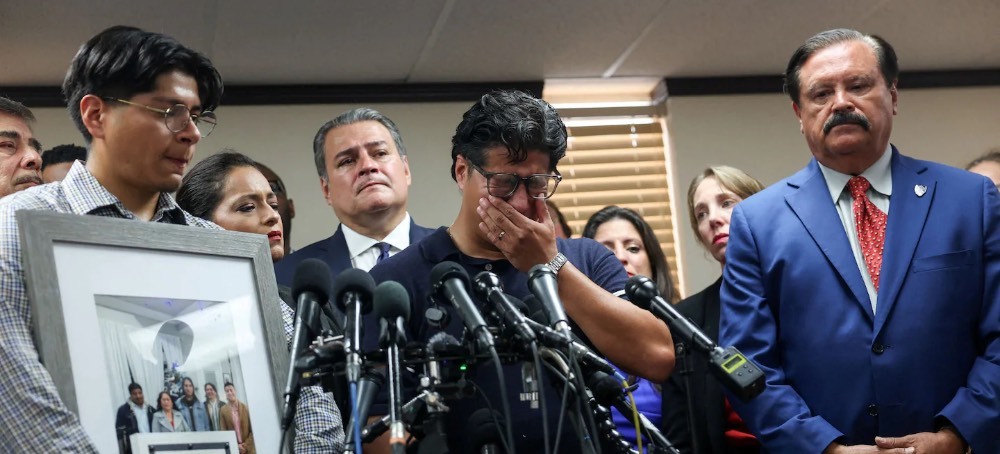 Ronaldo Salgado sobs during a news conference on Wednesday after an ICE agent fatally shot his father in Houston. ((photo: Antranik Tavitian/Reuters)
ALSO SEE: ‘He Did Not Deserve to Die’: Family of Man Shot by ICE Agent Demand Independent Probe
The eldest child of Lorenzo Salgado Araujo said his late father was “a family man” who was probably frightened by the unmarked vehicles following him.
The eldest son of Lorenzo Salgado Araujo got in his car and headed to Houston’s northern suburbs. He knew his father had been working on a construction site there, just as he had nearly every day throughout the three decades he had spent living in the United States. It was work that had allowed him to raise three sons and help send them to college — a job he did as an undocumented immigrant, hoping to one day have legal status and a shot at the American Dream himself.
Ronaldo Salgado found no sign of his father.
The first inkling of what had happened surfaced on his phone. Community activists were posting about Immigration and Customs Enforcement officers in the heart of a Houston neighborhood many Mexican immigrants call home. When he reached the site, Ronaldo Salgado saw his father’s white work van. Then a video popped up on his social media feed: It showed a man struggling on the ground after being shot by an ICE officer.
“I recognized him immediately,” Ronaldo Salgado said, sobbing as he recounted the events to reporters. “Not from his appearance, but from his voice, crying for help as he lay on the street bleeding out.”
Ronaldo Salgado relayed his panicked search for his father on Wednesday as he joined local legislators and activists in calling on the federal government and local authorities to conduct a full and transparent investigation into the killing. In the hours after the shooting, the Department of Homeland Security said an officer had fired “in self-defense” after Lorenzo Salgado Araujo refused to comply with orders and “weaponized his vehicle in an attempt to run over an ICE law enforcement officer.”
That does not square with the man Ronaldo Salgado says his father was. Lorenzo Salgado Araujo, 52, had no criminal record, he said, and would have obeyed any orders to stop. Ronaldo Salgado said his father was pursued by two unmarked vehicles, and he believes that his father would have stopped and complied if they had ICE insignia, or if he had known that the men were federal immigration officers.
Lorenzo Salgado Araujo was anxious about being robbed of his work tools, and his son suspects he was gripped by fear in his final moments.
“ICE did not present itself in an orderly manner,” Ronaldo Salgado said.
His father was a simple man wedded to his routines and work, the son said, and whose story echoed that of countless other immigrants. He’d married the girl he fell in love with as a teenager in Mexico and forged a life in the U.S. building homes. People routinely knocked on his door, seeking work, and he gave it to them. Eventually, he’d saved enough to build a home for his own family. It had a porch where he liked to sit and relax after a long day’s work.
On the last day of his life, Lorenzo Salgado Araujo woke up at 5 a.m. Ronaldo Salgado said his father brushed his teeth, showered and ate the hearty breakfast his wife had prepared for him. He got dressed, grabbed his lunch and coffee, and put on his work boots. He gave his wife a kiss goodbye and patted their dog on his head.
ICE activity had been picking up in Texas, and Ronaldo Salgado said his father had prepared for the possibility that he could get picked up. The family had settled on a plan: He would comply and sign nothing until his sons could work for his release. Despite their fears, Lorenzo Salgado Araujo could not stop working, and he was doing what he could to legalize his status in the U.S., his son said.
Lorenzo Salgado Araujo had filled out paperwork for a legal work permit and submitted good character affidavits and fingerprints. Ronaldo Salgado said 18 months had passed, and they expected the permission to be approved. The son did not clarify what type of immigration status they were seeking. Lorenzo Salgado Araujo’s children are all U.S. citizens.
The father always told his sons, “que siempre le echemos ganas en esta vida,” invoking the Mexican proverb of perseverance that describes generations of Mexican American resilience.
A rough translation: Give it your all, and never give up.
When Ronaldo Salgado arrived at the scene of the shooting, he tried to get more information but said he received little. The man shot had been taken to Ben Taub Hospital. That’s where Lorenzo Salgado Araujo’s three sons had been born. His eldest headed over. He’d seen his father moving in the video shared on social media, which gave him hope he was still alive.
Ronaldo Salgado said he couldn’t get answers from hospital staff. Instead, he found out his father had died from a news report. He called his mother, he said, to spare her the same indignity.
Ronaldo Salgado and others decried DHS’s characterization of their loved one as a defiant “illegal alien from Mexico.” They also criticized the agency for releasing Lorenzo Salgado Araujo’s name before they said any authority notified them of his death. Three others, including Lorenzo Salgado Araujo’s brother, were also detained.
“He deserved to live a quiet life as Lorenzo Salgado Araujo, a husband, father and a job creator for dozens of men who also wanted the American Dream,” Ronaldo Salgado said, clutching a framed portrait of his father.
The son closed his remarks in his father’s mother tongue.
“My father was always a strong man and never wanted us to know if he was in pain. He never complained,” he said in Spanish. “But it hurt my heart to hear his scream.”