Four Years After AIPAC Boosted Haley Stevens, She Can’t Escape It
Etan Nechin Haaretz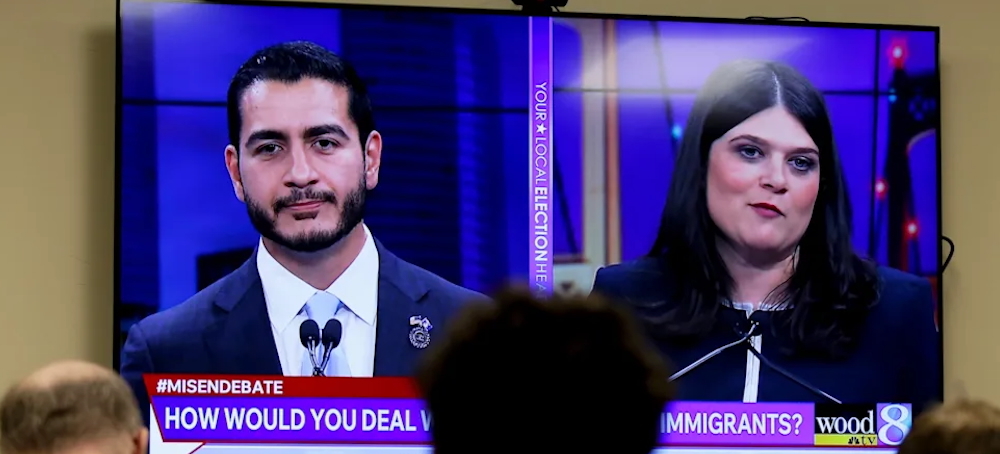 Michigan U.S. Senate candidates, Abdul El-Sayed, left, and Rep. Haley Stevens, D-Mich., are displayed on a television during a debate inside the spin room at WoodTV studios on Tuesday, July 7, 2026, in Grand Rapids, Mich. (photo: AP)
Four years ago, Haley Stevens thanked AIPAC after it helped propel her to victory over Rep. Andy Levin in the Democratic primary.
On Monday's debate, she dodged questions about the tens of millions of dollars AIPAC's super PAC reportedly spent in support of her campaign.
Four years ago, support from AIPAC and establishment Democrats would likely have reinforced Stevens's standing. This year, with progressive candidates challenging establishment Democrats across the country, those endorsements have become central to El-Sayed's campaign against her.
This illustrates how dramatically Democratic politics on Israel have shifted since AIPAC first entered Democratic primaries.
In 2021, ahead of the 2022 midterms, AIPAC launched its PAC, The United Democracy Project. Its mission was to direct ad spending in Democratic races, where the organization believed candidates weren't sufficiently supportive of Israel.
AIPAC spent tens of millions nationwide, including $4.2 million backing Stevens in Michigan's redistricted 11th district, where the new map pitted her against Rep. Andy Levin, a scion of a progressive Jewish political dynasty. Stevens won handily.
The race was seen as a referendum on the Democratic Party's stance on Israel and Palestine. It also showed the force of AIPAC's outsized spending.
After winning, Stevens thanked AIPAC and the pro-Israel community, saying, "our values spoke this evening very loudly."
At the time, AIPAC demonstrated overwhelming political strength. But after October 7 and the subsequent war in Gaza, U.S. public opinion on Israel began to shift.
This was particularly notable in Michigan, home to the largest Arab-American population in the United States. In the run-up to the 2024 presidential election, the Uncommitted movement, led by community leaders from Dearborn, withheld its endorsement from Kamala Harris, which many Democrats blame for helping Donald Trump carry the state.
Stevens has long represented the Democratic Party's pro-Israel mainstream. Elected to Congress in 2018 as part of the same Democratic class that produced the Squad – including fellow Michigander Rashida Tlaib – Stevens went on to lead the Bipartisan Task Force for Combatting Antisemitism and the Congressional Hostage Task Force. She is also a member of the Abraham Accords Caucus.
Though Stevens is made of the traditional Democratic mold of unwavering support for Israel, the race's focus on the war and AIPAC is a departure from the concerns that occupied her in Congress. Her congressional work focused on manufacturing and education, including helping push the CHIPS and Science Act, which supports investments in semiconductor manufacturing and research, and bills promoting STEM education and online job training.
Since October 7, Stevens has criticized Netanyahu and the war in Gaza, called for more aid to be allowed into the Strip, but stopped short of calling Israel's actions a genocide. "Netanyahu has not made us safer, has not brought us closer to peace, and he is a danger to Jews in America and around the world," she said in a recent debate.
At the same time, Stevens voted against a bill that would have cut U.S. aid to Israel, which was supported by a record number of House Democrats.
When pressed by El-Sayed on her AIPAC credentials in an early July debate, Stevens rejected the line of attack and noted she supported the two-state solution. "No one owns my vote, and no one owns my policies," she said. "Anyone who's contributing to my Senate campaign is doing so because of my proven record of fighting for Michigan."
Jessica "Decky" Alexander, chairwoman of the Michigan Democratic Jewish Caucus, was dismissive of El-Sayed's criticism of Stevens' AIPAC links. "If I were going to tell you who the AIPAC candidate is, I think it's Abdul, because that's all he talks about," she said.
"He has other great talking points, and there's an agreement on a lot of the things he's said. But the way he's making her out to be this corporate hack is absurd."
For Alexander, the underlying issue is ultimately personal safety. "People say it's economics – I always think it's security. Do I feel safe? Who's going to keep me safe?"
Despite her discomfort with El-Sayed, she said she's committed to help the Democratic Party win. "We are not 'Uncommitted 2.0.' We're not going anywhere."
Halie Soifer, CEO of the Jewish Democratic Council of America, which has backed Stevens since her first primary bid in 2018, said that El-Sayed's focus on Israel and AIPAC will backfire with voters.
"It may get headlines, but he's not focused on the issues directly impacting people's lives, which is how they determine what they're going to vote on," she said.
Meanwhile, J Street President Jeremy Ben-Ami is concerned that AIPAC's spending in the race is turning Israel into a wedge issue. "I think this is a real strategic mistake. It's bad for Israel, it's bad for the Jewish community, and it's bad for the U.S.-Israel relationship," said Ben-Ami.
J Street didn't endorse either candidate. The main focus, Ben-Ami said, should be on wresting control of the Senate away from the Republicans.
"We are very aware that American democracy is hanging in the balance with these elections, and for the American Jewish community, preservation of American democracy should be the number one issue," said Ben-Ami.