Fort Hood Shooter’s Execution Will Be Live-Streamed, Defense Dept. Says
Amy B Wang, Aoife Walsh and Maegan Vazquez The Washington Post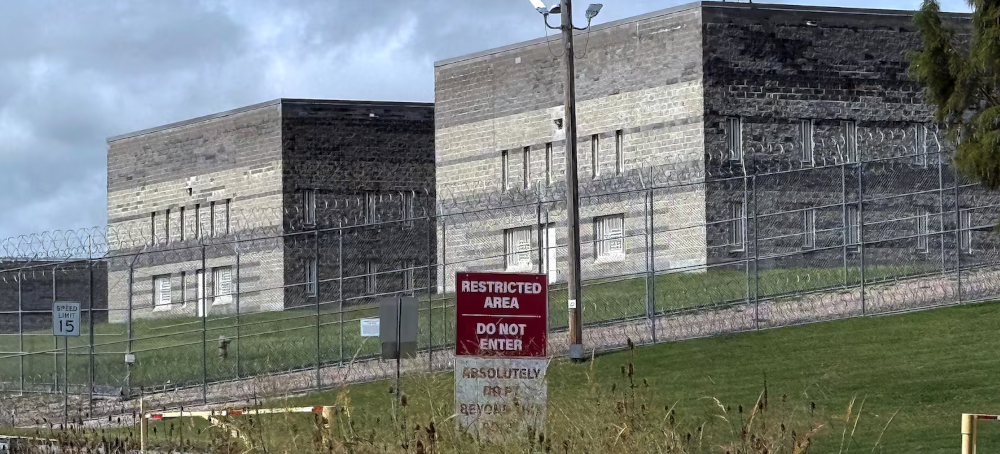 The military prison at Fort Leavenworth, Kansas, where Nidal Malik Hasan is being held on death row. (photo: Paul Hennessy/Getty)
“We’ll make sure that people are able to watch it,” Defense Secretary Pete Hegseth said Thursday about the firing squad execution of convicted Fort Hood shooter Nidal Malik Hasan.
Earlier Thursday, Defense Secretary Pete Hegseth said he wanted the execution to be public.
“He’s going to get a firing squad of soldiers. As it should be,” Hegseth said in an interview with far-right political activist Jack Posobiec. “We’ll make sure that people are able to watch it. That it’s public. Because people need to understand that there’s serious consequences for these types of things.”
The execution is scheduled for Dec. 3.
While a few countries still conduct public executions, government-sanctioned executions in the United States have long been hidden from public view. Hasan’s scheduled death by firing squad would be the first time the U.S. military broadcast an execution live on the internet.
Earlier this week, President Donald Trump approved the firing squad execution of Hasan, a former U.S. Army psychiatrist who opened fire on dozens of people at the Soldier Readiness Processing Center in Fort Hood, Texas, in 2009. Hasan was left partially paralyzed after being shot by officers responding to the attack and uses a wheelchair.
If Hasan’s execution is carried out, it would mark the first U.S. military execution since April 13, 1961, when Army Pvt. John A. Bennett was hanged after being convicted of rape and attempted murder, according to the nonprofit Death Penalty Information Center, which monitors capital punishment. The military’s last known firing squad execution was carried out by “musketry” on Nov. 9, 1945, according to the group.
“It hadn’t been since World War II since we’ve done that,” Hegseth told Posobiec, describing how he thought it was a “no-brainer” to request a firing squad execution. “Well, I kind of like the mentality we had in World War II, which was win. Which was understand when the enemy attacks you, you stand your ground.”
Hasan, an American-born Muslim, killed 13 people and injured 32 others at the Central Texas Army post where troops were preparing to deploy to Afghanistan. He shouted “Allahu akbar!” meaning “God is great,” before targeting soldiers with a handgun he had fitted with laser sights.
Hasan, who acted as his own attorney, was convicted of premeditated murder and sentenced to death in 2013. During his court-martial, he admitted responsibility for the shooting, saying he had been on the wrong side of a war against Islam and had switched over.
Hasan was scheduled to go to Afghanistan at the end of November 2009 but did not want to deploy, the court heard.
Execution by firing squad is rare in the United States, permitted in a handful of states: Idaho, Oklahoma, Utah, South Carolina and Mississippi.
Three people in South Carolina were put to death using the method last year, Death Penalty Information Center data shows. Before then, only three people had been executed in this manner since 1977 — all in Utah.
Countries such as Iran and Afghanistan still carry out public executions. But the Death Penalty Information Center said there was no precedent for a state-sanctioned execution to be live-streamed.
“Secretary Hegseth’s comments may be simply aspirational,” the center said in a statement. “There is currently no regulation or precedent for an execution to be live streamed on the internet or otherwise made widely available to the public.”
Polling on whether Americans support public executions is scant. One of the most recent polls is from April 2001, when the Pew Research Center asked if Oklahoma City bomber Timothy McVeigh’s execution should be broadcast on television: 24 percent of respondents said yes, while 73 percent said no.
As Trump was mulling another presidential run in 2023, a spokesperson denied a Rolling Stone report that he wanted to expand the use of the death penalty, televise executions and expand the methods of execution to permit death by firing squad, hanging and guillotine.
Under Trump, the Department of Justice has expanded methods of execution to allow death by firing squad and readopted lethal injections.
Since the federal death penalty was reinstated in 1988, 16 people have been executed. Thirteen of those individuals were executed during Trump’s first term.