FOCUS: Jonathan Blitzer | Locked Away
Jonathan Blitzer The New Yorker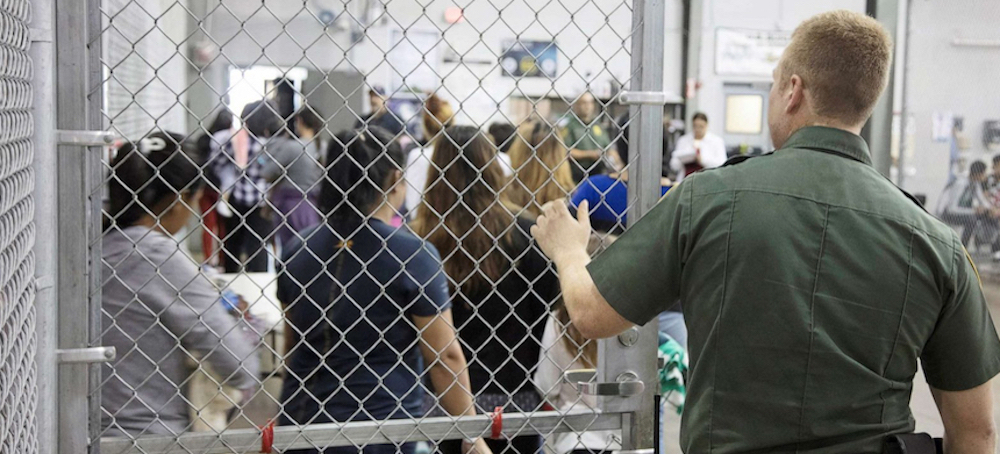 An immigrant detention center. (photo: ABC)
On a military base in West Texas, where the government has built a sprawling tent complex to hold thousands of immigrants, deprivation and dire conditions are part of the design.
One of the program’s participants, Rey, is a Cuban in his mid-fifties who came to the U.S. in 1994. Shortly after arriving, he was involved in a robbery in Florida. He served a five-year prison sentence, but, because Cuba didn’t coöperate with American authorities, he could not be deported. Instead, he was authorized to remain in the country. In 2014, Rey moved to El Paso, where he worked as a truck driver and began making regular visits to the local ISAP office. “My friends would tell me, ‘Are you crazy? One day they’re going to arrest you,’ ” he said recently. “I would tell them, ‘If, when we were young, we did things wrong, now we have to do things the right way.’ ”
Rey, who is tall, heavyset, and bald, with a baritone voice, is a laid-back optimist. He and his wife, a U.S. citizen whom I’ll call Sara, met at a weekly salsa night at an El Paso bar. She was struck by his unhesitating generosity. “Rey is the kind of person who, if he has something, he’ll give it to you,” she said. In El Paso, Rey went on to open a Cuban pizzeria, a night club, and trash-collection and furniture-restoration businesses. “My wife calls me a dreamer,” he told me. They got married a decade ago, when Sara’s son was a year old. “We eventually told him that Rey wasn’t his biological father, but he didn’t care,” Sara said. “As far as he was concerned, Rey was always his dad and always would be.”
Last October, Rey’s case manager at ISAP called and asked him to stop by for an appointment. He arrived between errands, having just taken his son to school and carrying two thousand dollars in his pocket, a payment for a new pizza oven. “I was running around like crazy,” he said. It was also Sara’s birthday; they were supposed to meet for lunch.
Rey spent a few minutes in the waiting room of the ISAP office—a drab space with bare blue-and-white walls and two rows of chairs—before an official summoned him inside. “Walk down that hallway,” he told him. A group of ICE agents was waiting. “No one explained what was happening,” Rey told me. They put him in handcuffs and led him to a van that was loaded with people. A woman inside was sobbing as she told the agents that her three children were currently in school. “What are they going to do?” she asked. “Who’s going to pick them up?”
By two o’clock that afternoon, Sara hadn’t heard from Rey and decided to drive to the ISAP office. His car was still in the parking lot. Inside, an official gave Sara the address of a detention center. When she got there, another official told her that family visits were conducted alphabetically, by detainees’ last names; she’d have to come a different day for Rey’s turn. Sara, a college graduate who works for the State of Texas, is pragmatic and personable. “You have a computer,” she replied. “Can you just do me the favor of telling me if my husband is being held here?” The official refused. Sara went to another detention center in the area, where she was told that Rey was at the place she’d just left. When she returned to the first jail, an official directed her to a side door of the building. A man in a khaki uniform emerged and handed her a ziplock bag containing Rey’s wallet, which was empty, and the shoelaces from his sneakers.
A few hours later, Rey and more than a dozen other detainees were driven ten minutes east, to a facility where he would spend the next six weeks. It was down a long, barren drive, almost a mile from the main road, and sealed off behind a metal gate. Four large white tents stood in an imposing line, flanked by a few small buildings. The desolate surroundings scared some of the others, but Rey, whose pizzeria was nearby, recognized where they were—at a military base called Fort Bliss.
Last summer, the Trump Administration picked Fort Bliss to be the site of the largest immigrant-detention center in the country. ICE was ramping up arrests nationwide, and the government, in search of more space to hold people, opted to erect tents—known in government parlance as “soft-sided facilities”—at military installations and close to existing ICE jails. “The idea seemed to be: How can we do this as cheaply and brutally as possible?” Claire Trickler-McNulty, a former senior ICE official, told me. Fort Bliss’s proximity to the U.S.-Mexico border, and its considerable size, made it an obvious place to start. (It also has a loaded history: during the Second World War, fifty-six U.S. citizens and residents of Japanese, German, and Italian descent were interned on the premises as “enemy aliens.”) ICE already had a detention center nearby, on Montana Avenue. The agency called the new installation, a sprawling tent complex that could hold up to five thousand people, Camp East Montana.
The contract for running Camp East Montana was worth more than a billion dollars. Initially, the Department of Defense awarded it to Deployed Resources, a logistics contractor that had operated tent facilities during the Biden Administration. But the decision was almost immediately reversed. The Trump Administration claimed that it had cancelled the contract for technical reasons. Current and former ICE officials, however, told me that Deployed Resources had landed on a “no-contract list,” because of its past association with the Biden White House. Among other things, one of the company’s board members was married to a former chief of staff to Doug Emhoff, Kamala Harris’s husband.
A few weeks later, the contract went out a second time, and eleven companies placed bids. On July 18th, the Army announced the winner: a Virginia-based firm called Acquisition Logistics, which had no prior detention experience. The largest federal contract it had previously received—a sixteen-million-dollar commission for program management at a California naval base—was a fraction of the new project. Public databases listed between eight and fifty employees at the company, and the firm’s official address was a modest gray house with red shutters in the suburbs of Richmond, which belonged to the company’s founder and C.E.O., Kenneth Wagner, a seventy-eight-year-old Navy veteran.
Wagner’s sixty-page bid offered little more than a rhetorical embrace of the Administration’s immigration policies. “Any misstep by inexperienced contractors can be detrimental,” creating political “fodder” that “detracts from, challenges, and slows down the exceptional work” of ICE, the proposal stated. Later, another government contractor filed a lawsuit claiming that Acquisition Logistics had failed to meet at least two of the bid’s “solicitation requirements.” The Army responded, in writing, that the contract was consistent with a recent executive order titled “Protecting the American People Against Invasion,” and that any further delay would “directly exacerbate the existing detention capacity crisis.”The scramble to ready the facility led to a string of other irregularities and mishaps. Flouting state legal requirements, Acquisition Logistics failed to register to operate in Texas, according to research by the nonprofit group Public Citizen. On July 21st, a thirty-eight-year-old construction worker named Hector González was crushed to death by falling building materials. The Occupational Safety and Health Administration later found three subcontractors responsible. One of them was owned by Nathan Albers, a Trump campaign donor who spent Election Night in 2024 at Mar-a-Lago. His companies had a raft of prior infractions, according to ProPublica, ranging from employing undocumented workers to violating minimum-wage and overtime laws.
The first detainees who were taken to Camp East Montana, in early August, arrived at an active construction site. They were kept awake at night by the sounds of trucks and jackhammers. During the day, plumes of dust blanketed the facility. “This place does not seem to be designed for humans to be here,” a Venezuelan father of two from Dallas told the American Civil Liberties Union in a sworn declaration.
On August 4th, Representative Veronica Escobar, a Democrat from El Paso, made a formal request to visit the facility. “We tried to get in as soon as we learned that they were already holding detainees,” she told me. Although members of Congress are, by law, allowed to inspect detention facilities, ICE denied Escobar’s request. In an e-mail, officials told her that the site was “still under construction and will not be operational” until August 17th. But, as the Washington Post later reported, fifteen people were already being held there. “It was definitely earlier than anticipated, including by the contractors,” an Administration official told me. “The seventeenth is what we were expecting internally. Then ICE just brought some people.”
The lack of preparation made the conditions intolerable. Toilets wouldn’t flush. Running water came sporadically. The detainees ate and slept next to the bathrooms; fetid water leaked into the dining area and under the beds. “Since we are not given anything to mop up the dirty water, we have to use our own underwear and socks,” a Cuban detainee said. He had pleaded with the guards to let him and the others go outside for recreation. Fifteen days passed before the men were allowed to leave the tent, and then only at night. “I have not seen the sun for approximately one month,” he said.
The outdoor spaces hadn’t been finished. Neither had the areas for visitation. Phone booths for making calls weren’t yet set up, and tablets that detainees were given to call their lawyers didn’t work. Most of the people inside had been transferred from the South Florida Detention Facility, another tent complex, which the government proudly called Alligator Alcatraz. But, for most of August, they were effectively off the grid. ICE’s detainee locator, which allows family members and lawyers to see where someone is being held, issued an error message for those who were now at Camp East Montana. This was seemingly by design, the Administration official told me. The system was generally supposed to show where a person was being held within seventy-two hours of his arrival at a new facility. Someone at ICE, the official said, “went in and changed the settings and made it say, ‘Call ICE for details.’ ”
By the time Rey arrived, in October, there had been so many complaints about conditions at Camp East Montana that both ICE and the Government Accountability Office sent teams to conduct site visits. “The physical layout was a disaster,” one of the officials who visited told me. A tent that was supposed to provide space for a barbershop, a law library, and religious services was closed because workers were using it as a staging area while they erected another tent to house more detainees. According to a G.A.O. report, ICE officials were unaware of many of these problems, because the agency hadn’t inspected the facility before it started sending detainees there. This itself was a breach of ICE policy.
The cells in the so-called Special Housing Unit, or SHU, which were used for solitary confinement, had features that, the official said, would make it easier for someone in distress to commit suicide—a handle on the door, a beam within reach of the bed. The cameras in that area still didn’t work. “You’re just putting people who are depressed and being kept alone in a room, and who, by the way, have nothing to do—there was zero activity, the tablets didn’t work, they never got to go outside, no books, no games, no TV—you’re leaving them in there and you’re not watching them,” the official said. “When we left, we told our leadership that someone was going to kill himself.”
When Sara learned that Rey had been sent to Camp East Montana, she tried to comfort herself with the thought that her husband was a survivor. In 1994, at the age of twenty-one, he was one of some thirty-five thousand Cubans who fled the island for the United States on makeshift rafts; hundreds drowned attempting the trip. It was the peak of a decade-long crisis, which Fidel Castro, the country’s leader, called the período especial, a bald euphemism for the economic collapse that occurred in Cuba after the fall of its patron, the Soviet Union. Ten people from Rey’s neighborhood in Havana, including his older half brother, were on his raft, which they had fashioned from a tractor tire. “There were moments when you really didn’t know if you were going north or if you were going the wrong way, back to Cuba,” he told me. At one point on the open sea, a smaller raft that had started to leak floated over, and a mother begged them to take her ten-year-old son. Rey and the others agreed, though they had to threaten the adults on the other raft not to jump aboard theirs, since the added weight would sink them all.
The U.S. Coast Guard eventually intercepted Rey’s raft, and he was taken to the American naval base in Guantánamo Bay, Cuba, where he spent the next eleven months. For much of that time, he couldn’t communicate with his mother, who had stayed behind in Havana, or with his father, who lived in El Paso. Guantánamo, he told me, “turned into a city where you had to make your own way.” He and his friends banded together to fend off attacks from other internees. The men in Rey’s group would chaperon the women around the base, watching the door when they used the bathroom. The biggest challenge, he said, was that “you didn’t know when you’d be able to leave.”
In the end, Rey was sent to live with his father in El Paso. But their relationship became tense, and he moved to Miami, where he had friends from Havana. These were wayward years: he took odd jobs and lived in a cramped apartment with roommates. He got arrested while driving a car full of stolen goods. After half a decade in prison, he returned to El Paso, where he briefly lived with a half sister before striking out on his own.
As a former internee at Guantánamo and a onetime federal inmate, Rey had enough experience to be immediately alarmed by the chaos at Camp East Montana. There was no formal intake process for new arrivals and no orientation to explain how things worked. When the guards took Rey’s cash, he asked them for an official receipt listing the amount. They told him not to worry. “Of course I’m worried,” he said. “It’s two thousand dollars.”
Rey has diabetes and high blood pressure. He took a battery of medications, including two separate pills for diabetes and an antibiotic to address an earlier infection, all of which were at home with Sara. He tried to tell a guard about his medical conditions. “Here’s my wife’s number,” he said. “Please call her.” The guard replied, “We’re not going to be doing that.” Rey spent his first night sleeping on the floor of a holding cell with twenty other men. “You didn’t have a blanket—it was cold. And you were hungry,” he said. “I could begin to feel the coldness of a prison.”
Every tent at Camp East Montana was divided into a dozen units, each containing about thirty-five bunk beds topped with thin pallets. When Rey was transferred from the holding cell to Tent C, he asked which bed was his. “Whatever one you find empty,” he was told. Rey knew more about his rights than the average detainee, and he tended to ask pointed questions. How could he make his first phone call? “It’s with a tablet,” the guard replied. But to access the tablet each detainee needed a pin, and it could take up to a week for a pin to be issued. “During that time, my family won’t know where I am?” Rey asked. “Exactly,” the guard replied.
One of the ironies of the facility was that, for an ice jail, actual ice officers were scarce. Instead, the detainees interacted with private contractors from multiple companies. Loyal Source was responsible for medical care; Amentum managed logistics, from I.T. to housing. The security guards, who were employed by Akima Global Services, were distinguishable by the color of their shirts.
One night, Rey was lying in bed when an older man in a wheelchair entered the tent. The unit was nearly full, and the only empty spaces were on the top bunks. Rey walked over to a guard to say that the man in the wheelchair needed help finding a place to sleep. The guard shrugged. “It always came back to the same thing,” Rey told me. “They weren’t prepared.” Someone eventually tossed the man a mattress pad, and he slept on the floor.
Without his medication, Rey often felt dizzy and weak. The guards told him to submit a formal request to see a doctor. He did so, but days passed without a response. He began to have trouble urinating, which was especially concerning: three months earlier, he’d been hospitalized with a similar problem that had led to sepsis, and doctors had inserted a catheter. “Sincerely, these are simple things,” he told me. “But the system turned them into something grave.”
One morning in early November, after Rey had been in detention for about a week, the guards ordered everyone in his unit to go outside to the yard while the staff cleaned the tent. Rey refused to leave his bed. A higher-ranking official came over and demanded to know what the problem was. “My reason is very simple,” Rey said. “I am diabetic. I need my medicine.” The guard replied, “I understand, but tomorrow we’ll resolve your problem. Right now, you need to leave the unit.” Rey complied, but the next day nothing happened. The following week, he once more refused to leave his bed during the cleaning.
“You again?” the guard said.
“No, it’s you again,” Rey replied. “You told me one thing, and nada. Don’t waste your time with me. If you want to send me to the hole, do it. But I need my medicine. My wife is outside, very worried. And all I’m asking for is my medicine.” Rey spent the next eight hours in the shu; afterward, he was sent back to his tent without any medication. “Look,” one of the guards told him. “We now understand what type of medicine you need, but we don’t have it here. We have to order it. And it’s a whole process.”
On a warm evening this April, I drove to the El Paso Service Processing Center, one of the city’s main immigration jails, for visiting hours. The person I’d come to see—Antonio Ascón Frometa—had much in common with Rey. Frometa had also come to the U.S. from Cuba in 1994, during the rafter crisis. Like Rey, he had spent time at Guantánamo before ending up in Florida, where, during the next three decades, he started a family and worked as a landscaper. He is sixty-four years old and trim, with bushy eyebrows, a full head of gray hair, and a lined face. Dressed in a loose-fitting red uniform, he picked up the phone in the visitation booth and looked at me through a Plexiglas divider with an expression of distrust. I hadn’t told him that I was coming.
Frometa had been detained for the previous eight months, following his arrest, last August, in an immigration raid in West Palm Beach. “I didn’t try to run,” he told me. “I wasn’t even arrested by ice. It was by someone from the Florida Highway Patrol.” He was promptly transferred to the South Florida Detention Facility—Alligator Alcatraz—where a guard punched him so hard in his right ear that he can no longer hear out of it. He was still nursing the injury when ice sent him to Camp East Montana. He arrived in late August. “Everything was covered in dust,” he said. “They were building more tents.” The nights were cold, and his ear throbbed.
A few weeks later, he bumped into someone he’d met decades earlier, at Guantánamo. The man’s name was Geraldo Lunas Campos. “He didn’t recognize me at first, but I recognized him,” Frometa told me.
Lunas Campos had been living in Rochester, New York, with his three children. He had served prison time in the U.S.—five years for attempting to sell drugs and one year for having “sexual contact with an individual under eleven,” which Kary Lunas, one of his daughters, has said was the result of an unfounded claim made during an acrimonious divorce. His criminal record led ice to arrest him last July. Lunas Campos arrived at Camp Montana East in September, about a month after Frometa. The two struck up their old friendship. “I know members of Geraldo’s family,” Frometa said.
Lunas Campos was asthmatic and used an inhaler. He also suffered from bipolar disorder, depression, and anxiety; a report obtained by ProPublica stated that during his time at Camp East Montana he had complained at least eight times about missing doses of antipsychotic drugs that he took for his conditions. At one point, he’d given himself a black eye, the result of banging his head against a wall. In October, guards found him with a bedsheet tied around his neck, threatening suicide.
On January 2nd, as Frometa later stated in a sworn declaration, he “saw Geraldo ask the guards the whole day for his asthma medicine.” The guards ignored him, but Lunas Campos pleaded with them again the following day, knocking on the door of the guard station to get their attention. “We’ll take you to the hole,” one of the guards threatened, to which Lunas Campos replied, “You can take me to the hole, but just give me my medicine.”
That was the last time Frometa saw him. The next morning, he called Lunas Campos’s wife to check in. Frometa was the only other detainee at Camp East Montana who had her phone number. She told him that ice had just called her to say that her husband “woke up dead.” Frometa told me, “She said they wanted to cremate the body, and I told her to wait, to investigate.”
Six days after Lunas Campos died, ice issued a statement saying that guards had “observed him in distress” and that his death was under investigation. A week later, the Washington Post reported that El Paso County’s Office of the Medical Examiner, which had performed an autopsy, was planning to classify the incident as a homicide, citing, as the cause of death, “asphyxia due to neck and chest compression.” At this point, ice revised its previous statement. It now claimed that Lunas Campos had “violently resisted the security staff and continued to attempt to take his life.” The Government Accountability Office later found that “evidence associated with the incident was missing or destroyed.”
To date, at least five other witnesses have contradicted the government’s version of events. The Special Housing Unit, where Lunas Campos had been taken that night, was in a smaller tent on the south side of the facility. Inside, each cell had a toilet and a bed and was covered by wire netting, presumably to prevent escape. About twenty-five men were held there at a time, most because they’d complained about conditions at the facility. The other inmates could easily hear what was happening in Lunas Campos’s cell. Santos Jesús Flores, a Salvadoran who was in the shu that night, said in a declaration that Lunas Campos’s hands and feet had been cuffed. He’d heard Lunas Campos begging for his medicine, followed soon afterward by “the sounds of the guards punching Geraldo, the clanking of Geraldo’s handcuffs, the sounds of shoes scraping against the floor. Then I heard Geraldo saying, ‘I have asthma. I can’t breathe.’ ” Flores’s account is consistent with that of Ricardo Andrade Mosquera, a twenty-nine-year-old from Venezuela, who was in another nearby cell. “They were on top of him,” he told the El Paso Times. “He screamed horribly as they hit him.”
Lunas Campos’s death was the second of three that occurred at the facility between December 3, 2025, and January 14, 2026. Francisco Gaspar-Andres, a forty-eight-year-old from Guatemala, had received medical treatment at Camp East Montana for nearly two months before he was transferred to a local hospital, where he died of liver and kidney failure. Victor Manuel Díaz, a thirty-six-year-old Nicaraguan, who was arrested while working at a Korean-barbecue restaurant in Coon Rapids, Minnesota, died seven days after being transferred to Camp East Montana, on January 7th, in what ice said was a “presumed suicide.” Díaz had previously got sick while working on a dairy farm and spent two months in a hospital, with tuberculosis. “He’d been fighting hard in the hospital to get better,” his ex-wife, who lives in the U.S., told me. “He was finally out and working. It doesn’t make sense that he would have committed suicide.” This time, unlike with Lunas Campos’s death, the autopsy was conducted at Fort Bliss.
The deaths were accompanied by a growing number of reports about abuse inside Camp East Montana. Between August, 2025, and January, 2026, a hundred and thirty calls to 911 were made from the facility, according to the Associated Press; in at least six of them, detainees said that they were considering suicide. Omar Ramsingh, a Dutch-born green-card holder who was detained at Camp East Montana before being deported to the Netherlands this year, told the A.P. that he overheard guards betting up to five hundred dollars on which detainee would next kill himself. (The Department of Homeland Security denied Ramsingh’s account.) “Every day felt like a week. Every week felt like a month. Every month felt like a year,” he said. “Camp East Montana was one thousand per cent worse than a prison.”
Lunas Campos’s children, who are U.S. citizens, have filed a lawsuit in federal court. Many of the witnesses, including Frometa and Flores, have said that ice has tried to punish them for speaking out. Flores lost his ability to make phone calls, after his pin was abruptly suspended. The government deported Mosquera to Mexico, where he was arrested by Mexican authorities, because he didn’t have legal papers to be in the country. Guards had already been pressuring Frometa to agree to be deported to Mexico. After he spoke with a journalist from the Washington Post, one guard told him that, unless he went to Mexico, he would “be locked up in this facility for my entire life.” Still, Frometa refused. “I’m Cuban, not Mexican,” he told me.
In February, Frometa was transferred to the El Paso Service Processing Center. When I visited him there two months later, a battered manila folder, containing a stack of legal documents that he’d filed for himself, sat on his side of the divider. ice had refused to release him on bond. Afterward, we continued to speak on the phone; by July, he was still being detained, which both angered and baffled him. “I’ve lived in the U.S. for thirty-two years,” he told me. “What is the danger I pose to society? Why am I still here?”
Sara and Rey’s house is about forty-five minutes away from Camp East Montana. Visiting the facility, which Sara did every day, took hours, but the commute was the least of her travails. “Walking through the door was like entering a different dimension,” she told me. Outside, the guards were often genial and chatty; inside, visitors were treated as objects of suspicion, barked at and insulted. “The gate was like a portal, like something out of Narnia,” she went on. “It’s a different world that you enter. It transforms you.”
If a visitor arrived during the detainee roll call, which happened in the mornings and evenings but at no set times, it could be two or three hours before visitation resumed. “I live here, at least,” Sara told me. “But there were people from New York, Minnesota, Boston, Florida, and other parts of Texas.” There was nowhere comfortable to wait at the facility, so the families of detainees often gathered at a nearby McDonald’s. Sara showed other visitors how to download an app called GettingOut, which allowed relatives to communicate with people on the inside. The app charged both the person sending a message and the one receiving it. There was also a limited number of characters allowed in each message. Rey and Sara developed a shorthand to save space and money. “TQM” meant “Te quiero mucho”; “TXME9” was an abbreviation for “Text me at 9.” Every tablet was shared among five detainees, and the men inside Rey’s unit created a rough schedule for themselves. Rey reserved two slots a day to align with his son’s routine—one in the morning, to talk to him before school, and the other at night, before bedtime.
On two occasions, his son came with Sara for an in-person visit. They were separated by a tall divider. Conversations at the booths blended together. “We are not a family that speaks softly,” Sara said. “But even we couldn’t hear each other.” A small circle in the divider was meant to allow the voices to carry across it, but it was so hard to hear that Sara had to put her ear against the Plexiglas to make out the words. The effect was a bizarre choreography in which it was virtually impossible to look at Rey when he was speaking: either she heard him or she saw him, but never both at the same time. In the background, electronic timers, meant to enforce a one-hour limit for visits in each booth, went off cacophonously, adding to the general din.
Rey was haggard and unshaven, and he was losing weight rapidly. “The deterioration was steady,” Sara told me. She’d got a doctor to write a note to the facility’s authorities specifying the medications he needed. With the help of Las Americas Immigrant Advocacy Center, a local legal-services group, she eventually recovered Rey’s two thousand dollars. But ice was immovable when it came to his medical care. “The problem wasn’t just the lack of a response—it was that they denied he was sick,” she told me. “They told him his blood pressure was fine, but they made no record. I can’t tell you if they did any of what they said.”
Rey hid his growing distress from their son. There wasn’t enough room in the visitation booth for both Sara and their son to sit in chairs facing him, so they alternated, with one crouching on the floor. Rey invented elaborate stories for the boy, often describing soccer games that he and the other detainees played in the yard. “He left happy as long as he knew that his father was O.K.,” Sara told me.
The ice officials who regularly appeared at Camp East Montana are called deportation officers. Officially, their job is to make sure that detainees with final orders of removal are deported; unofficially, they often pressured those without orders to agree to be deported anyway. The officers were aided, in the second task, by the conditions at the camp. Many detainees with valid or pending legal claims simply couldn’t stand to be held there any longer. But the deportation officers also had other means of persuading the holdouts. According to testimony given to the A.C.L.U. by multiple detainees from Cuba, the officers would periodically handcuff those who refused to be deported and drive them to remote stretches along the Mexican border. Buses with masked men, presumably agents from Mexico, waited on the other side. “I started yelling and screaming at the immigration guard in Mexico that this is a kidnapping,” a fifty-one-year-old Cuban man from Florida said. “Out of the thirteen people who came with me on the bus, only four people returned with me.”
Every few days, an officer showed up in Rey’s tent to ask if he was ready to sign a document acceding to his deportation. “Are you staying or are you leaving?” he’d ask Rey flatly. For weeks, Rey waved the officer away, but he was spending hours each day in bed with debilitating headaches. He could barely urinate, and he had lost about thirty pounds. “I couldn’t even tell you if there was a medical tent at the facility,” he said. “I just didn’t understand how, in an immigration detention center, they can’t give you medicine. Not only that, how is it that I can’t see a doctor?”
One day in December, the deportation officer made his regular visit, asking his customary questions. “What about my medicine?” Rey asked him. The officer replied, “I didn’t come to talk about your medicine. I’m not interested in your medicine. I’m with ice. Either you’re leaving or you’re staying.”
By then, Rey had met other detainees who’d been at Camp East Montana for even longer than he had—three, four, five months. What would happen, he asked Sara later that day, if his blood pressure dropped and he needed to be hospitalized? Would the same people who refused to give him medicine call an ambulance? “I could last a couple of weeks without medicine,” he said. “But I don’t want to die here.”
Afterward, he told the guard that he was ready to sign the papers. “In less than seventy-two hours, I was already in Mexico,” he told me. “You realize that, when they want to do something quickly, they do it.”
At around 5:45 a.m. on January 12th, Lidia, a forty-nine-year-old mother and grandmother from Mexico, was driving to work in Minnesota when she noticed a dark car in the rearview mirror. On her phone, she was connected, via Zoom, to a daily prayer session that she and her husband held with a group of nuns. The car behind her suddenly flashed its lights and signalled for her to pull over. Looking again, Lidia saw that it wasn’t a single car but two. Men emerged in ice vests. Lidia told the others on Zoom, “Hermanitas, I’m getting snatched.”
Lidia and her husband came to Minnesota in 2003, with their one-year-old daughter, Ariadna. They were undocumented and took cleaning jobs, working night shifts. The couple eventually had two boys, now ages twelve and twenty-one. Lidia, her husband, and their sons lived in a tidy mobile home about thirty miles northwest of Minneapolis. A few houses down, Ariadna, who’d obtained a form of legal protection through Deferred Action for Childhood Arrivals, or daca, lived with her partner and their two boys, an infant and a toddler.
The evening before Lidia was pulled over, the whole family had met at Ariadna’s house with a notary public. The Trump Administration had recently launched Operation Metro Surge, in which more than three thousand federal agents were deployed in roving patrols across Minnesota to make immigration arrests. Lidia and her husband gave power of attorney to their older son, Alexis, as did Ariadna and her partner, an undocumented immigrant from Jalisco. Alexis was the only one in the family who was both a U.S. citizen and a legal adult. “It scares me that something might happen,” Lidia’s husband had told her; the prospect of getting separated made him cry. Lidia replied, “We have to be strong. If something happens to you, I’ll have to get you out. If something happens to me, I want you to be strong with our kids.” They took an inventory of assets to liquidate—cars, TVs, furniture. Relatives in Mexico were put on alert in case a member of the family was deported. None of them expected that their plans would be tested quite so soon.
Lidia’s husband had logged on to the prayer Zoom from work. He immediately called Alexis, who rushed over in his car to try to intercede; Lidia had been stopped just a few miles from their home. “I’m a member of the National Guard,” Alexis told the agents when he arrived. He didn’t have time to explain that, about a year earlier, his mother had applied for a special type of legal parole tied to his service. Instead, he hugged her and said, “Do not sign anything.”
For the next two hours, while the agents made more arrests, Lidia sat, cuffed at her wrists and ankles, in the back of a van that had been disguised to look like a construction vehicle, with ladders, fluorescent vests, and tools displayed in the front windows. The van was parked in the lot of a Lutheran church, across the street from where she’d been pulled over. Eventually, Lidia was taken to an ice field office, where she was able to call Alexis. He told her that the family was contacting an immigration lawyer. Later that evening, Lidia and a group of other detainees were boarded onto a bus and driven to an airport tarmac. “They’re bringing us to Mexico,” someone said. Another person replied, “But I’m not from Mexico.” The plane touched down after dark, and everyone was ordered onto another bus. When they got out, about twenty minutes later, they could barely see anything. Lidia struggled to make out what looked like a row of enormous white tents. “Is this prison?” she asked an ice officer. “Where are we?”
“This is El Paso, Texas,” he said.
Seven other women arrived at Camp East Montana with Lidia, and together they were taken to Unit 4 of a tent called Eco. It was the last of the structures to go up at the facility, and ice used it primarily to house people arrested in Operation Metro Surge. Not everyone in Lidia’s group was from Minnesota, however. One couple lived in Chicago and had been vacationing in the state when they were arrested. Another woman, from Wisconsin, had gone to Minnesota to watch her son’s soccer team play a match.
There were about eighty women in the unit that Lidia joined, some of whom had already spent weeks there. “Most people had Hispanic last names,” Lidia told me. It would be another three weeks before she was given a physical exam and formally registered as a detainee. During that time, she wore the clothes that she was arrested in; it was cold, and Lidia went everywhere in her jacket, including to bed each night.
The detainees were not permitted to leave their unit, even for recreation. They ate at communal tables or on their beds. Two TVs blared late into the night; those who could block out the noise slept in the glow. Lidia didn’t pay much attention to several women with hacking coughs until she came down with covid. A sign had been placed outside their unit to alert guards of a covid outbreak, but Lidia and the others couldn’t see it.
Lidia’s symptoms eased after a few days, and she began helping to clean the unit’s bathroom, scrubbing toilets with a toothbrush, squares of toilet paper, and leftover bits of shampoo. The women worked in shifts because the staff never came to clean. Security guards sometimes offered the women cookies if they agreed to clean the dormitories themselves. This appeared to be one of the starker realities of the Eco tent: even by the low standards of Camp East Montana, detainees who’d been arrested in Minnesota were subject to an exceptional level of neglect, as though the unbridled spirit of Operation Metro Surge had carried over to West Texas.
At least once a day, however, an ice officer would peek in to ask who was ready to sign the papers authorizing their deportation. Lidia told me that at least half the women in her unit eventually acquiesced. She repeated Alexis’s instruction like a mantra: “I won’t sign. I won’t sign.”
It was a week before she spoke to her family, who were facing their own struggles as a result of Operation Metro Surge. Ariadna’s daca status no longer seemed to afford much protection. She and her partner were afraid to leave the house; they waited until one in the morning to take the trash out. Volunteers with an organization called Mobile Hope dropped off food, diapers, and other household items. Lidia’s husband continued to go to work. He and Alexis woke up each morning just after three and left before sunrise, around four. Alexis would drive in a separate car ahead of him to make sure that the roads were clear of agents. During calls with Lidia, the family was careful not to burden her with these details. Lidia had told them, “You can’t cry, because then I will cry, and then I won’t be able to talk.”
One morning in January, Lidia and the other women in Unit 4 were told that a member of Congress was coming to visit. “Be sure to look pretty,” one of the guards told them. The visitor, it turned out, was a staffer for Veronica Escobar. The congresswoman had also been making regular visits to Camp East Montana, despite the agency’s best efforts to stymie her. “I’ve had to sue twice in order to get in,” Escobar told me. On one occasion, she gave the local ice office advance warning that she would be visiting, only to learn that her plans had been leaked. “Sure enough, the local G.O.P. and some of the extremists who live in El Paso had shared the notice of my oversight visit,” she said. “There was only one way that they would have known the date and time of my visit, and that’s if ice had shared that with them.” (The El Paso County Republican Party denied this, saying that it had heard about the congresswoman’s upcoming visit through “the grapevine.”) Several weeks later, Escobar’s staffer, who had previously entered the facility without incident, was identified by ice and pilloried on Fox News for, according to the agency, trying to gain entry by falsely claiming to be a lawyer. “It has become a political operation,” Escobar said.
Nevertheless, the conditions in the camp improved slightly after the staffer’s visit. The women were given changes of clothes, and flip-flops to wear in the bathroom. In early February, they were transferred to a different tent, where contractors administered tuberculosis vaccines. Still, the indeterminacy of their detention had become its own form of torture. One of the women told Lidia and the others that she was contemplating suicide. They gathered around her and tried to talk her down. “You’re going to leave at some point,” Lidia said. “You’re not going to be here for an eternity. You’ll be here for three, four, or five months, and then you’ll be out.” Lidia, meanwhile, withdrew into herself. “Of course it hurts me to be here,” she told the other women. “But I think about my kids, and with that I try to survive.”
Typically, to be released on bond, a detainee needs to convince an immigration judge both that she isn’t a public-safety threat and that she isn’t a flight risk. Lidia, who had never been charged with a crime, wanted only to return to her family in Minnesota. The previous September, however, the Board of Immigration Appeals, an appellate body within the Justice Department that oversees the immigration courts, which the White House had overhauled to remove Biden-era appointees, had instructed immigration judges to deny bond to anyone in detention who had at some point entered the U.S. unlawfully. As a result, bond requests were being rejected en masse in immigration courts, forcing detainees to file habeas-corpus petitions, in which they asked a federal judge to rule directly on whether the government could continue to keep them in detention.
Since Donald Trump took office last year, according to a database maintained by ProPublica, close to sixty thousand immigration-related habeas petitions have been filed, which is more than in the previous sixteen years combined. The biggest spike in filings coincided with Operation Metro Surge. It wasn’t just that ice was arresting more immigrants—the Trump Administration was increasingly refusing to release those in custody.
A habeas petition has to be filed in the federal jurisdiction where someone is being held. Lidia’s immigration attorney, Terja Larsen, a veteran practitioner based in Anoka, Minnesota, had never had an occasion to file one before. What was more, she couldn’t file a habeas petition in Lidia’s case, because she wasn’t admitted to the Texas bar. “All of a sudden, I have these clients who are popping up in Texas,” she said. “That’s never happened before.” Lidia was one of eight clients who’d been sent there in a matter of days.
By sheer coincidence, at a meeting of a mutual-aid network, at a church in Anoka, Larsen ran into an attorney she knew, Brendan McBride, who had a legal practice in San Antonio. “I normally sue insurance companies,” he told me. On January 26th, he and Larsen filed a habeas petition on Lidia’s behalf. Two weeks later, on February 10th, she was released. ice didn’t fly Lidia back to Minnesota or pay for a bus ticket. Instead, officers dropped her off at a migrant shelter in El Paso. Alexis flew down to pick her up and take her home.
Rey currently lives in a small peach-colored house next to a playground in Ciudad Juárez, across the border from El Paso. When I arrived, one night in April, he smiled broadly and gestured to the street. “It’s super quiet, which is how I like it,” he said. Before his deportation, he’d never been to Mexico. Sara, who was born in El Paso and raised in Juárez, had regularly visited her family in the city, but Rey could never join her on those trips, because of his immigration status. Now it was his new home, and he was there alone.
The house was empty—no furniture, a bare fridge, a mattress on the floor. Two bicycles in a side room were aspirational; he hoped to use them when his son visited, but the tires needed air. On a counter in the kitchen was a laptop and a plastic bag full of medicine, which Sara had purchased at a Walgreens on the U.S. side of the border. She was paying the rent—about five hundred dollars a month—while Rey looked for a job. Neither of them, however, had any illusions about his prospects. He lacked legal status in Mexico, which meant that he didn’t have work papers, and the Cuban consulate, as a matter of policy, did not provide any services to deportees from the U.S.
That Rey had even made it to Juárez was a small miracle. The more common destination for deported Cubans is Villahermosa, a city fifteen hundred miles southeast of Juárez, in the state of Tabasco. Human Rights Watch recently published a report documenting the dire conditions faced by Cubans in Mexico. By early March, the Trump Administration had deported forty-three hundred Cubans to the country; more than a third of them had been arrested in Texas. Few had any ties to Mexico, and all were living in the country illegally. In Villahermosa, dozens slept on the streets or in shelters, left to fend for themselves.
Rey, by contrast, had been sent to a town in Chihuahua, where a former Mexican employee of his, from the pizzeria in El Paso, picked him up and drove him to Sara’s sister’s house, in Juárez. He stayed there for two months, in tight quarters, before it became too uncomfortable for everyone. Yet finding housing for a displaced immigrant in Juárez had grown more difficult during the past decade, as hundreds of thousands of people, beginning in the first Trump Administration, tried to enter the U.S. and instead got shunted into northern Mexico by American authorities. There were also cultural stereotypes to contend with: among norteños in Mexico, Cubans and Venezuelans were often considered lazy and entitled. Landlords, Sara told me, were especially suspicious of deportees. Having an American spouse was hardly a guarantee of financial solvency, a landlord told her, because couples separated by deportation frequently got divorced.
It had been a few weeks since Rey had seen Sara or his son in person. Their absence clearly tormented him, but his total dependence on Sara seemed to embarrass him, too. She was working excruciating hours to support their new binational situation, and their son’s weekends were filled with sporting events and school functions. Driving across the border could take hours in traffic. Juárez and El Paso are sister cities, geographically and culturally entwined. But visits were complicated. The proximity of the two cities at times accentuated, rather than ameliorated, the family’s sense of separation.
One evening, a few hours after having lunch with Rey in Juárez, I went to his son’s football game at a park in El Paso. The kids wore white-and-burnt-orange uniforms and did pre-game calisthenics with their coach. Sara, dressed in jeans, a T-shirt, and sneakers, met me on the sidelines. She was outgoing and sharp, but she also had an air of harried, overcaffeinated exhaustion. The boiler at her house had just burst, which cost a few thousand dollars to fix—money she didn’t have. “There’s a definition of the roles that each person has at home, and no one tells you how to fill that hole that someone leaves,” she said. “There were all the things the person did that you didn’t fully realize they were doing.” Her son had recently told her that he’d lost his father to la migra and his mom to work. The stress and sleep deprivation had led her to see a doctor, who recommended that she go for early-morning walks to manage her cortisol. “Did you listen to me before, about why my cortisol level is what it was in the first place?” she’d replied. “What do I do at five in the morning? Do I wake up my son to go walk with me? You’re talking to an adult who lives alone.”
The worst part, she told me, was leading a kind of double life—the one she had before Rey’s deportation and the one she has now. She was working and paying for both, and had begun to feel as though she was caring for two children: her husband, in Mexico, and her son, in El Paso. Yet it was taboo to talk about her family’s situation on either side of the border. “It doesn’t matter what you do—it makes you feel shame to say, ‘My husband, my uncle, my mother is detained,’ ” Sara said. “It implies criminality, even though it shouldn’t.” She went on, “The question you get is ‘Why?’ Then you have to say, ‘I don’t know.’ And the person thinks, ‘Of course you know.’ And then you just have one more problem to deal with.” It didn’t seem to matter that she was an American citizen. “It’s like some sort of grime sticks to you,” she said. “You married a criminal. You have a relationship with a criminal. You don’t matter, either, now.”
Other parents were arriving with coolers, pulling wagons that contained lawn chairs and food for the game. They’d stop to give Sara a hug and make a joke about the rival team. After they passed, Sara continued, underscoring the need she felt to keep up appearances—for her son’s sake as much as for her own. She pointed to the coach, who was leading the kids through warmups. “The coach works for ice,” she said. “He’s an official there. A lot of people here work for la migra.”
The Trump Administration’s mass-detention campaign is unprecedented by virtually every official metric. Today, there are more than sixty thousand people in ice jails across the country, up from thirty-nine thousand in January, 2025. Seventy per cent of them have no criminal record. At least fifty-two people have died while in custody since the start of the President’s second term, and, according to an A.P. investigation, nearly a fifth of those deaths have been suicides. When Trump returned to office, last year, the government had a hundred and thirty-four immigrant-detention centers nationwide; it now runs two hundred and thirty-nine. At facilities across the country, there have been hunger strikes and protests over inhumane conditions, including rotten and inedible food, physical abuse by guards, and insufficient medical care. Human Rights Watch found that, in the past year, migrants at detention centers in New York and New Jersey—including Delaney Hall, in Newark, the first immigration jail to open under the current Administration—were a thousand times more likely to agree to be deported compared with an equivalent period in 2024. The Administration’s goal, Trickler-McNulty, the former ice official, told me, “is to make detention look and feel so bad that people leave.”
In early February, the Department of Homeland Security purchased, for a hundred and twenty-three million dollars, three warehouses in Socorro, just outside El Paso, which it hoped would house eighty-five hundred immigrants. It was part of an ambitious plan by the Administration to invest some thirty-eight billion dollars to convert two dozen warehouses across the country into immigration jails. The contracts for these projects have been opaque. According to the Administration source, they have been kept out of the main D.H.S. databases, just as the one for Camp East Montana had been. In June, the Times reported that D.H.S. was planning to sell off seven of the warehouses, which had cost the department roughly seven hundred million dollars. The warehouses in Socorro, though, were not among the properties listed for sale.
I drove out to see them one afternoon. The buildings, which were designed as storage facilities for pecans, with a few scattered offices, were enormous and nondescript—long, flat white-and-gray rectangles sitting in the middle of the desert, just off the interstate. They would have to be overhauled to accommodate people, but there were no obvious plans for basic necessities, such as water and sewage removal. Iliana Holguin, an El Paso County commissioner, told me that she’d been at a meeting with the Socorro mayor and the Lower Valley Water District when the news of the D.H.S. purchase broke. “All of a sudden, I get an alert on my phone,” she said. The topic of the meeting was how to manage the area’s limited water supply—which comes from the city of El Paso—given recent commercial and residential development in the area. Holguin told me, “Whoever the government folks are that were put in charge of this plan of converting these warehouses had no idea that the infrastructure wasn’t there.”
It’s impossible to say what these warehouses might look like, but Charlotte Weiss, a lawyer at the Texas Civil Rights Project, told me that Camp East Montana may be the closest analogue. As with the warehouses, the grounds at Fort Bliss were never designed to serve as the site of long-term detention. The tents weren’t logical places to hold people who needed to eat, stay healthy, and be in contact with the outside world. The maximum detention capacity at Camp East Montana has never been met—at its peak, in January, the facility held around three thousand people. But, even then, the consequences were disastrous. Weiss told me, “Camp East Montana is a crystal ball into what the warehouses could look like.”
In March, D.H.S. announced that it was terminating its contract with Acquisition Logistics, the firm paid to manage the facility. Camp East Montana would instead be run by Amentum, one of the subcontractors, which has a well-documented history of safety, health, and regulatory violations. The guards at Camp East Montana switched their shirts and remained in their posts; their employer had changed, but little else did. For weeks, there was speculation that ice might begin relocating people from Camp East Montana to the new warehouses. By late April, owing in part to a measles outbreak, there were roughly seven hundred and fifty detainees left at Camp East Montana. The population began to creep up the following month, however, and would soon reach more than eighteen hundred detainees.
On May 29th, a group of legal organizations, including the A.C.L.U. and the Texas Civil Rights Project, sued ice over the conditions at Camp East Montana. “I have lived through the worst days and months of my life here,” one of the plaintiffs said. D.H.S. issued a statement in response: “These claims that there are ‘inhumane’ conditions at Camp East Montana are categorically false. No detainees are being beaten or abused.”
On the day of the football game, Sara had told me that many of her friends were shocked when they learned what Rey had gone through. “That is happening here in El Paso?” one person asked her. She told me, “This doesn’t come out in the news until someone dies. And, even then, it’s like it’s happening in another world. Far away, there’s this encampment, and no one knows why it’s there or who’s there. People don’t know that members of their own community are being held there.”
She now goes long stretches without speaking to Rey, mostly because she is overwhelmed by the logistics of life in El Paso. But their son continues to speak to his father every day. Rey and Sara were explicit with him about what had happened, but he was still confused: why his father and not someone else’s? At one point, Sara said, her son told her, “It would have been better if he stayed here, at that place, because at least we would have seen him more.” Sara often heard that having a family member deported was like experiencing a death. “But it’s not like someone dies,” she told me. “When someone dies, you know that the person isn’t going to come back. You know that the person cannot be in contact. You know that the person is gone. There’s no way to see that person again. When they deport someone you love, and who loves you, you know that person continues to exist, and that you can’t see them.”