Fears Grow for Sievierodonetsk Civilians as Plant Struck and Bridge Blown Up
Pjotr Sauer Guardian UK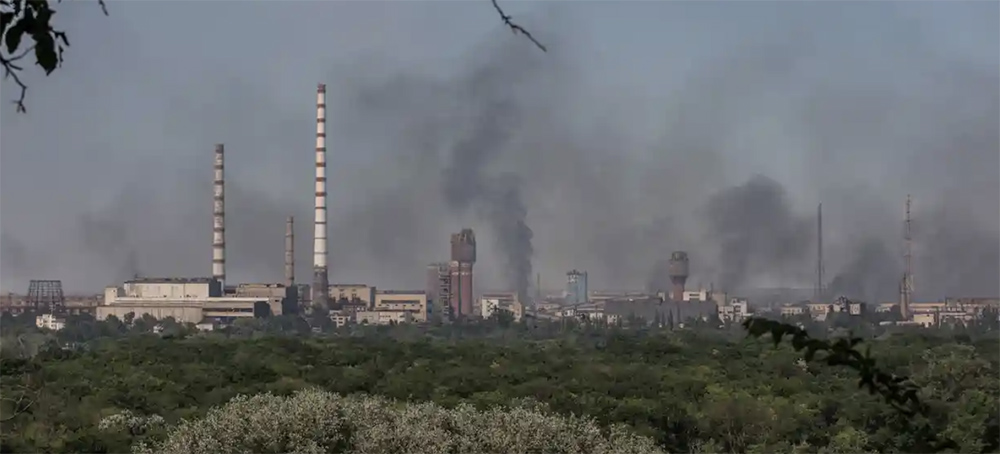 Smoke rises after a military strike on a compound of Sievierodonetsk's Azot chemical plant. (photo: Reuters)
13 June 22
Moscow said to control 70% of Ukrainian city, where destruction of bridge leaves residents with only one route out
“Russians continue to storm the city, having a significant advantage in artillery they have somewhat pushed back the Ukrainian soldiers,” said Serhiy Haidai, governor of the Luhansk region, in a morning report on his Telegram channel. “The Russians are destroying quarter after quarter,” Haidai said, adding that the Russian army had been “partially successful at night” and controlled 70% of the city.
The destruction by Russian forces of a bridge over the Siverskyi Donets River leaves stranded civilians with just one remaining bridge to escape west to the neighbouring city of Lysychansk, which is also being shelled but remains in Ukrainian hands.
“If after new shelling the bridge collapses, the city will truly be cut off. There will be no way of leaving Sievierodonetsk in a vehicle,” Haidai said.
There are fears that a scenario similar to the one seen in the southern port city of Mariupol, where hundreds of people were trapped for weeks in the Azovstal steelworks, could play out in Sievierodonetsk’s Azot chemical plant, where Haidai said 500 civilians were sheltering, 40 of them children.
Haidai said the Ukrainian side was negotiating the evacuation of civilians from Azot with Moscow but so far failed to reach an agreement. “We are trying to agree, with the help of [Ukrainian deputy prime minister] Irina Vereshchuk, to organise a corridor, so far it has been unsuccessful,” the official said. “Azot’s shelters are not as strong as in Mariupol’s Azovstal, so we need to take people out with security guarantees.”
Sievierodonetsk has become the focal point of Moscow’s efforts to advance in eastern Ukraine, where Russia wants to capture the regions of Luhansk and Donetsk, which are collectively known as Donbas, after its failure to quickly seize Ukraine’s capital, Kyiv, at the beginning of the war.
Ukrainian troops were fighting street by street to hold on to the city, with both Ukrainian and Russian forces suffering heavy losses, Roman Vlasenko, head of Sievierodonetsk district administration, told local TV. “Our boys are holding on but the conditions are tough,” he said. Vlasenko said the city had been without communications and normal services for a month.
Addressing his nation during his nightly video address, the Ukrainian president, Volodymyr Zelenskiy, said forces in Sievierodonetsk were fighting for “every metre”.
“The key tactical goal of the occupiers has not changed. They are pressing in Sievierodonetsk, severe fighting is ongoing there – literally for every metre,” the president said, adding that Russia’s military was trying to pour “poorly trained” reserves into Donbas.
The UK Ministry of Defence said in its latest intelligence report that river crossing operations were likely to be among the most important determining factors in the course of the war.
The key, 90km-long central sector of Russia’s frontline in Donbas lies to the west of the Siverskyi Donets river and in order to achieve success in the current operational phase of its offensive, Russia was “either going to have to complete ambitious flanking actions or conduct assault river crossings”, the MoD said,
Last month Russia incurred heavy losses during multiple attempts to cross the river. In one attempt, Russia is believed to have lost more than 80 vehicles as a result of Ukrainian fire, according to open-source estimates.
Also on Monday, Amnesty International accused Russia of war crimes in Ukraine, saying attacks – many using banned cluster bombs – on Ukraine’s second-largest city of Kharkiv had killed hundreds of civilians.
“The repeated bombardments of residential neighbourhoods in Kharkiv are indiscriminate attacks which killed and injured hundreds of civilians, and as such constitute war crimes,” the prominent rights group said in a report titled “Anyone can die at any time.”