Far-Right Jews: What Stephen Miller and Itamar Ben-Gvir Have in Common
Esther Solomon Haaretz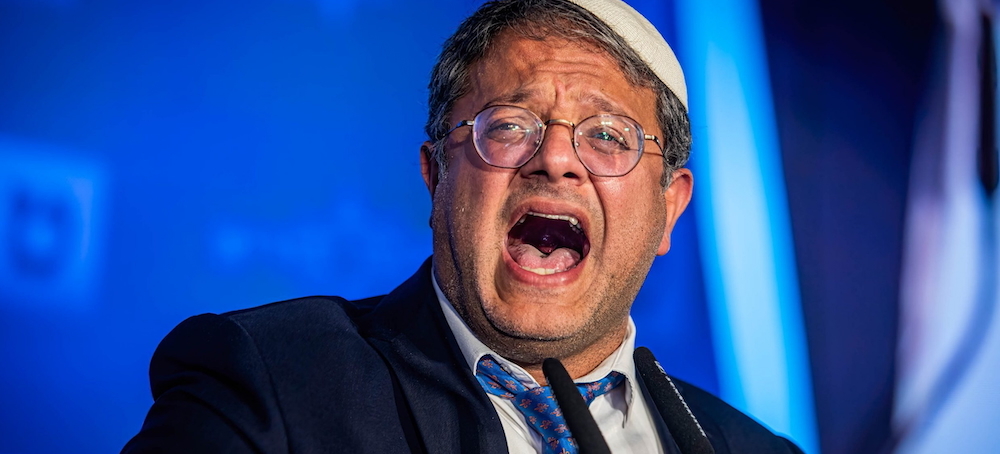 Israeli National Security Minister Itamar Ben-Gvir. (photo: WAFA)
Stephen Miller, the incoming White House chief of staff, and Israel's outgoing national security minister, Itamar Ben-Gvir, share plenty of racist, authoritarian beliefs. Both are often called 'Nazis.' How does their Jewish identity fit in?
Hakeem Jeffries, the Democratic House of Representatives minority leader who is likely to become its first Black speaker, wrote that Miller is a "dangerous xenophobe and reckless extremist" with "American blood on his hands" whose "presence in government should be eradicated like a malignant tumor." Republican Sen. Thom Tillis called the appointment of "one of the most partisan, polarizing figures…even among Republicans" a "colossal mistake."
The fact that Miller is one of a select band of U.S. political operatives who regularly attracts the epithet "Nazi" connects him to perhaps Israel's most infamous contemporary racist ethnonationalist, Itamar Ben-Gvir.
The outgoing national security minister is frequently described as a Nazi, and not only by U2's Bono; his recent AI-generated election campaign ad, which showed emaciated Palestinian detainees, were widely considered to resemble Nazi concentration camps. During Trump's first term, the Miller-led policy of caging detainees, separating migrant children from their parents and establishing internment centers also attracted analogies to concentration camps.
Both men are steeped in far-right ideology and racism, whether Miller's "Camp of the Saints"- and Robert Spencer-style white supremacy or Ben-Gvir's Kahanist Jewish supremacy. Both seek to incite fear and repulsion toward minorities, whether against "illegal aliens" – the deliberately dehumanising term used by Miller, who is just as keen on cracking down on legal migrants – or against Palestinians – Israeli citizens or not – whom Ben-Gvir reliably terms "terrorists."
Both are committed to mass expulsion: Miller has had the upper hand in implementation, with his Muslim ban and sometimes lethal ICE deportation campaign, which went hand in hand with his efforts to target pro-Palestinian campus advocates and exclude Gazans from applying for asylum. Meanwhile, Ben-Gvir's official vision is for a Palestinian-free West Bank and Gaza, with Israel as a bonus. For both of them, brutality is both the medium and the message.
Neither shows much interest in norms, checks and balances or the rule of law. Miller tried to suspend habeas corpus during Trump's first term and wrote the president's pre-insurrection speech on January 6; during Trump's current term, he has led the renditions of hundreds to El-Salavdor's most notorious prison without due process. A convicted terror supporter, Ben-Gvir, like Prime Minister Benjamin Netanyahu's whole coalition, has been at war with Israel's attorney general and the judicial system for four years, accusing them of serving the "deep state," while he has subjugated the police force to his own partisan command.
Both owe their prominence, and access to power, to their enablers, Trump and Netanyahu, and both have doggedly claimed that the elections which brought down their mentors' administrations were stolen and illegitimate.
But it hasn't been a smooth ride for either extremist. Their provocateur-arsonist stances are blamed for the recent misfortunes of their political blocs, whether losing the Latino vote in the U.S. or propelling Israeli Arabs to the polling station in record numbers. Ben-Gvir, who has been banned from entering 10 countries, was extensively cited in South Africa's case accusing Israel of genocide in Gaza at the International Court of Justice in The Hague.
However, there's a clear difference in their current political fortunes: If Yashar leader Gadi Eisenkot manages to build a coalition, Ben-Gvir will have to fulminate from the opposition. But Miller now has access to the most political power he has ever had.
And that leads to another key difference: Whereas Ben-Gvir's grotesque racism has certainly had fatal real-world consequences, much of the real work in de facto annexing the West Bank and facilitating the violence radiating out from outposts and settlements, which actually forces Palestinians to leave, has been done by Bezalel Smotrich from his perches in the finance and defense ministries. Ben-Gvir provides the performance, but Smotrich and Miller are, unfortunately, people who "get things done."
And what about the other connection, that both Miller and Ben-Gvir are Jewish? Here, the differing contexts are crucial. From a position of privilege as part of Israel's Jewish majority, Ben-Gvir foments bigotry to oppress Palestinians, whether they are living as a minority within Israel or under Israeli occupation in the West Bank. His party is literally called "Jewish Power"; his Kahanism requires total Jewish domination between the river and the sea – political, military and territorial, the master of all it sees.
Miller, while enjoying the privilege of working in the White House, is part of a minority in America. That is why his cold nativism causes such discomfort among U.S. Jews, an immigrant community that has faced discrimination and lethal barriers to entry as desperate refugees.
Miller's own family has for years denounced his rank hypocrisy on emigration and his intimacy with the antisemitic far right. His uncle noted that his ancestors found sanctuary in the U.S. at the beginning of the 20th century, but 74 relatives were killed in the Holocaust, "shut out of America by the race/religion based immigration exclusion act of 1925 enacted by the 'America First' populists of the day."
What we learn from the enormous gap between Miller and the roughly 70 percent of U.S. Jews who voted Democratic, and the less dramatic but still significant 55 percent of Israelis who voted against a Netanyahu coalition, including Ben-Gvir, is that neither have a lock on Jewish identity – but neither do Jews who believe in liberal democracy.
There is no "Jewish gene" and no definition of Judaism that predetermines an affinity for authoritarianism or for progressivism, for exclusion or for humanism, for esotericism or for activism, for militarism or for diplomacy – just like in any other religious, ethnic or social community, and just as every political ideology can develop innumerable branches or mutations.
That was amply demonstrated by a Saturday night rally in Tel Aviv in support of the establishment of an Eisenkot-led government. Dan Meridor, an "old school" Likudnik and former justice minister, said that the Netanyahu government had "contaminated Zionism" and that contrary to Ben-Gvir's claim, Israel was not established as a state for Jewish supremacy, but for equality for Jews and all its citizens. At a small right-wing counter-protest, they were chanting "a state for [only] Jews." The bulldozer of Ben-Gvir may be in retreat from the halls of power, but Miller's juggernaut is still advancing.