Even Republicans Want Ken Paxton to Lose
Christopher Hooks New York Magazine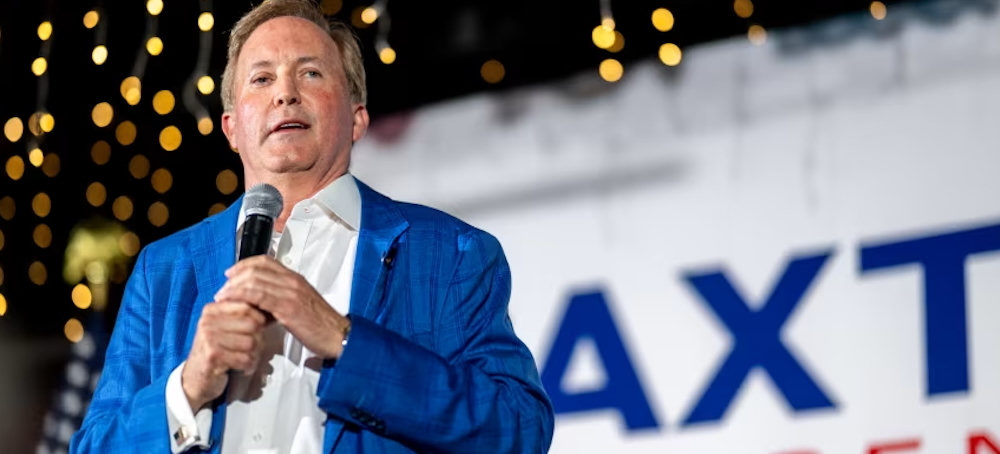 Texas Attorney General Ken Paxton speaks during a campaign event in Allen, Texas. (photo: Brandon Bell/Getty Images)
Texas’s corrupt Senate candidate is the crude end point of Trump’s war against the GOP Establishment.
And sure enough, when it comes through, there he is, in all his glory: Warren Kenneth Paxton, Texas’s Republican nominee for United States Senate and top law-enforcement officer of the eighth-largest economy in the world. Paxton is in a pale-blue button-down shirt, a tiny bit of chest hair showing, two plastic cups in his left hand. His right hand is pointing down — probably not intentionally, but who knows — at his penis. Paxton’s hair is tousled, and he’s talking to a blonde woman. Yes, he’s wearing his wedding ring. He looks like a cardiologist at a swingers’ resort. Or, really, he looks like Ken Paxton: a little sleazy, a little disheveled. A man who’s used to other people cleaning up his mess.
In Texas these days, every conversation returns to Paxton. On the national stage, there is much chatter about his opponent James Talarico, the clean-cut Presbyterian seminarian who just might win the Democrats’ first Senate seat in Texas since 1988. He’s run a good campaign. But the seat is Paxton’s to lose more than Talarico’s to win. Paxton is perhaps the weakest candidate ever put up by the Texas GOP in the modern era. Donald Trump needs him to win if he wants to stave off investigations and maybe worse from a Democratic-controlled Senate in the back half of his term, leading to an unprecedentedly expensive effort to hoist this electoral lump over the finish line.
Nevertheless, Paxton has trailed in most polls conducted. The Cook Political Report rates the race a toss-up. It is a difficult prospect to accept; it is Texas, after all. Democrats have, for years, convinced themselves they have a chance here, but this has always felt like a pipe dream for Democratic operatives and MS NOW watchers. Now, in private, Republicans are worried. They grouse about a man who has been given everything he needs to win — including more than $150 million from Elon Musk — and still might lose.
Paxtonfreude is a bipartisan business in Texas these days. “This is one of the biggest dirtbags that has ever run for office,” the lawmaker who sent the picture tells me. With a measure of satisfaction, he says that his party’s pollsters report that “there’s no amount of money in the world that can save him.” The lawmaker supported his party’s failed effort to impeach Paxton in 2023. He tells me he’s in a large group chat with other veterans of that fight, many of whom paid a heavy price for crossing Paxton. The chat is active. Every bad poll, every bad pic, every embarrassing leak. “Forty times a day,” he says.
Former House Speaker Dade Phelan, a longtime Paxton foe, tells me Republicans across the state are telling him they’ll skip the ballot line for Senate. “That never happened in 2018,” he said, when Beto O’Rourke lost by only 2.8 points to Ted Cruz. “I don’t even know if I want him to win,” says a longtime Republican consultant about Paxton. While he can’t support Talarico, he says, “there might be a certain sadistic pleasure for me in, like, us getting our just deserts.” Trump seems to understand the problem. Paxton “may not dress right, he may not talk exactly perfectly, and he may not be the best-looking guy I’ve ever seen,” he says. But he is, for better or worse, Trump’s man.
Ken Paxton in his element.
Other politicians have a scandal, maybe a few. Paxton, who did not return a request for comment, has a whole taxonomy of scandals. You can try to distinguish between Paxton’s personal failures (repeated infidelity to his wife, State Senator Angela Paxton, which led to divorce last year) and professional failures (his repeated attempts to sell access to his office and connections with many different kinds of accused and convicted criminals). But the two sets of failures are intertwined. Paxton’s wife was a joint partner in quite a few of Paxton’s alleged schemes, and one time even allegedly served as a getaway driver rescuing him from a process server. Nate Paul — the troubled Austin real-estate magnate at the center of Paxton’s impeachment for corruption, whom Paxton seemed to be trying to protect from an FBI investigation — helped Paxton give his then-mistress a job when it no longer became possible for her to work in the Texas Senate, where she worked for one of Angela’s colleagues.
Paxton’s campaign has not been able to move on from these controversies because new ones keep popping up. In October, the Wall Street Journal released a video of Paxton celebrating New Year’s in 2024 in Dubai with his alleged current mistress, the Christian social-media influencer Tracy Duhon, while he was still married to his wife. Beside them were two fugitives from American justice, accused of millions of dollars of health-care fraud in Chicago, who also happened to have donated $190,000 to Paxton’s campaigns. This would have been the political story of the decade in a duller state, but it was so par for the course for Paxton that much of the social-media commentary dwelt instead on Paxton’s lounge-lizard shirt collar.
The bad press has been relentless. At a fundraiser in Washington, D.C., Paxton delivered wide-ranging remarks about the sad state of his campaign, including the ways the president’s poor record was hurting him. Someone present taped it, cut it into pieces, and leaked them to six different outlets (so far), which did maximum harm. (“Does he not understand how campaigns work?” a Republican consultant laughs. “Rule one, everyone’s phones stay in the other room.”) The New York Times received a fabled deposition, one of the crown jewels of Paxton lore, from a case in which he recommended his legal clients invest in Servergy, a fraudulent tech company, without telling them he was being compensated to do so. This was a violation of Texas securities law, and it resulted in felony indictments in 2015. Asked in the deposition why the head of the company tapped him to do the dirty work, Paxton said that “God had told him to,” confirming that He moves in highly mysterious ways. (In 2024, Paxton agreed to pay $300,000 in restitution for the case’s dismissal.)
This is the standard-bearer of the Republican Party of Texas, one of the most dominant and ruthless political machines in the nation, which has exerted unilateral control over the state for the last 23 years. And now it’s all threatening to come apart, thanks to a decade-plus of factional squabbles that are frenzied and abstract enough to put the DSA to shame. What has happened in Texas is unique to Texas but also indicative of Trump’s GOP as a whole, which is constantly at war with itself, allowing some of the most unsavory politicians in conservative America to clamber to the top. Paxton just might be the worst of them all.
If Paxton loses, it will be because of discontent within the Republican Party, which goes back much further than Paxton’s victory against 22-year incumbent John Cornyn in his primary Senate campaign. Republican-leaning voters swinging for Talarico or staying home may make the difference, but that’s not all. The Establishment has the money and connections to dig Paxton out of his hole, except it won’t. “This disaster has been in the making since he first started running for statewide office” in 2014, a veteran Republican consultant tells me. “The one group that can save him, he has spent the better part of over a decade ostracizing and attacking.”
There was a recent fundraiser in Highland Park, the consultant says, the top-class Dallas neighborhood where George W. Bush lives and that is a sort of spiritual home of the old-school Texas GOP. Here were top moneymen, the “higher-part mafia crew,” like Bob Rowling, Ross Perot Jr., Dick Weekley. They talked about races all around the state. “Paxton just didn’t come up,” he says. “Three guys who could change his life.”
There might conceivably have been a window after the primary, the consultant says, when Paxton could have tried to arrange a sit-down with the Republican aristocracy — maybe even with Dubya — to bend the knee and say, Let bygones be bygones. But that’s not who Paxton is.
Ken Paxton came up in Collin County, a cluster of exurbs north of Dallas. He was not born into the kind of wealth you see in Highland Park — in fact, he was born in North Dakota. Paxton was one of the many millions of strivers who came to the Dallas–Fort Worth metroplex in the ’90s. There was almost literally money growing out of the ground in McKinney, one of the many suburban boomtowns driving explosive population growth in the state. Paxton was a probate lawyer, working on wills and estates and taking the occasional ethical shortcut. (The Houston Chronicle called his handling of a deceased billionaire’s estate “ill-defined and unorthodox.”) If he was a little déclassé — if his jackets often looked suspiciously like couch upholstery — he was true to his surroundings and his increasingly large mansions.
He won a seat in the legislature in 2002, when Bush’s popularity secured Republicans the state House for the first time since Reconstruction. Even then, there were issues. “He was never fucking there, man,” a Republican former House staffer remembers. According to the former staffer, a colleague named Jodie Laubenberg voted for him while “he was back home doing deals in Collin County.” Among the few notable bills he passed was a measure putting up signs on Texas highways declaring the state Bush Country.
He secured his elevation to higher office in 2011, when he became an avatar for a group of Christian moneymen who had become obsessed with unseating the Republican Speaker of the Texas House, Joe Straus, who happened to be Jewish. Those donors, waging an insurrectionary war to cleanse the Texas GOP of moderating influences, would fund most of Paxton’s future campaigns. In 2012, they elevated him to the state Senate, and in 2014, they funded his campaign for attorney general.
With the help of Cruz, he beat Dan Branch, an “Establishment” Republican from wealthy Dallas. Shortly after taking office, he was indicted for fraud related to the Servergy case, but he ultimately beat the criminal charges, which were kicked back to his home base in Collin County, run by officials friendly to Paxton, who suddenly had control of the purse funding the special investigators. The case dragged on for almost eight years until it fell apart. The episode was a harbinger of Paxton’s style of government. His AG office was reportedly poorly run — serially understaffed, bungling cases. The Associated Press revealed that one of his deputies showed child porn at an office meeting to demonstrate that child porn was evil.
Over the course of his time in office, the Paxtons have accumulated more than 15 properties and tens of millions of dollars, figures have been oft-repeated by Talarico on the trail. In 2020, his handpicked senior staff, which included die-hard movement activists and veteran law enforcement officers, wrote a letter to the Department of Justice accusing Paxton of bribery. Paxton fired them all, then tried to settle their wrongful-termination suit with taxpayer money. The incident led the Texas House to impeach him.
The trial was held in the Texas Senate. Paxton’s top donor donated $3 million to the “judge,” Lieutenant Governor Dan Patrick, which seemed a good indicator that the upper chamber was not likely to make any particular use of its investigative abilities. Paxton’s lawyers argued that Paxton had been set up by the Bush wing of the party. In 2022, George P. Bush, Jeb Bush’s son, had run against Paxton and failed. Now the Bushes and Karl Rove and Cornyn and their big-money buddies were getting their revenge. This was substantively ridiculous but politically smart. Grassroots conservatives in Texas no longer had any love for the Bush family. Paxton had identified more clearly than ever before that traditional Republicans in Texas were his enemy and forswore any cooperation with them in the future. He was acquitted.
That rift would have significant consequences. During his impeachment, Cornyn had indicated that Paxton had less than his full confidence. Paxton immediately began teasing a future primary challenge, which led Cornyn to taunt him more directly, tweeting once that Paxton would have a hard time running “from prison.” But Cornyn was no longer operating, if he ever did, in a state that would put a man like Paxton in jail. Texas Republicans, who once had to put up strong candidates to win office, had ceased to be interested in policing their own. For that reason, Cornyn got whipped earlier this year.
The lawmaker who sent me the picture and voted to impeach Paxton had similarly misjudged the party. Had the Senate convicted Paxton, he says, the GOP would be in better shape. Now, though, looking forward to two years of a Democratic Congress investigating Trump, his party was going to “look like the party of corruption, and we probably deserve it.” The Texas Democratic Party, he reminds me, went into decline because of its own corruption problems. “It’s not inconceivable that this state is a purple state or more in four to six years if Talarico pulls it off, even if he doesn’t pull it off. It’s obviously a battleground state now.”
In the general election, Paxton has seemed lethargic at rallies. His campaign seems to understand that “affordability” is the issue of the cycle, but his action plan seems a little off the mark (it includes a proposal to make gym memberships tax-deductible). It can feel, at times, like Paxton’s main desire was to knock off Cornyn — and that he hadn’t put a whole lot of thought into what came next.
Recently, a longtime Republican political operative in the Metroplex with a sinking feeling about Paxton’s chances did what a good practitioner does: He convened a focus group. “I told my wife, ‘You have to go to your mahjong group and casually bring up the Senate race,’” he says. Several of the women go to Prestonwood Baptist, Paxton’s old church. Game-playing Dallas ladies with comfortable homes have been a pillar of the Republican coalition in Texas for as long as fire-breathing Church of Christ preachers and the Yell Leaders of Texas A&M. And yet each of the women said that they would be voting for Talarico.
The most important factor was that these women knew Ken Paxtons — plural — as a type. Reporters can waste a lot of words differentiating between Paxton’s major and minor sins. The mahjong ladies cut through the knot in a much cleaner way. “Paxton represents what they don’t want from their husbands,” the operative tells me. They didn’t want to end up with this quintessential Metroplex striver — the man on the boat, double-fisting beer. (Paxton’s “strongest group,” the operative says, “is the men that want to be him.”)
In other years, a Republican candidate could overcome this general revulsion. But right now, the Texas GOP faces many headwinds. On top of inflation, tariffs, gas prices, the war, and everything else coming out of Trump’s Washington, there’s the backlash against data centers, fierce in many parts of Texas that normally turn out for the GOP. There’s the Flock camera panic. There’s the Texas legislature’s accidental legalization of THC products and subsequent efforts to reban them. ICE keeps shooting peaceful migrants in big Texas cities, and the administration wants to build a border wall through the heart of Big Bend National Park.
The party has been contending with bizarre scandals all year. Bo French, the GOP candidate for the commission that oversees the state’s oil and gas industries, posted and then doubled down on racist comments, saying the University of Texas has too many Indian American students and that America has become Rhodesia — in other words, a place where whites might need to fight a war of survival. Comptroller candidate Don Huffines’s family bought Jeffrey Epstein’s New Mexico ranch and tried to hide the purchase. The AG nominee to replace Paxton calls himself Mayes “MAGA” Middleton, tying himself to a president whose approval rating here, like elsewhere, is in the toilet. Things get bleaker downballot. In the 23rd Congressional District, which Dems have a remote chance of winning, the incumbent retired after his former mistress killed herself by setting herself on fire. He was replaced by a “gun-tuber” who once called human children “cum trophies.”
“The fact that Governor Greg Abbott is also kind of maybe nearly losing to his Democratic opponent tells me that this is as much to do with the national economic and political climate as it is with Ken Paxton,” says Brendan Steinhauser, a Republican consultant who ran John Cornyn’s 2014 campaign. It’s a testament to how forbidding Texas still is for Democrats that almost all of the Republican statewide slate is expected to win, if only by a few points. The bull case for Paxton is that the GOP can comfortably absorb a loss of ground in South Texas and the suburbs as long as it doesn’t go too far.
On the whole, the mood among GOP insiders in the closing stretch of the race is sour verging on panicked — sometimes with a little vindication mixed in. An Austin consultant went to the Republican convention in Dallas in September after hearing about bad internal poll after bad internal poll, hoping to ask the big dogs for some good news. There wasn’t any, he was told. Some of those internal polls are, indeed, pessimistic to the point of being hard to believe. At the outside margin, Texas Democrats could have a chance of winning the Texas House and picking up several seats in the Texas Senate.
On top of the blue reversion in South Texas, where Hispanic voters who lined up for Trump seem to be back with the Democratic Party, Republicans worry that all four of the major counties in the Metroplex — Dallas, Tarrant, Collin, and Denton — could go blue. The loss of Tarrant, until recently the most populous red county in the country with 2.2 million people, would be a crushing blow. (“Tarrant is gone,” a strategist who has worked there tells me, as in for good — following the path of other major urban counties in the state that have pulled solidly to the left.)
Paxton’s foes and GOP skeptics may be making the same mistake they’ve always made. Anti-Paxton Republicans, a longtime consultant says, “are powered by wish fulfillment. They are hoping that there will be some sort of justice for some rather personal offenses. But that is not the way things work.”
If Paxton wins, he’s the nation’s problem, able to cut his deals at a higher level than ever before. If he loses, he still wins. He set out, many years ago, to wreck the Texas GOP and change it for good. He may do exactly that, just not in the way he intended.