E.U. Offers Canada ‘Associate’ Membership as Haven From Trump Tariffs
Ellen Francis The Washington Post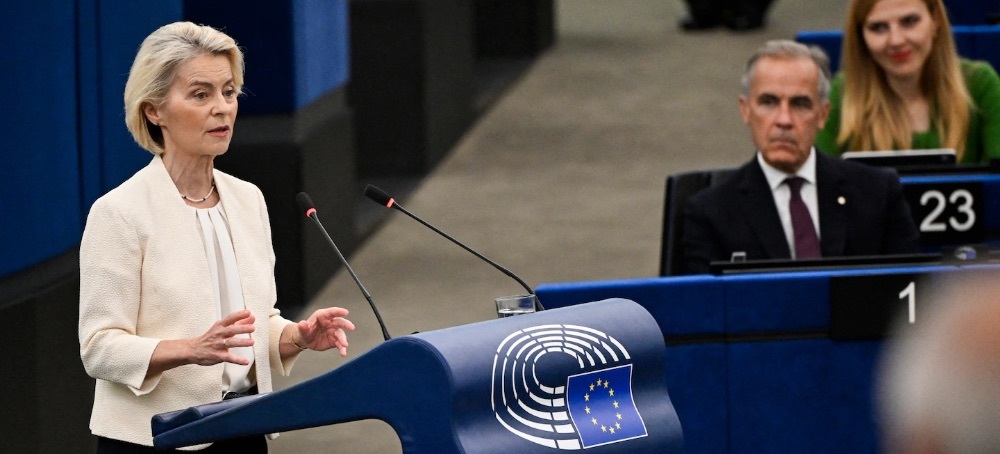 Canadian Prime Minister Mark Carney watches European Commission President Ursula von der Leyen speak in Strasbourg, France, on Wednesday. (photo: Jean-Christophe Verhaegen/Getty)
The head of the E.U.’s executive branch is proposing “associate membership” for Canada, as Ottawa also pursues new trade deals with China.
On Wednesday, sitting as a guest of honor inside the European Parliament, Canadian Prime Minister Mark Carney received an unprecedented offer: European Commission President Ursula von der Leyen said she wants to make Canada the first “associate member” of the 27-nation bloc.
“We want to bring the relationship with Canada to the highest level possible,” she said in her annual State of the Union address.
The declaration at the Parliament in Strasbourg, France, received a standing ovation from European lawmakers and from Carney.
The offer, which would see two longtime U.S. partners expand their alliance from trade to security, highlights the extent to which Trump is redefining alliances.
The president’s foreign policy gyrations, including threats to take Greenland from NATO ally Denmark, have triggered a reckoning among Washington’s traditional friends about their relationship with the United States.
Amid the standoff with Trump on tariffs, Canada has pursued a thaw in ties with China including new trade deals. Beijing has praised Ottawa for walking away from talks rather than caving to Trump’s demands, and this month, China and Canada revived a dialogue on military issues after an eight-year break.Ask The Post AIDive deeper
Ahead of his trip to Europe this week, Carney said he wanted a “unique alliance” with the E.U., including on energy and critical minerals, to help safeguard Canada against economic coercion. “The world’s more dangerous and divided, and friends need to stick together in these times,” he said.
European leaders have echoed Canada’s bid to strengthen ties.
“Dear Mark, I said we must urgently reimagine our partnerships,” von der Leyen said in her speech. “So, I would like to work with you on opening the door for Canada to be the first associate member of the European Union.”
Von der Leyen described the move as “not against anyone else, but for our common strength.”
Yet America’s jilted allies are having once-unthinkable conversations about whether Washington could abandon or even turn against them, and are working to limit their dependence.
European leaders have vowed to take responsibility for their defenses as the U.S. shifts resources away and have rushed to close ranks with allies including Britain and Canada.
A new arrangement with Canada could involve visa-free work for Canadians in the 27 nations of the E.U., said two European diplomats, speaking on the condition of anonymity to discuss sensitive diplomacy. Talks could include further reducing trade barriers and boosting joint arms production, they said.
Carney said Tuesday that visa-free opportunities are “one aspect of the discussion.”
In facing Trump’s tariffs and rhetoric about annexing Canada, Carney has cast himself as a leader who can rally together “middle powers” to protect their interests.
Trump has leveled personal attacks against Carney since trade talks between the North American neighbors collapsed last month. Carney retaliated against U.S. tariffs after rejecting U.S. demands that he said would undermine Canada’s sovereignty.
“What Carney has been saying to Europe, to Latin America, to Asia, is that now’s the time to stand up to Donald Trump,” said Fen Hampson, a professor of international affairs at Carleton University in Ottawa. “That’s his message: We’re gonna stand up, and if you guys have any guts, you’ll do the same thing.”
Carney, who has described Canada as “the most European non-European country,” has found a receptive audience in Europe. He is scheduled to give a speech at the European Parliament on Thursday.
But while European nations similarly stared down the barrel of Trump’s threats, E.U. leaders ultimately tabled retaliatory measures and agreed to a trade deal with higher tariffs to prevent a spiraling confrontation.
Valérie Hayer, a French lawmaker who leads a centrist faction in the European Parliament, told Carney on Wednesday that he has “shown what to do in the face of Trump: Refuse to compromise ... speak the language of power.”Ask The Post AIDive deeper
“Canada is welcome in the European Union because we share the same values and our interests align,” Hayer added. “So let’s go further.”
Von der Leyen, who heads the E.U. executive branch, did not offer details on how associate membership for Canada would work or when it might occur.
Instead, she used her speech to tout plans for a deeper partnership on economic security, energy and technology, as well as in the Arctic. “We see the world with the same eyes,” von der Leyen said.
She said the two would build on their existing free trade agreement and “integrate” their defense industries.
Canada last year sent some 70 percent of its exports to the United States, which is also the E.U.’s largest export market for goods. Canada and Europe have sought access to new markets via deals with other trade partners, including in Latin America and Asia, amid Chinese competition and U.S. pressure.
Trade between the E.U. and Canada stood around $150 billion last year, while the U.S. and Canada traded more than $850 billion.
The E.U. and Canada, which have long sheltered under U.S. military guarantees, have pledged to ramp up their defenses and collaborate on upgrading their weapons industries. Like Canada, most E.U. countries are also members of the U.S.-led NATO alliance.
Canada this year became the first non-European country to join the E.U.’s 150-billion-euro loan program for joint weapons procurement, giving Canadian arms manufacturers access.
In a separate announcement this week, the European Parliament also said it plans to open a satellite office in Ottawa.
The status of associate member, proposed by von der Leyen, does not exist in the European Union, which oversees trade policy for its 27 member states and operates a single economic market based on the free movement of goods and people.
Creating such a category could complicate the E.U. setup with other nations such as Britain or Norway, and also potentially the membership bids of countries eager to join, such as Ukraine.
Joining the E.U. can be a years-long ordeal that requires thorny negotiations and legislative changes. Several nations on the continent have long been waiting in line, and the E.U. typically has not been flexible about membership rules.
Earlier this week, commenting on a Wall Street Journal report about E.U. associate membership, Carney said that Canada was “not looking to become a member” of the E.U. but was seeking an enhanced alliance.
“We share the same values,” Carney told reporters in Toronto. “We have the same priorities and we have very complementary strengths.”
Hampson said the key question is how the new relationship “is actually defined” and whether “it is just a new bow tied around existing agreements.”
“But if it does involve a much deeper and broader relationship than what we have now,” he added, “it will be significant.”